Latest — May 16, 2025
Unpacking the gap between compliance and culture

Introduction

Companies spend millions on cybersecurity policies — but often overlook the human side of enforcement. Why do employees ignore security rules, even when they’re clearly defined and regularly updated? And how can organizations shift from checkbox compliance to genuine behavioral change?

These were the big questions tackled in our latest Passwork cybersecurity webinar, featuring ISO 27001 consultant and ISMS Copilot founder, Tristan Roth. Together, we explored how companies can strengthen security culture, align leadership and compliance teams, and ultimately get employees to care about cybersecurity policies.

This article highlights the key insights from that discussion, offering a practical roadmap for businesses aiming to turn policy fatigue into proactive security awareness.

The compliance trap: Why policies fall flat

According to a 2024 ISACA survey, just 38% of organizations believe their compliance efforts have improved their actual security posture. The rest? Going through the motions.

They want to be ISO-certified in three weeks. They write 50 documents, sign them, and think the job is done. But there’s no substance. And without substance, there’s nothing to embed into company culture.
Tristan Roth

Tristan noted that many companies pursue ISO 27001 purely for external reasons — sales pressure, vendor demands, regulatory requirements. But this "checkbox compliance" mindset often leads to rushed implementations, shallow training, and policies that nobody reads.

That’s precisely why meaningful certifications stand out. As a case in point, Passwork itself recently achieved ISO/IEC 27001:2022 certification — a milestone that underscores our commitment not just to technical excellence, but to real, operational security practices. You can view the certification details here. For us, it’s not about the certificate on the wall — it’s about living the standard in our day-to-day approach to product design, customer trust, and internal controls.

The real reason employees tune out

It's easy to blame employees for ignoring security policies. But in many cases, they’re not wrong to do so.

Tristan described how companies often copy-paste policy templates from the internet without adapting them to their specific context. A policy meant for
a university might get handed to a startup team. A remote work rule might ignore hybrid realities.

If a policy obviously doesn’t reflect your real work environment, of course employees will skip it. They know when no effort was made.

This disconnect between policy and reality creates distrust. Employees learn
to view documentation as bureaucracy, not guidance.

Training vs. transformation

Security training is everywhere — but it’s often treated like background noise.

Tristan emphasized that truly effective awareness programs require empathy, relevance, and context. Instead of one-size-fits-all e-learning modules, what works best is direct, human conversation. Sitting down with small groups. Tailoring sessions to different roles. Explaining why a policy exists, not just what it says.

Sometimes, the most effective approach is doing things that don’t scale. A 10-person training session can do more than a 2-hour video everyone skips.

This type of pedagogy isn’t flashy — but it changes behavior. It creates a feedback loop between employees and security teams that policy documents alone can’t.

Third-party risk: The unseen threat

In 2024, over 60% of data breaches were linked to third parties. Yet many organizations still conduct vendor assessments as a one-time task during onboarding — and never revisit them.

The companies I work closest with — I know the people. And if something changes, I can ask for proof, or pivot fast. That’s the mindset companies need to adopt.

Tristan warned against over-relying on surface-level due diligence. He stressed the importance of designating a responsible person (even in small companies) to build real relationships with vendors, revisit risk exposure over time, and keep alternative solutions in mind for business continuity.

According to Verizon’s Data Breach Investigations Report (DBIR), over 80% of hacking-related breaches still involve stolen or reused credentials.

Despite having password policies in place, many companies don’t monitor whether employees actually follow them. Shared passwords in messaging apps, weak variations of old passwords, or resistance to using MFA — these are all symptoms of convenience overriding policy.

A good password policy isn’t enough. You need to design systems assuming passwords will be compromised — and build defenses like MFA around that assumption.

Passwork and similar tools offer self-hosted or cloud-based solutions, but Tristan’s advice was clear: tools help, but they don’t replace responsibility. Compliance teams need to combine tech with empathy, audits, and clear communication.

Automating GRC without alienation

Automation can cut Governance, Risk management and Compliance (GRC) workloads by up to 60%, but it’s not a silver bullet. Poorly implemented tools can actually increase policy fatigue.

Some platforms take ten times longer than Excel. People go back to Excel — not because they don’t believe in compliance, but because the tool wasn’t built with their workflow in mind.

Instead of aiming for “full automation,” companies should focus on effective automation — solutions that reduce friction, not increase it. This means assigning a project owner, setting realistic expectations, and piloting changes before rolling them out at scale.

Leadership role in building security-first culture

Cybersecurity is often seen as an IT issue, but real change starts with leadership.

A recent PWC survey found that 80% of executives say they prioritize security — yet only 30% of CISOs feel supported. Tristan argued that this misalignment often stems from poor communication.

Security leaders need to speak the language of business. Not vulnerability management. Risk in financial terms. Loss potential. Mitigation cost. Impact.

CISOs must become translators — connecting security risks to business outcomes. When leadership understands the stakes in terms they care about, support and budget follow.

Final thoughts

Employees ignore cybersecurity policies not because they’re lazy — but because the policies feel irrelevant, the training feels generic, and the tools feel like obstacles.

Shifting that mindset requires a cultural transformation: from compliance to care, from documentation to dialogue. As Tristan put it, be the captain of your own security ship. Know your context. Use the tools wisely. But lead with empathy and clarity.

Ready to take the first step? Request a free demo and explore how Passwork helps your team move from policy fatigue to security-first thinking.

Further reading:

Four ways to make users love password security
Identifying fake apps on your smartphone
The necessity of cyber hygiene training in today’s digital world
Information security (IS) courses are needed not only for IS department employees and not even only for certain employees of a company but for everyone. Information security training in today’s world, where virtually all areas of life have been digitized, should be on par with fire safety and other fundamental

Why do employees ignore cybersecurity policies?

Employees often ignore cybersecurity rules not out of laziness, but because they feel generic, irrelevant, or disconnected from real work. True change starts with empathy, leadership, and context-driven policies. Read the full article to learn how to make security stick.

May 6, 2025 — 6 min read
Passwork 7

In Passwork 7 wurde alles verbessert: Der Code wurde mit den neuesten Technologien komplett neu geschrieben, eine vollwertige API implementiert, die Oberfläche aktualisiert, Gruppen und Rollen neu gestaltet, das automatische Hinzufügen von Systemadministratoren zu Tresoren abgeschafft und die Verwaltung der Zugriffsrechte noch flexibler gestaltet. Dies wird den Komfort der Administration und Passwortverwaltung erheblich verbessern sowie die Entwicklung neuer Funktionen deutlich beschleunigen.

Aktualisierte Oberfläche

Die Passwork-Oberfläche wurde neu gestaltet und alle wichtigen Bereiche aktualisiert — viele Anfragen wurden berücksichtigt und logische sowie funktionale Fehler behoben, während die gewohnte Benutzerfreundlichkeit bei der Arbeit mit Passwörtern erhalten blieb. Außerdem wurde die Möglichkeit hinzugefügt, Spaltenbreiten anzupassen und Oberflächenelemente zu verschieben — jeder Benutzer kann sie an seine Bedürfnisse anpassen.

Passwortsuche über Browser-Erweiterung

Erweiterte API-Funktionalität

Die API-Funktionalität wurde erheblich erweitert — sie ermöglicht nun die vollständige Interaktion mit allen Passwork-Funktionen: vom Kopieren von Passwörtern bis zur Verwaltung von Benutzern und Sicherheitseinstellungen.

Um die Arbeit mit der API zu vereinfachen, wurde ein offizieller Python-Connector vorbereitet — eine Entwicklerbibliothek, die die Integration von Passwork mit Anwendungen und Skripten in Python ermöglicht, sowie das Dienstprogramm Passwork-CLI, das die Arbeit mit der API über die Befehlszeile ermöglicht.

Anstelle von API-Schlüsseln werden nun Tokens verwendet — eine modernere und zuverlässigere Methode für den Systemzugriff. Darüber hinaus wurden die API-Zugriffseinstellungen auf die Rollenseite verschoben.

Neues Backend und Frontend

Der Code wurde mit moderneren Methoden vollständig aktualisiert — dies wird die Leistung verbessern und die Erstinstallation von Passwork vereinfachen. Darüber hinaus wird der neue Code die Grundlage für die Entwicklung von Desktop-Anwendungen bilden und die Einführung neuer Funktionen erheblich beschleunigen.

Benutzerrollen

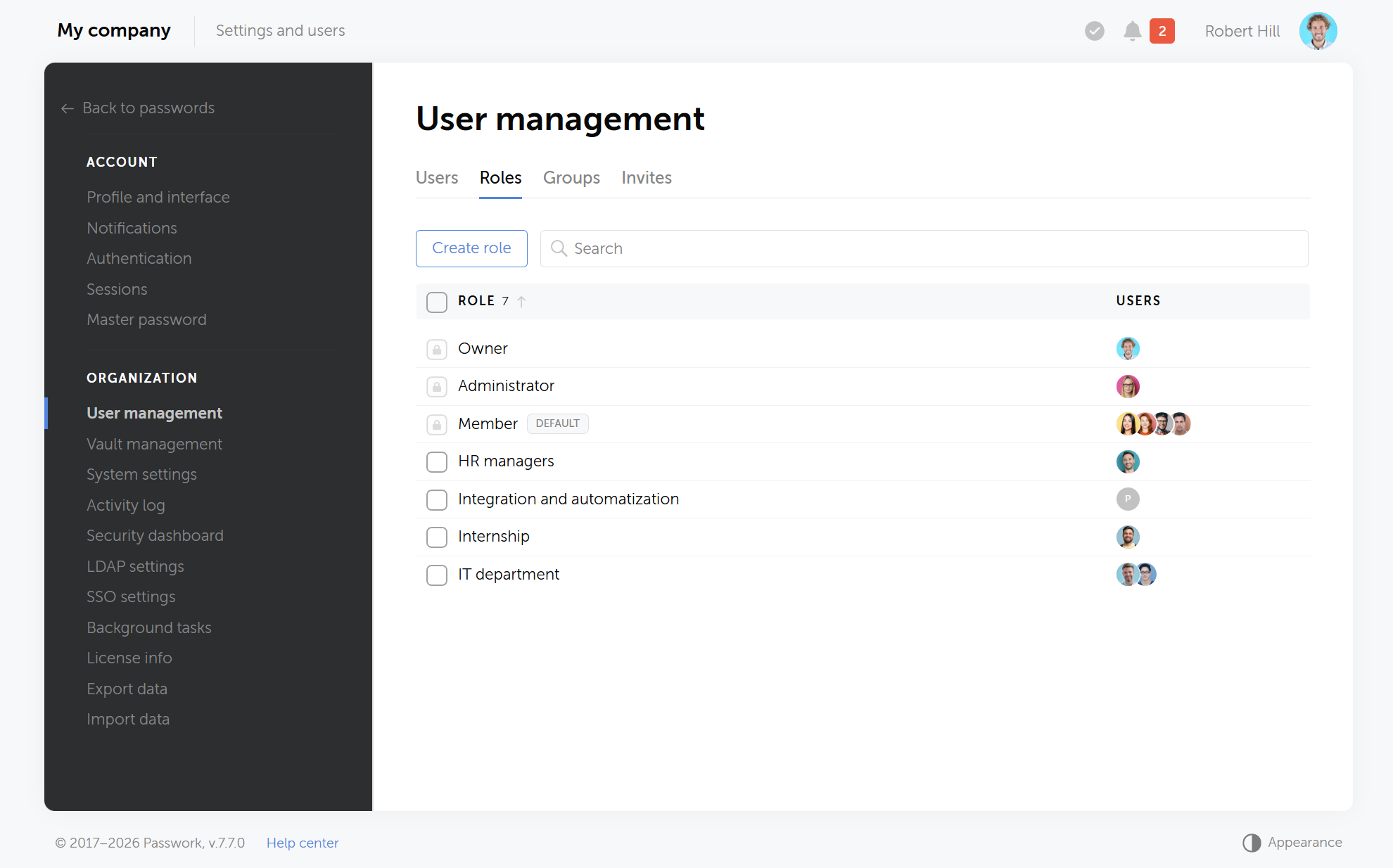
Das Statussystem wurde aktualisiert, indem administrative Rechte und Benutzereinstellungen kombiniert und in Rollen umbenannt wurden — anstelle der zwei Standardstatus Administrator und Mitarbeiter kann nun eine unbegrenzte Anzahl von Rollen mit individuellen Rechten und Einstellungen erstellt werden.

Passwortsuche über Browser-Erweiterung

Benutzergruppen

Was in früheren Versionen Rollen hieß, wurde in Gruppen umbenannt, wodurch der Benutzerverwaltungsprozess intuitiver wird und näher an gängigen Standards liegt, wie sie beispielsweise in Active Directory verwendet werden. Gruppen ermöglichen die Einschränkung des Benutzerzugriffs auf Tresore basierend auf bestimmten Berechtigungen.

Passwortsuche über Browser-Erweiterung

Aktualisierte Tresorstruktur

Die Tresorstruktur wurde vereinfacht — anstelle von Organisationstresoren und persönlichen Tresoren können Benutzer nun private Tresore erstellen. Ein privater Tresor wird zu einem geteilten Tresor, wenn andere Benutzer hinzugefügt werden. Gleichzeitig werden Administratoren nicht mehr automatisch zu neuen Tresoren hinzugefügt.

Die aktualisierte Tresorstruktur gewährleistet eine zuverlässige Verschlüsselung und bietet neue Möglichkeiten für die Passwortverwaltung, wodurch der Prozess komfortabler und sicherer wird.

Passwortsuche über Browser-Erweiterung

Bestätigung des Tresorzugriffs

Wenn Benutzer zu Gruppen hinzugefügt werden, erhalten sie nicht mehr automatisch Zugriff auf die Tresore anderer Benutzer — der Zugriff erfordert eine Bestätigung durch den Tresoradministrator. Benutzer, die während der LDAP-Synchronisierung Zugriff auf einen Tresor erhalten haben, müssen ebenfalls bestätigt werden. Dies bietet zusätzliche Kontrolle und verhindert unbefugten Zugriff auf Tresorinhalte.

Passwortsuche über Browser-Erweiterung

Änderung der Zugangslevel

Das Zugangslevel-System wurde überarbeitet und eine Reihe von Änderungen an einigen davon eingeführt:

  • Das Navigations-Level wurde durch die Möglichkeit ersetzt, alle übergeordneten Verzeichnisse des Ordners anzuzeigen, auf den das Zugangslevel angewendet wird.
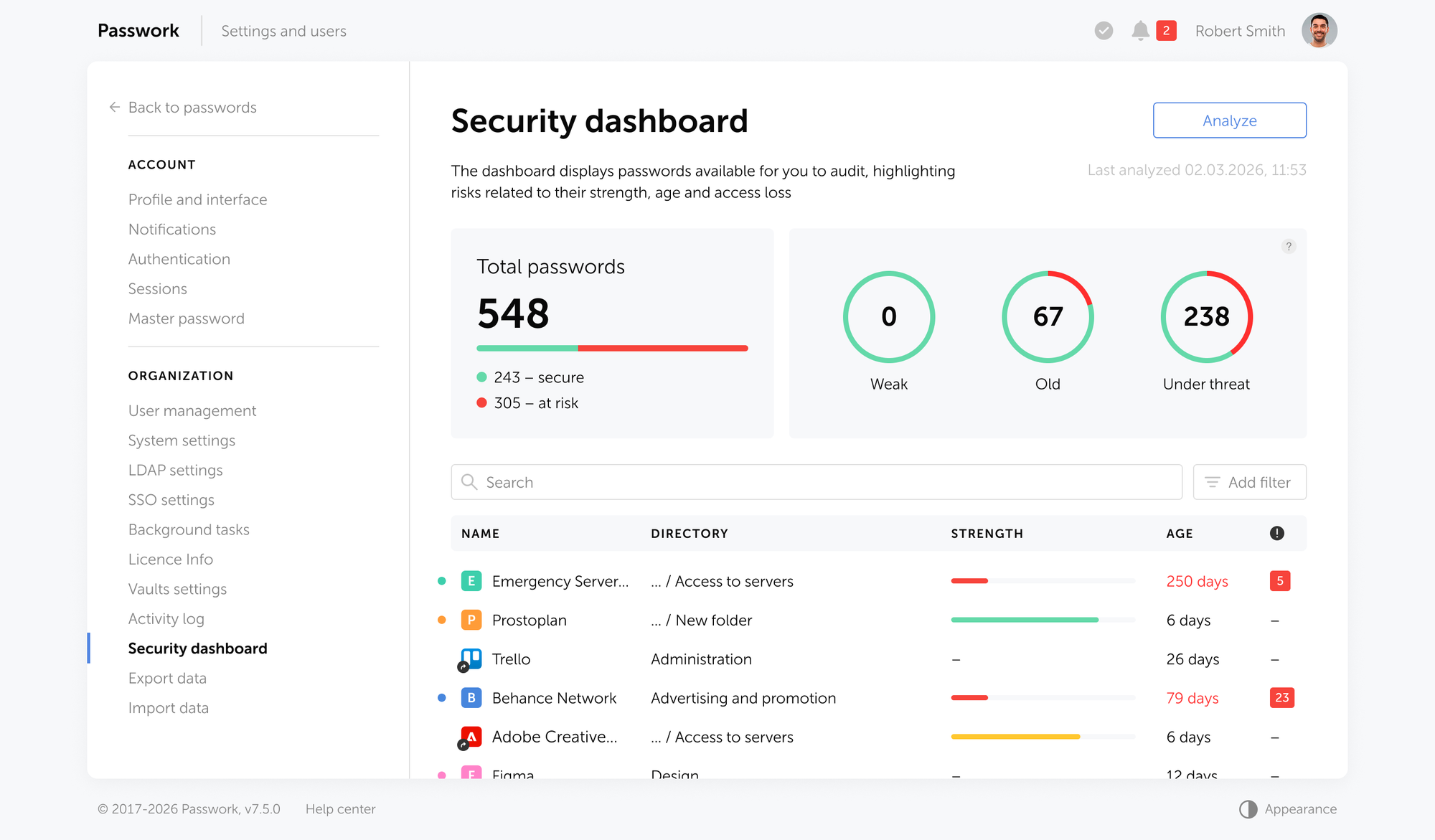
  • Benutzer mit dem Zugangslevel „Vollständiger Zugang" können nun Zugangslevel anderer Benutzer einsehen, zusätzlichen Zugriff verwalten, den Änderungsverlauf innerhalb des Verzeichnisses anzeigen und die ihnen zur Verfügung stehenden Passwörter über das Security-Dashboard analysieren.
  • Die Möglichkeit wurde hinzugefügt, Benutzern in Ordnern Administratorrechte zuzuweisen. Das Zugangslevel „Administration" wird an untergeordnete Ordner vererbt, ohne die Möglichkeit, es zu ändern.
Passwortsuche über Browser-Erweiterung

Aktionsverlauf und Benachrichtigungen

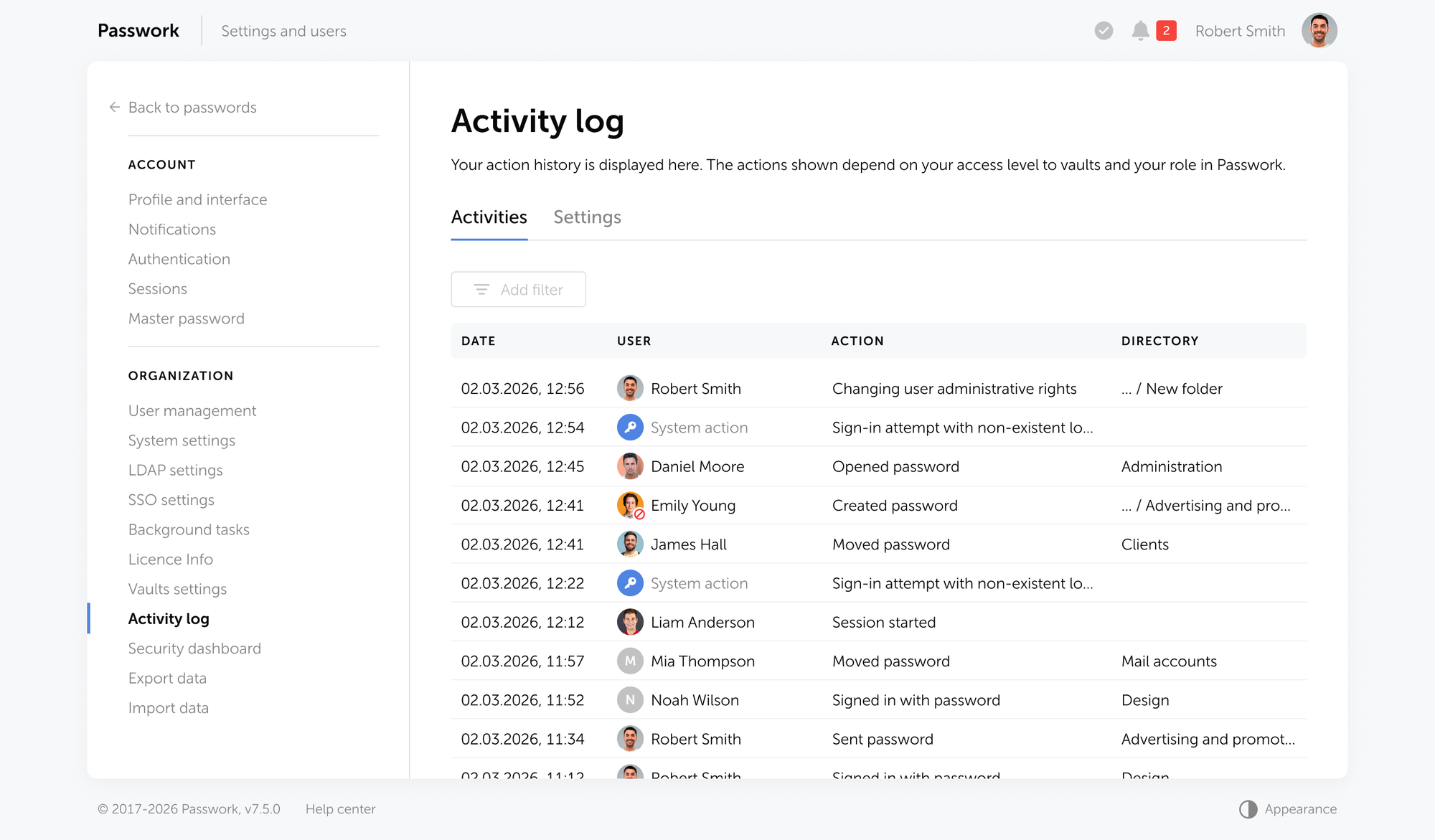
Die Liste der protokollierten Aktionen wurde erweitert, ihre Beschreibungen aktualisiert und das Benachrichtigungssystem vollständig überarbeitet. Kurz nach der Veröffentlichung werden Benachrichtigungseinstellungen eingeführt, die mehr Flexibilität bei der Verfolgung wichtiger Änderungen und Benutzeraktionen bieten.

Passwortsuche über Browser-Erweiterung

Verwendung von Shortcuts

Um die Sicherheit zu erhöhen, wurden einige Änderungen an der Funktionsweise von Shortcuts vorgenommen:

  • Es ist nun nicht mehr möglich, Shortcuts für Passwörter zu kopieren, bei denen die Shortcut-Erstellung nicht erlaubt ist.
  • Ordner, die Shortcuts enthalten, die einem Benutzer nicht zur Verfügung stehen, werden nun ohne diese kopiert.

Hinzufügen von Tags zu Passwörtern

Beim Erstellen oder Bearbeiten eines Passworts kann nun ein Tag aus einer Liste bereits erstellter Tags ausgewählt werden. Dies hat den zusätzlichen Vorteil, dass die Erstellung von Tags mit demselben Namen verhindert wird (sales ↔ Sales usw.). Bei der Auswahl von Tags werden nur diejenigen angezeigt, die in den Tresoren des Benutzers verfügbar sind.

Passwortsuche über Browser-Erweiterung

Änderungen am 2FA-Zurücksetzungsprozess

Beim Zurücksetzen des Autorisierungspassworts wird die Zwei-Faktor-Authentifizierung nun nicht mehr automatisch mit zurückgesetzt. Benutzer können 2FA nicht ohne eine erfolgreiche Anmeldung zurücksetzen, was die Sicherheit erhöht.

Kontosperrungsoption

Eine Kontosperrungsfunktion wurde eingeführt. Es können ein Limit für fehlgeschlagene Anmeldeversuche, ein Zeitrahmen für die Verfolgung der fehlgeschlagenen Versuche und eine Sperrdauer festgelegt werden.

Passwortsuche über Browser-Erweiterung

Weitere Änderungen

  • Die Einstellungen wurden aufgeräumt, indem ihre Struktur übersichtlicher gestaltet wurde.
  • Automatischer Abruf von E-Mail und Name aus Single Sign-On-Systemen (SSO) hinzugefügt.
  • Einstellungen für die automatische Bereinigung von Sitzungen, Benachrichtigungen und Hintergrundaufgaben hinzugefügt.
  • Die Möglichkeit wurde hinzugefügt, ein Systembanner zu aktivieren, das für alle Passwork-Benutzer sichtbar ist. Es kann für wichtige Benachrichtigungen, Warnungen oder Anweisungen verwendet werden.
  • Die Möglichkeit wurde hinzugefügt, eine Zeitzone sowie ein Datums- und Zeitformat auszuwählen.
  • Filter in wichtigen Bereichen für eine schnellere und einfachere Suche aktualisiert.

Upgrade auf Passwork 7

Für das Upgrade auf Version 7.0 muss Passwork auf Version 6.5 aktualisiert, die Daten migriert und dies im Kundenportal bestätigt werden. Eine Upgrade-Anleitung ist hier zu finden.

Es wird empfohlen, die neuen Funktionen und Besonderheiten der Datenmigration in einer Testumgebung zu erkunden, bevor die Self-hosted-Version aktualisiert wird. Für Tests kann Passwork 7 auf einem separaten Server bereitgestellt werden — dies ermöglicht die Überprüfung aller Änderungen in der neuen Version, ohne die aktuelle Arbeitsumgebung zu beeinträchtigen.
Passwork 7.1: Tresortypen
Tresortypen Passwork 7.1 führt eine robuste Tresortypen-Architektur ein, die unternehmensgerechte Zugangskontrolle für verbesserte Sicherheit und Verwaltung bietet. Tresortypen lösen eine zentrale Herausforderung für Administratoren: die Kontrolle des Datenzugriffs und die Delegation der Tresorverwaltung in großen Organisationen. Zuvor war die Auswahl auf zwei Typen beschränkt. Jetzt können Sie erstellen
Passwork 7.2 Release
Die neue Version führt anpassbare Benachrichtigungen mit flexiblen Zustellungsoptionen ein, verbesserte Beschreibungen der Ereignisprotokollierung, erweiterte CLI-Funktionalität, serverseitige PIN-Code-Speicherung für die Browser-Erweiterung und die Möglichkeit, clientseitige Verschlüsselung während der Erstkonfiguration von Passwork zu aktivieren. Benachrichtigungseinstellungen Ein dedizierter Bereich für Benachrichtigungseinstellungen wurde hinzugefügt, in dem Benachrichtigungen ausgewählt werden können
Passwork: Secrets-Management und Automatisierung für DevOps
Einführung In Unternehmensumgebungen nimmt die Anzahl der Passwörter, Schlüssel und digitalen Zertifikate rapide zu, und Secrets-Management wird zu einer der kritischen Aufgaben für IT-Teams. Secrets-Management befasst sich mit dem gesamten Lebenszyklus sensibler Daten: von der sicheren Generierung und verschlüsselten Speicherung bis hin zur automatisierten Rotation und Audit-Trails. Da

Passwork 7 Release

May 6, 2025 — 6 min read
Passwork 7

En Passwork 7, mejoramos todo: reescribimos completamente el código utilizando las últimas tecnologías, implementamos una API completa, actualizamos la interfaz, rediseñamos los grupos y roles, abandonamos la adición automática de administradores del sistema a las bóvedas e hicimos la gestión de derechos de acceso aún más flexible. Esto mejorará significativamente la comodidad de la administración y la gestión de contraseñas, además de acelerar considerablemente el desarrollo de nuevas funcionalidades.

Interfaz actualizada

Rediseñamos la interfaz de Passwork y actualizamos todas las secciones clave — tuvimos en cuenta muchas solicitudes y corregimos errores lógicos y funcionales, preservando la comodidad familiar de trabajar con contraseñas. También añadimos la posibilidad de personalizar el ancho de las columnas y mover elementos de la interfaz — cada usuario podrá adaptarla a sus necesidades.

Búsqueda de contraseña mediante extensión del navegador

Funcionalidad de API ampliada

Ampliamos significativamente la funcionalidad de la API — ahora permite una interacción completa con todas las características de Passwork: desde copiar contraseñas hasta gestionar usuarios y configuraciones de seguridad.

Para simplificar el trabajo con la API, preparamos un conector oficial de Python — una biblioteca para desarrolladores que permite integrar Passwork con aplicaciones y scripts en Python, y la utilidad Passwork-CLI, que permite trabajar con la API desde la línea de comandos.

En lugar de claves API, ahora se utilizan tokens — una forma más moderna y fiable de acceder al sistema. Además, la configuración de acceso a la API se ha trasladado a la página de roles.

Nuevo backend y frontend

Actualizamos completamente el código utilizando métodos más modernos — esto mejorará el rendimiento y simplificará la instalación inicial de Passwork. Además, el nuevo código se convertirá en la base para desarrollar aplicaciones de escritorio y acelerará significativamente la introducción de nuevas funcionalidades.

Roles de usuario

Actualizamos el sistema de estados combinando los derechos administrativos y la configuración de usuarios, y los renombramos como Roles — ahora, en lugar de dos estados estándar Administrador y Empleado, puede crear un número ilimitado de roles con derechos y configuraciones individuales.

Búsqueda de contraseña mediante extensión del navegador

Grupos de usuarios

Lo que se llamaba Roles en versiones anteriores ha sido renombrado a Grupos, haciendo el proceso de gestión de usuarios más intuitivo y cercano a los estándares comunes, como los utilizados en Active Directory. Los grupos permiten restringir el acceso de los usuarios a las bóvedas según ciertos privilegios.

Búsqueda de contraseña mediante extensión del navegador

Estructura de bóvedas actualizada

Simplificamos la estructura de las bóvedas — en lugar de bóvedas de organización y bóvedas personales, los usuarios podrán crear bóvedas privadas. Una bóveda privada se convierte en compartida cuando se añaden otros usuarios. Al mismo tiempo, los administradores ya no se añaden automáticamente a las nuevas bóvedas.

La estructura de bóvedas actualizada garantiza un cifrado fiable y ofrece nuevas posibilidades para la gestión de contraseñas, haciendo el proceso más cómodo y seguro.

Búsqueda de contraseña mediante extensión del navegador

Confirmación de acceso a bóvedas

Al añadir usuarios a grupos, ya no recibirán automáticamente acceso a las bóvedas de otros usuarios — el acceso requerirá confirmación del administrador de la bóveda. Los usuarios que obtuvieron acceso a una bóveda durante la sincronización LDAP también necesitan ser confirmados. Esto proporciona control adicional y previene el acceso no autorizado al contenido de las bóvedas.

Búsqueda de contraseña mediante extensión del navegador

Cambios en los niveles de acceso

Hemos reformulado el sistema de niveles de acceso e introducido una serie de cambios en algunos de ellos:

  • El nivel de navegación ha sido reemplazado por la capacidad de ver todos los directorios principales de la carpeta a la que se aplica el nivel de acceso.
  • Los usuarios con el nivel de acceso completo ahora pueden ver los niveles de acceso de otros usuarios, gestionar el acceso adicional, ver el historial de cambios dentro del directorio y analizar las contraseñas disponibles para ellos a través del panel de seguridad.
  • Se ha añadido la capacidad de asignar derechos administrativos a usuarios en carpetas. El nivel de acceso de administración se hereda a las carpetas secundarias sin posibilidad de modificarlo.
Búsqueda de contraseña mediante extensión del navegador

Historial de acciones y notificaciones

Hemos ampliado la lista de acciones que se registran, actualizado sus descripciones y reformulado completamente el sistema de notificaciones. Poco después del lanzamiento, introduciremos la configuración de notificaciones, que añadirá flexibilidad para realizar un seguimiento de los cambios importantes y las acciones de los usuarios.

Búsqueda de contraseña mediante extensión del navegador

Uso de accesos directos

Para mejorar la seguridad, hemos realizado algunos cambios en la forma en que funcionan los accesos directos:

  • Ahora es imposible copiar accesos directos para contraseñas que no permiten la creación de accesos directos.
  • Las carpetas que incluyen accesos directos no disponibles para un usuario ahora se copiarán sin ellos.

Añadir etiquetas a las contraseñas

Ahora, cuando cree o edite una contraseña, podrá seleccionar una etiqueta de una lista de las ya creadas. Esto tiene el beneficio adicional de prevenir la creación de etiquetas con el mismo nombre (ventas ↔ Ventas, etc.). Al seleccionar etiquetas, solo se mostrarán aquellas disponibles en las bóvedas del usuario.

Búsqueda de contraseña mediante extensión del navegador

Cambios en el flujo de restablecimiento de 2FA

Cuando restablezca su contraseña de autorización, la autenticación de dos factores ya no se restablecerá junto con ella. Los usuarios no podrán restablecer 2FA sin un inicio de sesión exitoso, lo que aumenta la seguridad.

Opción de bloqueo de cuenta

Hemos introducido una función de bloqueo de cuenta. Podrá establecer un límite de intentos de inicio de sesión fallidos, un período de tiempo para el seguimiento de los intentos fallidos y la duración del bloqueo.

Búsqueda de contraseña mediante extensión del navegador

Otros cambios

  • Organizamos la configuración haciendo su estructura más clara.
  • Se añadió la recuperación automática de correo electrónico y nombre desde sistemas de inicio de sesión único (SSO).
  • Se añadió configuración para la limpieza automática de sesiones, notificaciones y tareas en segundo plano.
  • Se añadió la capacidad de habilitar un banner del sistema que será visible para todos los usuarios de Passwork. Puede usarlo para notificaciones importantes, alertas o instrucciones.
  • Se añadió la capacidad de elegir una zona horaria y formato de fecha y hora.
  • Se actualizaron los filtros en las secciones clave para una búsqueda más rápida y sencilla.

Actualización a Passwork 7

Para actualizar a la versión 7.0, necesitará actualizar su Passwork a la versión 6.5, migrar sus datos y confirmar esto en el portal del cliente. Las instrucciones de actualización se pueden encontrar aquí.

Recomendamos explorar las nuevas funcionalidades y las especificaciones de la migración de datos en un entorno de prueba antes de actualizar su versión autoalojada. Para las pruebas, puede desplegar Passwork 7 en un servidor separado — esto le permitirá revisar todos los cambios en la nueva versión sin afectar su entorno de trabajo actual.
Passwork 7.1: Tipos de bóvedas
Tipos de bóvedas Passwork 7.1 introduce una arquitectura robusta de tipos de bóvedas, proporcionando control de acceso de nivel empresarial para una seguridad y gestión mejoradas. Los tipos de bóvedas abordan un desafío clave para los administradores: controlar el acceso a los datos y delegar la gestión de bóvedas en grandes organizaciones. Anteriormente, la elección se limitaba a dos tipos. Ahora, puede crear
Lanzamiento de Passwork 7.2
La nueva versión introduce notificaciones personalizables con opciones de entrega flexibles, descripciones mejoradas del registro de eventos, funcionalidad CLI ampliada, almacenamiento del código PIN en el servidor para la extensión del navegador y la capacidad de habilitar el cifrado del lado del cliente durante la configuración inicial de Passwork. Configuración de notificaciones Hemos añadido una sección dedicada de configuración de notificaciones donde puede elegir la notificación
Passwork: Gestión de secretos y automatización para DevOps
Introducción En el entorno corporativo, el número de contraseñas, claves y certificados digitales está aumentando rápidamente, y la gestión de secretos se está convirtiendo en una de las tareas críticas para los equipos de TI. La gestión de secretos aborda el ciclo de vida completo de los datos sensibles: desde la generación segura y el almacenamiento cifrado hasta la rotación automatizada y los registros de auditoría. A medida que

Lanzamiento de Passwork 7

May 6, 2025 — 6 min read
Passwork 7

In Passwork 7, we improved everything: completely rewrote the code using the latest technologies, implemented a full-fledged API, updated the interface, redesigned groups and roles, abandoned the automatic addition of system administrators to vaults, and made access rights management even more flexible. This will significantly enhance the convenience of administration and password management, as well as greatly accelerate the development of new features.

Updated interface

We redesigned the Passwork interface and updated all key sections — took into account many requests and fixed logical and functional errors while preserving the familiar convenience of working with passwords. We also added the ability to customize column widths and move interface elements — each user will be able to adapt it to their needs.

Searching password by browser extension

Expanded API functionality

We significantly expanded the API functionality — now it allows full interaction with all Passwork features: from copying passwords to managing users and security settings.

To simplify working with the API, we prepared an official Python connector — a developer library that allows integrating Passwork with applications and scripts in Python, and the Passwork-CLI utility, which enables working with the API from the command line.

Instead of API keys, tokens are now used — a more modern and reliable way to access the system. In addition, API access settings have been moved to the role page.

New backend and frontend

We completely updated the code using more modern methods — this will improve performance and simplify the initial installation of Passwork. Moreover, the new code will become the basis for developing desktop applications and will significantly speed up the introduction of new features.

User roles

We updated the status system by combining administrative rights and user settings, and renamed them to Roles — now, instead of two standard statuses Administrator and Employee, you can create an unlimited number of roles with individual rights and settings.

Searching password by browser extension

User groups

What was called Roles in previous versions has been renamed to Groups, making the user management process more intuitive and closer to common standards, such as those used in Active Directory. Groups allow restricting user access to vaults based on certain privileges.

Searching password by browser extension

Updated vault structure

We simplified the vault structure — instead of organization vaults and personal vaults, users will be able to create private vaults. A private vault becomes shared when other users are added to it. At the same time, administrators are no longer automatically added to new vaults.

The updated vault structure ensures reliable encryption and offers new possibilities for password management, making the process more convenient and secure.

Searching password by browser extension

Vault access confirmation

When adding users to groups, they will no longer automatically receive access to other users' vaults — access will require confirmation from the vault administrator. Users who gained access to a vault during LDAP synchronization also need to be confirmed. This provides additional control and prevents unauthorized access to vault contents.

Searching password by browser extension

Changing access levels

We’ve reworked the access level system and introduced a number of changes to some of them:

  • Navigation level has been replaced by an ability to view all parent directories of the folder the access level is applied to
  • Users with the Full access level now can view access levels of other users, manage additional access, view the history of changes within the directory and analyze passwords available to them via Security dashboard
  • Added the ability to assign administrative rights to users in folders. The Administration access level is inherited by child folders without the ability to change it
Searching password by browser extension

History of actions and notifications

We’ve expanded the list of actions that are logged, updated their descriptions and completely reworked the notification system. Soon after the release we are going to introduce notification settings, which will add flexibility to keeping track of important changes and user actions.

Searching password by browser extension

Using shortcuts

In order to enhance security, we’ve made some changes to the way shortcuts work:

  • It is now impossible to copy shortcuts for passwords which don’t allow shortcut creation
  • Folders which include shortcuts unavailable to a user will now be copied without them

Adding tags to passwords

Now when you create or edit a password, you will be able to pick a tag from a list of already created ones. This has an added benefit of preventing creation of tags with the same name (sales ↔ Sales, etc.). When selecting tags, only those available in the user's vaults will be displayed.

Searching password by browser extension

Changes to 2FA reset flow

When you reset your authorization password, two-factor authentication now won’t be reset along with it. Users won’t be able to reset 2FA without a successful login, which increases security.

Account locking option

We’ve introduced an account locking feature. You will be able to set a limit on failed login attempts, timeframe for tracking the failed attempts and lockout duration.

Searching password by browser extension

Other changes

  • Tidied settings up by making their structure more clear
  • Added automatic retrieval of email and name from single sign-on systems (SSO)
  • Added settings for automatic clearing of sessions, notifications and background tasks
  • Added the ability to enable a system banner that will be visible to all Passwork users. You can use it for important notifications, alerts or instructions
  • Added an ability to choose a time zone and date & time format
  • Updated filters in key sections for faster and simpler search

Upgrading to Passwork 7

To upgrade to version 7.0, you’ll need to update your Passwork to version 6.5, migrate your data, and confirm this in the customer portal. Upgrade instructions can be found here.

We recommend exploring the new features and data migration specifics in a test environment before updating your self-hosted version. For testing, you can deploy Passwork 7 on a separate server — this will allow you to review all the changes in the new version without affecting your current working environment.
Passwork 7.1: Vault types
Vault types Passwork 7.1 introduces a robust vault types architecture, providing enterprise-grade access control for enhanced security and management. Vault types address a key challenge for administrators: controlling data access and delegating vault management across large organizations. Previously, the choice was limited to two types. Now, you can create
Passwork 7.2 release
The new version introduces customizable notifications with flexible delivery options, enhanced event logging descriptions, expanded CLI functionality, server-side PIN code storage for the browser extension, and the ability to enable client-side encryption during initial Passwork configuration. Notification settings We’ve added a dedicated notification settings section where you can choose notification
Passwork: Secrets management and automation for DevOps
Introduction In corporate environment, the number of passwords, keys, and digital certificates is rapidly increasing, and secrets management is becoming one of the critical tasks for IT teams. Secrets management addresses the complete lifecycle of sensitive data: from secure generation and encrypted storage to automated rotation and audit trails. As

Passwork 7 release

Nov 8, 2024 — 4 min read

Kindernothilfe (KNH) ist eine deutsche gemeinnützige Organisation, die sich der Unterstützung gefährdeter Kinder in verarmten und benachteiligten Regionen weltweit widmet. Seit ihrer Gründung im Jahr 1959 hat sie als eine der größten europäischen Wohltätigkeitsorganisationen im Bereich Kinderhilfe bedeutende Beiträge geleistet.

In über 30 Ländern tätig, betont Kindernothilfe die Bedeutung der Sicherung von Kinderrechten und des Zugangs zu Bildung, Gesundheitsversorgung, Kinderschutz und Gemeindeentwicklungsinitiativen — alles mit dem Ziel, die Lebensbedingungen von Kindern zu verbessern und Armut zu beseitigen.

Unternehmen: Kindernothilfe
Standort: Duisburg, Deutschland
Branche: Gemeinnützige Organisation
Unternehmensgröße: Über 300 Mitarbeiter in mehr als 30 Ländern

Die Herausforderung: Eine sichere und benutzerfreundliche Lösung für globale Teams finden

Vor der Entscheidung für Passwork setzte Kindernothilfe auf KeePass — eine Lösung, die die Skalierbarkeit einschränkte und keine benutzerfreundlichen Funktionen bot, die für eine global operierende Organisation unerlässlich sind. Mit über 300 Mitarbeitern in mehr als 30 Ländern benötigte die Organisation eine sichere, skalierbare und intuitive Lösung für die Passwortverwaltung.

Quelle: Betterfuturejobs

Dies war entscheidend, um den wachsenden Anforderungen des internationalen Teams gerecht zu werden — insbesondere zur Verbesserung der Passwortfreigabe und der Zugriffsverwaltung für remote arbeitende Mitarbeiter.

Die Lösung: Wechsel zu Passwork für verbesserte Sicherheit und vereinfachten Benutzerzugriff

Kindernothilfe entschied sich für Passwork aufgrund seiner robusten Self-Hosting-Funktionen, die optimale Datenkontrolle und Sicherheit gewährleisten. Die nahtlose Integration mit SAML2 für Single Sign-On (SSO) vereinfachte die Zugriffsverwaltung über mehrere Plattformen hinweg.

Darüber hinaus ermöglichten die intuitive Benutzeroberfläche von Passwork sowie die mobile App und Browser-Erweiterung eine mühelose Passwortverwaltung von jedem Gerät aus. Die sicheren Funktionen zur Passwortfreigabe verbesserten die Teamzusammenarbeit, reduzierten menschliche Fehler erheblich und optimierten die gesamten Sicherheitsprotokolle.

Die Implementierung: Schrittweise Einführung und Aufbau einer sicheren Infrastruktur

Der Implementierungsprozess dauerte etwa zwei Monate. Der Schwerpunkt lag auf dem Aufbau und der gründlichen Prüfung der Infrastruktur, um sicherzustellen, dass Passwork die Sicherheitsanforderungen von Kindernothilfe erfüllt. Die Integration von SAML2 für Single Sign-On (SSO) verlief reibungslos und wurde innerhalb kurzer Zeit abgeschlossen.

Um die erfolgreiche Implementierung von Passwork zu ermöglichen, entschied sich Kindernothilfe für eine schrittweise Einführung anstelle einer sofortigen organisationsweiten Bereitstellung der Passwortverwaltungslösung. Die Organisation begann mit einer kleineren Gruppe von Mitarbeitern, um die Vorteile des Systems zu demonstrieren, und förderte die Nutzung schrittweise.

Quelle: Kindernothilfe

Durch die Organisation verschiedener Werbe- und Schulungsaktivitäten wie „Lunch and Learn"-Veranstaltungen ermutigte die Organisation die Mitarbeiter, sich mit Passwork vertraut zu machen. Das Ziel war es, dass mindestens 50 % der Belegschaft Passwork aktiv nutzen, bevor das System auf die gesamte Organisation ausgeweitet wird.

Die Ergebnisse: Steigerung der operativen Effizienz für länderübergreifende Teams

Derzeit nutzen etwa 50 % der Belegschaft aktiv Passwork — eine zentralisierte, sichere und benutzerfreundliche Lösung für die Passwortfreigabe. Dieser schrittweise Ansatz sorgte nicht nur für ein höheres Benutzerengagement, sondern stärkte auch die Sicherheitsprotokolle in der gesamten Organisation erheblich.

Quelle: Kindernothilfe

Durch die Verbesserung der Passwortverwaltungsprozesse steigerte Kindernothilfe die gesamte operative Effizienz, insbesondere für länderübergreifende Teams. Schulungsinitiativen wie „Lunch and Learn"-Sitzungen trugen maßgeblich dazu bei, das Bewusstsein für Passwork zu schärfen und die erfolgreiche Einführung in der gesamten Organisation zu fördern.

„Passwork erfüllte unsere Anforderungen mit seiner erschwinglichen Preisgestaltung und Benutzerfreundlichkeit und ist damit ein unverzichtbares Werkzeug für unsere globale Belegschaft." — Bernd Schlürmann, Netzwerk- und Sicherheitsmanager
CTA Image

Machen auch Sie den ersten Schritt! Starten Sie Ihre kostenlose Passwork-Testversion und erleben Sie, wie einfach sichere Passwortverwaltung sein kann.

Die Cybersicherheits-Checkliste 2025 für kleine Unternehmen: Ein vollständiger Leitfaden | Passwork
Passworks Cybersicherheits-Checkliste 2025, basierend auf dem NIST-Framework, bietet umsetzbare Schritte zur Vermeidung von Datenschutzverletzungen und finanziellen Verlusten.
Fallstudie: Stadt Melle und Passwork
Passwork hat die interne Sicherheit der Stadt Melle durch die Schaffung eines zuverlässigen Systems für die Passwortverwaltung verbessert.
Was ist ein Passkey? Leitfaden zur passwortlosen Anmeldung
Ein Passkey ist eine phishing-resistente Zugangsdaten auf Ihrem Gerät. Anmeldung per biometrischem Touch — kein Passwort nötig. Der Leitfaden deckt Technik, Plattform-Setup, Leistungsdaten und den Unternehmensübergang ab.

Kindernothilfe: Vereinfachung der globalen Zusammenarbeit mit Passwork

Die Kindernothilfe benötigte eine sichere Passwortlösung für ein global verteiltes Team. Mit Passwork gelangen SSO-Integration, kontrolliertes Self-Hosting und eine schrittweise Einführung, die Sicherheit und Zusammenarbeit über Ländergrenzen hinweg verbesserte.

Nov 8, 2024 — 4 min read

Kindernothilfe (KNH) es una organización sin fines de lucro alemana dedicada a apoyar a niños vulnerables en regiones empobrecidas y desfavorecidas de todo el mundo. Fundada en 1959, ha realizado contribuciones significativas como una de las organizaciones benéficas más grandes de Europa dedicadas a la ayuda infantil.

Operando en más de 30 países, Kindernothilfe enfatiza la importancia de garantizar los derechos de los niños y proporcionar acceso a educación, atención médica, protección infantil e iniciativas de desarrollo comunitario, todo orientado a mejorar las condiciones de vida de los niños y erradicar la pobreza.

Empresa: Kindernothilfe
Ubicación: Duisburgo, Alemania
Industria: Organización sin fines de lucro
Tamaño de la empresa: Más de 300 empleados en más de 30 países

El desafío: Encontrar una solución segura y fácil de usar para equipos globales

Antes de elegir Passwork, Kindernothilfe dependía de KeePass, una solución que limitaba la escalabilidad y carecía de funciones fáciles de usar esenciales para una organización que opera a nivel global. Con más de 300 empleados en más de 30 países, la organización requería una solución de gestión de contraseñas segura, escalable e intuitiva.

Fuente: Betterfuturejobs

Esto era crucial para satisfacer las crecientes demandas de su equipo internacional, especialmente para mejorar las capacidades de compartición de contraseñas y gestión de acceso para empleados remotos.

La solución: Cambiar a Passwork para mejorar la seguridad y simplificar el acceso de usuarios

Kindernothilfe optó por Passwork debido a sus sólidas capacidades de autoalojamiento, garantizando un control y seguridad óptimos de los datos. La integración perfecta con SAML2 para SSO simplificó la gestión de acceso en múltiples plataformas.

Además, la interfaz intuitiva de Passwork, junto con su aplicación móvil y extensión de navegador, hizo posible gestionar contraseñas sin esfuerzo desde cualquier dispositivo. Las funciones de compartición segura de contraseñas mejoraron la colaboración del equipo, reduciendo significativamente el error humano y mejorando los protocolos de seguridad generales.

La implementación: Despliegue gradual y construcción de una infraestructura segura

El proceso de implementación tomó aproximadamente dos meses. Se centró principalmente en establecer y probar exhaustivamente la infraestructura para asegurar que Passwork cumpliera con los requisitos de seguridad de Kindernothilfe. La integración de SAML2 para SSO fue fluida y se completó en un corto período de tiempo.

Para facilitar la implementación exitosa de Passwork, Kindernothilfe optó por un despliegue gradual en lugar de implementar la solución de gestión de contraseñas en toda la organización de una sola vez. Comenzaron con un grupo más pequeño de empleados para demostrar los beneficios del sistema y promovieron gradualmente su uso.

Fuente: Kindernothilfe

Al organizar diversas actividades promocionales y educativas, como eventos «Lunch and Learn», la organización animó a los empleados a interactuar con Passwork. El objetivo era alcanzar el punto en el que al menos el 50% del personal usara activamente Passwork antes de expandir el sistema a toda la organización.

Los resultados: Aumento de la eficiencia operativa para equipos transfronterizos

Actualmente, aproximadamente el 50% del personal utiliza activamente Passwork — una solución centralizada, segura y fácil de usar para compartir contraseñas. Este enfoque incremental no solo aseguró una mayor participación de los usuarios, sino que también fortaleció significativamente los protocolos de seguridad en toda la organización.

Fuente: Kindernothilfe

Al mejorar los procesos de gestión de contraseñas, Kindernothilfe aumentó su eficiencia operativa general, especialmente para equipos transfronterizos. Las iniciativas educativas, como las sesiones «Lunch and Learn», fueron fundamentales para crear conciencia sobre Passwork y facilitar su adopción exitosa en toda la organización.

«Passwork cumplió con nuestras necesidades con sus precios asequibles y facilidad de uso, convirtiéndose en una herramienta esencial para nuestra fuerza laboral global.» — Bernd Schlürmann, gerente de redes y seguridad
CTA Image

¡Dé el primer paso usted también! Comience su prueba gratuita de Passwork y descubra lo fácil que puede ser la gestión segura de contraseñas.


Lista de verificación de ciberseguridad para pequeñas empresas 2025: Una guía completa | Passwork
La lista de verificación de ciberseguridad 2025 de Passwork, basada en el marco NIST, proporciona pasos prácticos para prevenir filtraciones de datos y pérdidas financieras.
Caso de estudio: La ciudad de Melle y Passwork
Passwork ha mejorado la seguridad interna en la ciudad de Melle al crear un sistema confiable para la gestión de contraseñas.
¿Qué es una passkey? Guía de autenticación sin contraseñas
Una passkey es una credencial resistente al phishing almacenada en su dispositivo. Acceda con un toque biométrico — sin contraseña que recordar. La guía cubre técnica, configuración, datos de rendimiento y la transición empresarial.

Kindernothilfe: Simplificando la colaboración global de empleados con Passwork

Kindernothilfe, una de las mayores ONG de ayuda infantil de Europa, necesitaba gestionar contraseñas para un equipo distribuido en 30 países. Passwork aportó self-hosting, SSO vía SAML2 y una interfaz intuitiva para equipos internacionales.

Nov 8, 2024 — 4 min read

Kindernothilfe (KNH) is a German non-profit organization dedicated to supporting vulnerable children in impoverished and underprivileged regions worldwide. Founded in 1959, it has made significant contributions as one of Europe's largest charities dedicated to child aid.

Operating in over 30 countries, Kindernothilfe emphasizes the importance of ensuring children's rights and providing access to education, healthcare, child protection, and community development initiatives, all aimed at enhancing children's living conditions and eradicating poverty.

Company: Kindernothilfe
Location: Duisburg, Germany
Industry: Non-profit organization
Company size: Over 300 employees in more than 30 countries

The challenge: Finding a secure and user-friendly solution for global teams

Before choosing Passwork, Kindernothilfe relied on KeePass, a solution that limited scalability and lacked user-friendly features essential for a globally operating organization. With over 300 employees across more than 30 countries, the organization required a secure, scalable, and intuitive password management solution.

Source: Betterfuturejobs

Doing so was crucial to meet the growing demands of its international team, especially for enhancing password sharing and access management capabilities for remote employees.

The solution: Switching to Passwork for improved security and simplified user access

Kindernothilfe opted for Passwork for its robust self-hosting capabilities, ensuring optimal data control and security. The seamless integration with SAML2 for Single Sign-On (SSO) streamlined access management across multiple platforms.

Furthermore, Passwork's intuitive interface, along with its mobile app and browser extension, made it possible to manage passwords effortlessly from any device. The secure password-sharing features enhanced team collaboration, significantly reducing human error and improving overall security protocols.

The implementation: Gradual rollout and building a secure infrastructure

The implementation process took approximately two months. It was primarily focused on establishing and thoroughly testing the infrastructure to ensure Passwork met Kindernothilfe's security requirements. The integration of SAML2 for Single Sign-On (SSO) was smooth and completed within a short timeframe.

To facilitate the successful implementation of Passwork, Kindernothilfe opted for a phased rollout rather than deploying the password management solution organization-wide all at once. They began with a smaller group of employees to showcase the benefits of the system and gradually promoted its use.

Source: Kindernothilfe

While organizing various promotional and educational activities, such as "Lunch and Learn" events, the organization encouraged employees to engage with Passwork. The goal was to achieve the point where at least 50% of the staff actively used Passwork before expanding the system to the entire organization.

The results: Increasing operational efficiency for cross-border teams

Currently, approximately 50% of the staff are actively using Passwork — a centralized, secure, and user-friendly solution for password sharing. This incremental approach not only ensured higher user engagement but also significantly strengthened security protocols across the organization.

Source: Kindernothilfe

By improving password management processes, Kindernothilfe increased its overall operational efficiency, especially for cross-border teams. Educational initiatives, such as "Lunch and Learn" sessions, were instrumental in raising awareness about Passwork and facilitating its successful adoption throughout the organization.

"Passwork met our needs with its affordable pricing and ease of use, making it an essential tool for our global workforce." — Bernd Schlürmann, network and security manager
CTA Image

Take the first step too! Start your free Passwork trial and see how easy secure password management can be.


Case study: City of Melle and Passwork
Passwork has improved the internal security at the City of Melle by creating a reliable system for password management.
European password manager hosting: Cloud vs on-premises guide
What hosting model actually protects your credentials under EU law and why picking an EU data center isn’t enough. A practical guide for European organizations navigating GDPR, NIS2, DORA, and the US CLOUD Act.
NIS2 password requirements: What European companies must do in 2026
Credential gaps are the leading NIS2 audit failure point in 2026. This guide covers Article 21 password requirements, NIST SP 800-63B alignment, AD hardening steps, and the audit evidence regulators ask for first.

Kindernothilfe: Simplifying global employee collaboration with Passwork

Kindernothilfe, one of Europe's largest child aid organizations, needed a scalable password manager for a globally distributed team. They chose Passwork for self-hosting, SSO via SAML2, and an intuitive interface that simplified access management across borders.

Jun 4, 2024 — 4 min read

Passwork 6.4, we have introduced a number of changes which enhance our browser extension security, make user permissions settings more flexible, and improve the logging of settings related changes:

  • Mandatory extension PIN code
  • Logging of all changes related to settings
  • User access to history of actions with passwords
  • Automatic updating of LDAP group lists

Mandatory extension PIN code

With the new setting ‘Mandatory PIN code in extension’, administrators can set a mandatory browser extension PIN code for all users, minimizing potential unauthorized access. Once enabled, users who have not yet set a PIN code will be prompted to do so upon their next login to the extension. Users will be able to configure their auto-lock timeout and change the PIN code, but they cannot disable these functions.

The ‘Mandatory PIN code in extension’ setting is located in the ‘API, extension and mobile app’ section of the System settings

Now all changes in the Account settings, User management, LDAP settings, SSO settings, License info, and Background tasks are displayed in the Activity log.

All changes related to settings logged in the Activity log in the Settings and users

History of actions with passwords

The new setting ‘Who can view the history of actions with passwords’ makes it possible for vault administrators to let other users view password history, password editions, and receive notifications related to their changes. Previously, these features were available only to vault administrators.

You can customize this feature in the Vaults section of the System settings

Automatic updating of LDAP group lists

Automatic updating of LDAP group lists can now be configured on the Groups tab in the LDAP settings. The update is performed through background tasks with a selected time interval.

To configure LDAP group list updates, select LDAP server, go to the Groups tab, and click the Edit settings button

Other improvements

  • Added pop-up notifications when exporting data or moving data to the Bin
  • Improved display of dropdown lists on the Activity log page
  • Changed time display format of the ‘Automatic logout when inactive’ and ‘Maximum lifetime of the session when inactive’ settings
  • Changed the Enabled / Disabled dropdown lists on the System settings and LDAP settings pages with toggles
  • Increased minimum length of generated passwords to six characters

Bug fixes

  • Fixed an issue in the Password generator where selected characters were sometimes missing in the generated password
  • Fixed an issue where local users could not independently recover their account password when an LDAP server was enabled
  • Fixed an issue where local users could not register in Passwork when an LDAP server was enabled
  • Fixed an issue which occurred after moving a folder with shortcuts to another vault and shortcuts not being displayed in the new vault
  • Fixed an issue that occurred when trying to move a shortcut found in search results without opening any vaults right after logging into Passwork
  • Fixed an issue that occurred when trying to copy a password found in search results without opening any vaults right after logging into Passwork
  • Fixed an issue that occurred when a password was sent to another user and remained on the recipient's Recents and Starred pages after the initial password was moved to the Bin
  • Fixed the value in the time field for the ‘API key rotation period (in hours)’ setting which was reset to zero after disabling it
  • Fixed incorrect event logging in the Activity log after changing folder permissions
  • Fixed incorrect text notification about assigning access rights to a user through a role
  • Fixed incorrect tooltip text when hovering over the username of a recently created user
  • Fixed incorrect display of long invitation titles
  • Removed the local registration page when the LDAP server is enabled

Passwork: Secrets management and automation for DevOps
Introduction In corporate environment, the number of passwords, keys, and digital certificates is rapidly increasing, and secrets management is becoming one of the critical tasks for IT teams. Secrets management addresses the complete lifecycle of sensitive data: from secure generation and encrypted storage to automated rotation and audit trails. As
Cyber insurance: A false sense of security?
Introduction As cyber threats and data breaches become more frequent and sophisticated, many organizations are looking to cyber insurance as a way to manage risk. But is cyber insurance a true safety net — or is it just a false sense of security? This question was at the core of the
Comprehensive guide: Cybersecurity vocabulary – terms and phrases you need to know
Cybersecurity — as complex as it sounds — is an essential concept that we all need to be aware of in this day and age. Computers, phones, and smart devices have become an extension of our bodies at this point, which makes their security paramount. From your family photos to your bank

Passwork 6.4

Feb 14, 2024 — 4 min read

In Passwork 6.3, we have implemented numerous changes that significantly improve organization management efficiency, provide more flexible user permission settings, and increase security:

  • Administrative rights
  • Hidden vaults
  • Improved private vaults
  • Improved settings interface

Administrative rights

Available with the Advanced license

Now there is no need to make users administrators in order to grant them specific administrative rights. This option is a response to one of the most frequent requests from our customers.

Administrators can grant only those rights or permissions that are necessary for users to fulfill their duties and flexibly customize access to settings sections and manage Passwork. For instance, you can grant employees the right to create and edit new users, view the history of user activity, track settings changes, while restricting access to organization vaults and System settings.

You can configure additional rights on the Administrative rights tab in User management. There are four settings sections to flexibly customize Passwork for your business:

General
In this section, you can grant users access rights to manage all existing and new organization vaults, view the history of actions with settings and users, access license info and upload license keys, view and modify the parameters of SSO settings and Background tasks.

User management
In this section, you can grant users access rights to view and modify User management parameters. This includes performing any necessary actions with users and roles, such as creating, deleting, and editing users, changing their authorization type and sending invitations.

System settings
In this section of settings, you can grant users the right to view and modify specific groups of System settings.

LDAP settings
In this section, you can grant users the right to view and modify LDAP parameters which include adding and deleting servers, registering new users, managing group lists, viewing and configuring synchronization settings.

Activity log
The event of changing user administrative rights has been added to the Activity log. All changes are now recorded in the Activity log, that includes the users who initiated such changes as well as each setting that was modified with its previous and current values.

Interface improvements

Users with additional administrative rights are marked with a special icon next to their user status.

Some items remain unavailable until the necessary settings have been activated. When hovering your cursor over such items, a tooltip with information regarding dependent settings will be displayed.

Hidden vaults

In the previous versions of Passwork only organization administrators were able to hide vaults. Also, only organization vaults could be hidden. In this new version, all users can hide any vaults. Hiding makes vaults invisible only to the users who choose to do it and does not affect others.

Hidden vault management is now carried out in a new window, which is available directly from the list of vaults. You can view the list of all available vaults and customize their visibility there.

Private vault improvements

Displaying private vaults in User management
Besides hiding private vaults, employees with User management access can now see all vaults which they administer (including private vaults). The new feature which makes it possible to add users to private vaults has also been added to User management.

Logging of events in private vaults
Private vault administrators can view all events related to their vaults in the Activity log.

Other changes

  • Fixed an issue which prevented users from changing their temporary master password
  • Fixed an issue which prevented users from setting the minimum length for authorization and master passwords
  • Fixed an issue in User management which made administrator self-deletion possible
  • Minor improvements to the settings interface

Python connector 0.1.5: Automated secrets management
The new Python connector version 0.1.5 expands CLI utility capabilities. We’ve added commands that solve critical tasks for DevOps engineers and developers — secure retrieval and updating of secrets in automated pipelines. What this solves Hardcoded secrets, API keys, tokens, and database credentials create security vulnerabilities and operational bottlenecks.
The 2025 small business cybersecurity checklist: A complete guide | Passwork
Passwork’s 2025 cybersecurity checklist, based on the NIST framework, provides actionable steps to prevent data breaches and financial loss.
Passwork: Secrets management and automation for DevOps
Introduction In corporate environment, the number of passwords, keys, and digital certificates is rapidly increasing, and secrets management is becoming one of the critical tasks for IT teams. Secrets management addresses the complete lifecycle of sensitive data: from secure generation and encrypted storage to automated rotation and audit trails. As

Introducing Passwork 6.3

Jan 19, 2024 — 4 min read

In Passwork 6.2 we have introduced a range of features aimed at enhancing your security and convenience:

  • Bin
  • Protection against accidental removal of vault
  • Protection against 2FA brute force
  • Accelerated synchronization with LDAP
  • Improved API settings
  • Bug fixes in role management

Bin

Now, when deleting folders and passwords, they will be moved to the Bin. If needed, they can be restored while preserving previously set access permissions. Vaults are deleted without being moved to the Bin — they can only be restored from a backup.

Who can view deleted passwords and folders in the Bin?

Inside the bin users can see the deleted items from those vaults in which they are administrators. For instance, an employee who is not an administrator of organization vaults will only see the deleted passwords and folders from his personal vaults when opening the Bin.

In addition to object names, the Bin also displays the usernames of people who deleted data. You can also see the initial directory name and the deletion date.

Object restoration

Objects from the Bin can be restored to their initial directory if it has not been deleted or moved. Alternatively, you can choose any other directory where you have edit and higher access levels.

When restoring deleted folders to their initial directories, user and role access levels will also be restored exactly as they were previously manually set in these folders. Other access permissions will be set based on the current permissions in the initial directory.

When restoring folders to a directory different from the initial, access levels will always depend on the current permissions in the selected directory.

Additional access to deleted passwords

If passwords have been shared with users, moving them to the Bin will remove them from the “Inbox” section, and any shortcuts or links to these passwords will become nonfunctional.

Restoring additional access

When restoring from the Bin, it is possible to regain additional access levels to passwords. Passwords that were shared with users will reappear in their “Inbox” section, access to passwords through shortcuts will be restored, and links that have not expired will become functional again.

Bin cleanup

You can delete selected items from the Bin or use the "Empty Bin" button to remove all items contained inside.

It's important to note that in the Bin you only see the items which were deleted from the vaults where you are an administrator. Objects from other vaults are not visible, and clearing the Bin will not affect them.

In future, the option to configure automatic Bin cleanup will be added.

Protection against accidental removal of vault

To confirm the deletion of a vault, you now need to enter its name. It will be permanently deleted along with all the data inside. Additionally, if there are passwords or folders from this vault in the Bin, they will also be removed.

Protection against 2FA brute force

Protection against 2FA brute-force attacks has been added. After several incorrect attempts to enter the 2FA code, the user will be temporarily locked. The number of attempts, input intervals, and the lockout time are set in the config.ini file.

Other changes

  • LDAP synchronization has been accelerated
  • Descriptions of parameters and minimum allowable values for API token expiration time and API refresh token expiration time have been added to the API settings section
  • Automatic assignment of "Navigation" to parent folders in role management has been fixed
  • The issue when a vault administrator could not add roles to a vault and manage its permissions has been fixed
  • The issue with showing additional access rights to passwords when moved to another vault has been fixed

Why do employees ignore cybersecurity policies?
Employees often ignore cybersecurity rules not out of laziness, but because they feel generic, irrelevant, or disconnected from real work. True change starts with empathy, leadership, and context-driven policies. Read the full article to learn how to make security stick.
Python connector 0.1.5: Automated secrets management
The new Python connector version 0.1.5 expands CLI utility capabilities. We’ve added commands that solve critical tasks for DevOps engineers and developers — secure retrieval and updating of secrets in automated pipelines. What this solves Hardcoded secrets, API keys, tokens, and database credentials create security vulnerabilities and operational bottlenecks.
The 2025 small business cybersecurity checklist: A complete guide | Passwork
Passwork’s 2025 cybersecurity checklist, based on the NIST framework, provides actionable steps to prevent data breaches and financial loss.

Introducing Passwork 6.2

Aug 8, 2023 — 5 min read

This latest update demonstrates our focus on refining user experience and enhancing collaborative password management.

No longer will you need to create password copies in various vaults — we've introduced shortcuts. With these handy labels, you can easily organize access to passwords from different directories.

The new enhanced settings provide administrators with more control over configurations and user rights, and all changes require approvals, preventing any unintentional actions.

LDAP user management has now become simpler with its cleaner interface and background data updates.

In addition to that, Passwork 6.0 brings new notifications and interface improvements. All these enhancements contribute to a more comfortable user experience while ensuring the security of passwords and sensitive data.

Shortcuts

Shortcuts are a new way to share passwords, enhancing collaboration flexibility. There's no need for creating password duplicates in different vaults — instead, create multiple shortcuts in required directories. All changes to original passwords are reflected in shortcuts, keeping your team up to date. Users can view or edit data via shortcuts according to their access rights.

Choose the directories where you would like to create shortcuts
View the complete list of shortcuts to passwords created in a specific vault

Sending passwords without granting partial access to vaults

Previous versions of Passwork encrypt passwords at the vault level. This type of encryption gives users partial access to vaults even when a single password is shared with them. Now, when users access passwords via their "Inbox" or a shortcut, they receive keys to specific passwords, but not their vaults.

Administrators can clearly see who has vault access rights, and who can only work with specific passwords.

Send passwords to users with necessary access rights
View the complete list of all passwords that were sent from a specific vault

LDAP

The LDAP interface is now cleaner and more intuitive, with a reimagined user management logic. Adding new LDAP users is simpler and safer, especially with the client-side encryption enabled.

Previously, admins had to add an employee and provide a master password. Now, users set their master passwords upon the first login, and admins confirm them afterwards.

The "Users" tab shows registered users, and there is a separate window for adding new ones. LDAP user data updates take place in the background, allowing admins to navigate elsewhere without waiting for data refresh.

View your LDAP user list and add users to Passwork
Set up your LDAP integration in the updated interface

Passwork now provides more detailed security group information. The groups that are linked to roles are marked with special tags, and the groups which were not loaded from LDAP during the last update are marked as "Deleted", alerting admins to adjust the search settings or remove such groups. Also, you can now see the members of each security group.

Map your LDAP groups with Passwork roles and set up their automatic synchronization

Improved settings

We've redesigned all settings sections for a unified visual style and enhanced functionality, reimagined the logics of some settings.

Rights for links, tags, and password sharing
Previously, these settings were applied individually to each user. Now, they are applied to everyone with a certain level of vault access. For example, anyone with the “Edit” access rights or higher can create hyperlinks to passwords. These parameters are located in the system settings under the “Global” tab.

Change confirmation
We've added “Save” and “Cancel changes” buttons in system settings. Now, any changes to settings must be confirmed — this helps to prevent accidental actions.

Custom auto-logout time
Users can now set these parameters individually, and admins specify the maximum inactivity time period before automatic logout.

Language selection
In the new version of Passwork, admins can allow employees to choose their interface language.

Choose the required access level which will make it possible to send passwords, create links and shortcuts

Interface enhancements

Improved drag and drop
Now, when dragging and dropping passwords and folders into desired directories, Passwork displays selectable actions — move, copy, or create a shortcut.

Select folders and passwords, then drag and drop them to the required directory
Choose actions for the selected objects: move, copy, create shortcuts

Other improvements

Separate windows for access to the vault and additional access
Vault access info is now split into two easy-to-read windows. One window shows users who has access to a specific vault, and the other displays alternative ways passwords from this vault can be accessed — shortcuts, hyperlinks, or shared passwords.

Redesigned password action buttons
On the password panel, we've added the "Edit" button and grouped together all actions for additional password access via shortcuts, links, or direct user sharing.

Additional fields for password import and export
Passwork 6.0 supports the use of custom fields, that means you can transfer not only login and password but also additional information stored within password cards.

New notifications
Administrators will receive notifications about new unconfirmed users, and employees will be notified of new passwords in the "Incoming" section.


HIPAA requirements for password management
Introduction In the complex ecosystem of modern healthcare, patient data is essential for secure management. In 2024, the U.S. healthcare sector experienced over 700 large-scale data breaches, marking the third consecutive year with such a high volume of incidents. This surge compromised over 275 million patient records, a significant
GDPR password security: Guide to effective staff training
Learn proven strategies to train employees for GDPR password security compliance. Reduce breach risks with practical training methods.
Cyber insurance: A false sense of security?
Introduction As cyber threats and data breaches become more frequent and sophisticated, many organizations are looking to cyber insurance as a way to manage risk. But is cyber insurance a true safety net — or is it just a false sense of security? This question was at the core of the

Introducing Passwork 6.0

Jul 21, 2023 — 6 min read

A Security Operations Center (SOC) is a critical hub for cybersecurity within organizations. It combines people, processes, and technologies to detect, analyze, and respond to security incidents. In this article, we will delve into the components that make up a SOC, starting with its basic systems, then moving on to heavier software tools, and finally exploring emerging technologies that hold promise for the future of SOC operations.

Basic systems

The foundation of any SOC lies in its basic systems, which provide fundamental capabilities for monitoring, analysis, and incident response. These systems include:

A Security Information and Event Management (SIEM) system: A SIEM tool collects and correlates data from various sources, such as logs, network traffic, and endpoint events. It helps identify security incidents and generates alerts for further investigation. SIEM systems provide a centralized view of security events, allowing SOC analysts to detect patterns and anomalies.

Intrusion Detection Systems (IDS) and Intrusion Prevention Systems (IPS): IDS and IPS monitor network traffic, searching for suspicious patterns or known attack signatures. IDS detects intrusions, while IPS can actively block or mitigate threats in real time. These systems play a crucial role in detecting and preventing unauthorized access and malicious activities within the network.

Vulnerability management systems: Vulnerability management systems scan and assess the organization's network, applications, and systems for vulnerabilities. They enable proactive identification and remediation of security weaknesses, reducing the risk of exploitation by attackers. These systems play a vital role in maintaining a secure infrastructure.

Log management systems: Logs are critical for forensic analysis and incident response. Log management systems collect, store, and analyze logs from various sources, providing valuable insights into security events. They help SOC teams investigate incidents, identify the root cause of security breaches, and ensure compliance with regulatory requirements.

Network Traffic Analysis (NTA) tools: NTA tools analyze network traffic at a granular level, identifying anomalies and potential threats. By monitoring and analyzing network traffic patterns, these tools help SOC teams detect and respond to suspicious activities. NTA tools enhance visibility into network behavior, allowing SOC analysts to identify sophisticated threats that traditional security systems may miss.

Heavier software

As threats become more sophisticated, SOC teams require advanced software tools to combat them effectively. Let’s take a look at some examples.

Threat intelligence platforms: Threat intelligence platforms aggregate data from various sources to provide up-to-date information about known threats, vulnerabilities, and indicators of compromise. They enhance incident detection and response capabilities by enabling SOC teams to proactively identify and mitigate potential risks. Threat intelligence platforms allow organizations to stay informed about emerging threats and adopt appropriate defense measures.

Endpoint Detection and Response (EDR): EDR solutions monitor endpoint devices for suspicious activities and potential threats. They provide real-time visibility, investigation, and response capabilities, helping SOC teams swiftly identify and contain incidents. EDR tools leverage behavioral analysis and threat intelligence to detect and respond to advanced threats, such as file-less malware and insider threats, at the endpoint level.

Security Orchestration, Automation, and Response (SOAR): SOAR platforms streamline and automate SOC processes, integrating various tools and technologies. They facilitate incident triage, investigation, and response, enabling faster and more efficient security operations. SOAR platforms automate routine tasks, allowing SOC analysts to focus on high-value activities like threat hunting and incident response.

User and Entity Behavior Analytics (UEBA): UEBA tools leverage machine learning algorithms to establish baseline behaviors for users and entities within an organization. They detect anomalous activities, such as insider threats or compromised accounts, by analyzing behavior patterns. UEBA tools provide insights into user activities, helping SOC teams identify potential security incidents and mitigate risks.

Deception technologies: Deception technologies create decoys and traps within a network, luring attackers and diverting their attention. By interacting with deception assets, SOC teams can gather valuable threat intelligence and gain insights into attackers' techniques. Deception technologies complement traditional security measures by providing early detection and response capabilities.

Looking forward

The evolving threat landscape calls for constant innovation in the field of cybersecurity. Several technologies show promise for enhancing SOC capabilities in the future. Let’s take a look at a few.

Artificial Intelligence (AI) and Machine Learning (ML): AI and ML techniques are already being utilized in various aspects of cybersecurity. They can aid in threat detection, anomaly detection, and behavior analysis, enabling more proactive and accurate identification of security incidents. AI and ML algorithms can analyze vast amounts of data and identify patterns that human analysts may miss, improving the efficiency and effectiveness of SOC operations.

Advanced analytics: Advanced analytics techniques, such as predictive analytics and behavioral analytics, can provide deeper insights into security events and help identify emerging threats. By analyzing historical and real-time data, SOC teams can uncover hidden connections and predict future attack trends. Advanced analytics empower SOC analysts to make informed decisions, prioritize threats, and allocate resources effectively.

Cloud-based security: As organizations increasingly adopt cloud infrastructure, SOC operations will need to adapt accordingly. Cloud-native security solutions, including Cloud Access Security Brokers (CASBs) and Cloud Security Posture Management (CSPM) tools, are emerging to address the unique challenges of cloud environments. These solutions provide visibility, control, and compliance assurance across cloud services, ensuring that organizations can protect their data and applications effectively.

Internet of Things (IoT) security: With the proliferation of IoT devices, SOC teams will face the challenge of securing these endpoints. Future SOC technologies should incorporate specialized IoT security solutions that monitor and protect connected devices. IoT security platforms can detect and mitigate IoT-specific threats, such as device tampering, unauthorized access, and data exfiltration. These technologies enable SOC teams to secure the expanding landscape of IoT devices within organizations.

Quantum computing: Quantum computing has the potential to revolutionize cryptography and threat intelligence analysis. With its immense computational power, quantum computers may help SOC teams tackle complex cryptographic algorithms and facilitate faster threat analysis. Quantum-resistant encryption algorithms and quantum-enabled threat detection techniques may become crucial components of future SOC operations.

Conclusion

A well-equipped SOC comprises basic systems, advanced software, and future technologies. The basic systems form the foundation, providing essential monitoring and analysis capabilities. Heavier software tools enhance incident response and detection, allowing SOC teams to stay ahead of evolving threats. Looking ahead, emerging technologies like AI, advanced analytics, cloud-based security, IoT security solutions, and quantum computing hold the potential to revolutionize SOC operations, enabling organizations to protect their assets and data more effectively in an ever-changing cybersecurity landscape.


HIPAA requirements for password management
Introduction In the complex ecosystem of modern healthcare, patient data is essential for secure management. In 2024, the U.S. healthcare sector experienced over 700 large-scale data breaches, marking the third consecutive year with such a high volume of incidents. This surge compromised over 275 million patient records, a significant
Why do employees ignore cybersecurity policies?
Employees often ignore cybersecurity rules not out of laziness, but because they feel generic, irrelevant, or disconnected from real work. True change starts with empathy, leadership, and context-driven policies. Read the full article to learn how to make security stick.
Python connector 0.1.5: Automated secrets management
The new Python connector version 0.1.5 expands CLI utility capabilities. We’ve added commands that solve critical tasks for DevOps engineers and developers — secure retrieval and updating of secrets in automated pipelines. What this solves Hardcoded secrets, API keys, tokens, and database credentials create security vulnerabilities and operational bottlenecks.

Exploring the components of a Security Operations Center (SOC): Basic systems, advanced software, and future technologies

Jul 19, 2023 — 5 min read

Symmetric algorithms, forming the backbone of modern cryptography, offer a secure method of encrypting and decrypting data utilizing a single shared key. They have been widely adopted for their unmatched speed and efficiency. Like any other technology, symmetric algorithms come with their own set of benefits and drawbacks. This article seeks to offer a comprehensive review of the pros and cons of symmetric algorithms, providing a deeper understanding of their integral role in data security and the potential challenges they entail.

Pros of symmetric algorithms

Unrivaled efficiency

Symmetric algorithms are best known for their superior efficiency in handling large volumes of data for encryption and decryption. The use of a single key significantly reduces the demand for computational resources, setting symmetric algorithms apart from their asymmetric counterparts. This makes them an excellent fit for applications that demand high-speed data processing, including secure communication channels and real-time data transfers.

Impressive speed

Symmetric algorithms, by virtue of their simplicity, can process data at a much faster rate than asymmetric algorithms. Without the need for complex mathematical operations, such as prime factorization or modular arithmetic, symmetric algorithms can encrypt and decrypt data rapidly, reducing latency. This speed advantage is particularly beneficial for applications requiring swift data encryption, including secure cloud storage and virtual private networks (VPNs).

Key distribution

Symmetric algorithms simplify the key distribution process. Given that both the sender and receiver utilize the same key, they only need to execute a secure key exchange once. This offers increased convenience in scenarios where multiple parties need to communicate securely, such as within large organizations, military operations, or corporate communications.

Computational simplicity

Symmetric algorithms are relatively straightforward to implement due to their computational simplicity. This allows for efficient coding, making them ideally suited for resource-constrained devices that possess limited computational capabilities, such as embedded systems or Internet of Things (IoT) devices. This simplicity also contributes to easier maintenance and debugging, reducing the potential for implementation errors that could compromise security.

Cons of symmetric algorithms

Complex key management

The management and distribution of shared keys are significant challenges inherent to symmetric algorithms. The security of these algorithms is closely tied to the confidentiality of the key. Any unauthorized access or compromise of the key can lead to a total breach of data security. Consequently, robust key management protocols are essential, including secure storage, key rotation, and secure key exchange mechanisms, to mitigate this risk.

Lack of authentication

Symmetric algorithms do not inherently provide authentication mechanisms. The absence of additional measures, such as digital signatures or message authentication codes, can make it challenging to verify the integrity and authenticity of the encrypted data. This opens the door for potential data tampering or unauthorized modifications, posing a considerable security risk.

Scalability

Symmetric algorithms face challenges when it comes to scalability. Since each pair of communicating entities requires a unique shared key, the number of required keys increases exponentially with the number of participants. This can be impractical for large-scale networks or systems that involve numerous users, as managing a vast number of keys becomes complex and resource-intensive.

Lack of perfect forward secrecy

Symmetric algorithms lack perfect forward secrecy, meaning that if the shared key is compromised, all previous and future communications encrypted with that key become vulnerable. This limitation makes symmetric algorithms less suitable for scenarios where long-term confidentiality of data is crucial, such as secure messaging applications.

An in-depth analysis of symmetric algorithms

Symmetric algorithms, including the widely adopted AES, DES, and Blowfish, are favored for their speed and efficiency. However, their robustness is largely dependent on the size of the key and the security of the key during transmission and storage. While larger keys can enhance security, they also increase the computational load. Thus, selecting the appropriate key size is a critical decision that requires a careful balance between security and performance requirements.

One of the standout strengths of symmetric encryption is its application in bulk data encryption. Because of their speed, symmetric algorithms are ideally suited for scenarios where large amounts of data need to be encrypted quickly. However, they may not always be the best solution. In many cases, asymmetric encryption algorithms, despite their higher computational demands, are preferred because of their additional security benefits.

It's also crucial to note that cryptographic needs often go beyond just encryption and decryption. Other security aspects, such as data integrity, authentication, and non-repudiation, are not inherently provided by symmetric algorithms. Therefore, a comprehensive security scheme often uses symmetric algorithms in conjunction with other cryptographic mechanisms, such as hash functions and digital signatures, to provide a full suite of security services.

Final thoughts

Symmetric algorithms occupy a pivotal place in the realm of cryptography. Their efficiency and speed make them an invaluable asset for many applications, especially those involving large-scale data encryption. However, the limitations inherent in symmetric algorithms, including key management complexities, lack of authentication, and absence of perfect forward secrecy, necessitate meticulous implementation and the incorporation of additional security measures. Therefore, the decision to utilize symmetric algorithms should be made based on a thorough understanding of these pros and cons, as well as the specific requirements of the system in question.


Python connector 0.1.5: Automated secrets management
The new Python connector version 0.1.5 expands CLI utility capabilities. We’ve added commands that solve critical tasks for DevOps engineers and developers — secure retrieval and updating of secrets in automated pipelines. What this solves Hardcoded secrets, API keys, tokens, and database credentials create security vulnerabilities and operational bottlenecks.
GDPR password security: Guide to effective staff training
Learn proven strategies to train employees for GDPR password security compliance. Reduce breach risks with practical training methods.
Incident response planning: Preparedness vs. reality
Discover key insights from Passwork webinar on incident response planning. Why teamwork and tools drive real cybersecurity resilience.

Pros and cons of symmetric algorithms: Ensuring security and efficiency

May 16, 2023 — 7 min read

In an era where cybercrime is rampant, businesses must take a proactive approach to safeguard their confidential information. In 2021 alone, over 118 million people have been affected by data breaches, and this number is expected to rise exponentially.

In this post, we’ll discuss some of the best practices for businesses to protect themselves from cyber threats.

Always have a back-up

A good backup system is one of the best ways to maintain computers’ security and protect your business’s data. Regularly backing up important files can help ensure that you don’t lose any information if a cyber incident or computer issue occurs. Here are some tips on how to effectively back up your data:

  • Use multiple backup methods. Have an effective backup system by using daily incremental backups to portable devices or cloud storage, end-of-week server backups, quarterly server backups, and yearly server backups. Remember to regularly check and test whether you can restore your data from these backups.
  • Use portable devices. Consider using external drives or portable devices such as USB sticks to store your data. Store the devices separately offsite, and make sure they are not connected to the computer when not in use to prevent malicious attacks.
  • Utilize cloud storage solutions. Cloud storage solutions are a great way of backing up all your important information. Choose a solution that provides encryption for transferring and storing your data and multi-factor authentication for access.
  • Practice safe backup habits. Make it a habit to regularly back up your data, not just once but multiple times throughout the week or month, depending on the type of information you’re backing up. Additionally, it’s important to practice safe backup habits, such as keeping your devices away from computers when not in use and regularly testing that your data is properly backed up.

Train your employees

To protect your business from cyber threats, educating your employees about the risks and how to stay safe is essential. Training should focus on identifying phishing emails, using strong passwords, and reporting any suspicious activity immediately to the IT department.

Ensure that everyone is up-to-date with the latest threats and strategies for protection by conducting regular cybersecurity training sessions with all of your employees. Provide helpful resources such as tips for creating secure passwords, methods for spotting phishing attempts, and steps for safely sharing confidential information online.

Putting this emphasis on education and training will help create an environment of alertness so that any potential risk can be identified quickly and addressed appropriately.

Password management

Weak passwords are one of the most common entry points for cyber attackers, so using a secure password and password manager is essential to keep your business safe.

A password manager is a tool that allows you to store and manage all your passwords securely, with only one strong master password needed to access them all. Here are some tips for creating strong passwords and using a reliable password manager:

  • Create strong passwords. Choose passwords that include numbers, symbols, upper-case letters, and lower-case letters. Avoid using personal information like birthdays or pet names in your passwords. Additionally, avoid using the same username/password combination for multiple accounts.
  • Use a password manager. A reliable password manager will help you create and store secure passwords. Be sure to select a trustworthy provider, as they will be responsible for protecting your data.

An on-premise password manager like Passwork is an excellent option for businesses that need to store passwords on their own servers. Passwork provides the advantage of having full control over your data and features like password sharing and a secure audit log.

  • Enable multi-factor authentication. Adding an extra layer of security to your accounts is easy with multi-factor authentication (MFA). MFA requires two or more pieces of evidence to authenticate the user's identity, such as passwords and biometric data. Most password managers can enable MFA for all your accounts, so be sure to take advantage of this feature.

Finally, make sure you update your passwords regularly and always keep them private. Following these tips will help ensure that you are protecting your business from cyber threats.

Securing your network

Using a Virtual Private Network (VPN) effectively protects your business's sensitive data and prevents unauthorized access to your network. A VPN creates an encrypted connection between your device and the internet, making it more difficult for hackers or malicious actors to intercept and access confidential information. Here are some tips on how to leverage a VPN for optimal security:

  • Research the best VPN providers for features that best suit the needs of your organization
  • Ensure that the provider meets industry standards such as AES 256-bit encryption
  • Set up two-factor authentication with users’ login credentials
  • Configure the VPN for reliable and secure connections
  • Monitor your network for any suspicious activity or unauthorized access attempts
  • Make sure to update the VPN software with new security patches regularly
  • Train users on the proper internet safety and best practices when using a VPN
  • Use an antivirus program and scan all devices connected to the network for malware threats

VPNs are not only important for protecting data and preventing unauthorized access but also for maintaining user privacy. By encrypting the data sent and received over the internet, your organization can ensure that any information stays secure and confidential.

Consistent vulnerability assessments are crucial

Organizations of all sizes must remain vigilant in mitigating cyber threats — and one of the best ways to do this is by conducting regular vulnerability assessments. This will help identify any potential weaknesses or vulnerabilities that could be used by malicious actors to gain access to your system, allowing you to patch and address them before they become a problem.

Here are a few steps to help get you started:

Develop an assessment plan for your organization

Before starting, it’s important to understand the scope and objectives of the vulnerability assessment. Define the overall goals and objectives before identifying any assets or systems that should be included in the assessment.

Identify and document threats

Once you have developed a plan, it’s time to begin searching for potential vulnerabilities within your system. You can use various open-source intelligence techniques, such as scanning public databases and researching known security issues with similar software versions or operating systems that are present in your system.

Create a testing environment

After potential threats have been identified and documented, you should create a safe testing environment to validate the vulnerability assessment results. Doing so will help ensure that any tests conducted do not adversely affect production systems.

Run automated scans

Following the creation of your secure test environment, it’s time to run automated scans on your organization's target systems or assets. This should include both internal and external scanning tools, such as port scanners, web application scanners, or configuration management tools, depending on the scope of the assessment.

Analyze scan results

Once the automated scans have been completed, it’s time to analyze the results and identify any potential issues or vulnerabilities. Assess any weaknesses present in order to prioritize and address them more effectively.

Develop a remediation plan

After identifying potential security issues, you should develop a remediation plan based on the risk level of each issue. This could include patching vulnerable systems, implementing new security measures, or restricting access to certain areas of your system, depending on the severity of the threat.

By conducting regular vulnerability assessments, organizations can stay ahead of cyber threats and ensure their systems remain secure.

Bottom line

Protecting your business from cyber threats should be a top priority for any organization. With the increasing prevalence of cybercrime and data breaches, implementing effective cybersecurity practices is more important than ever.

By regularly backing up important files, training employees on identifying and reporting potential threats, using a secure password manager, utilizing a VPN, and conducting consistent vulnerability assessments, businesses can significantly reduce their risk of falling victim to cyber-attacks.


Passwork 7: Security verified by HackerOne
Passwork has successfully completed the penetration testing, carried out by HackerOne — the world’s largest platform for coordinating bug bounty programs and security assessments. This independent evaluation confirmed Passwork’s highest level of data protection and strong resilience against modern cyber threats. What the pentest covered Security architecture and data
Insider threats: Prevention vs. privacy
Insider threats are a major cybersecurity risk, often overlooked. Prevention requires balancing trust and security focus on monitoring risk-based behaviors, not constant surveillance. Use AI for early detection, educate staff, and be transparent to foster trust while protecting data.
Passwork: Secrets management and automation for DevOps
Introduction In corporate environment, the number of passwords, keys, and digital certificates is rapidly increasing, and secrets management is becoming one of the critical tasks for IT teams. Secrets management addresses the complete lifecycle of sensitive data: from secure generation and encrypted storage to automated rotation and audit trails. As

5 ways to keep your business safe from cyber threats

Feb 27, 2023 — 5 min read

We live in a digital age, and children must learn about internet safety as a first port of call. They are constantly on their phones and tablets, and many of them complete their coursework online. To secure personal information, all of these services require a password, but the passwords are frequently pre-set for youngsters, who do not get to create their own.

Children will never learn how to create secure passwords if such passwords are never changed. This renders them vulnerable to hacking. It is our responsibility as parents to educate our children about internet safety. This includes not only stopping kids from accessing improper information, but also explaining why. The greatest method for children to learn about computer security is to see adults who are skilled in the field. Continue reading to learn how to teach your children about password security fast and effortlessly.

Make unique and fun passwords

Passwords should be easy for your children to remember but tough for others to guess. That may appear to be an oxymoron, but if you make it fun, your child will be more likely to remember their passwords. Here are some easy ideas to get their creative juices flowing:

• Make up your own sentences or words. If they had a favorite stuffed animal as a youngster, try to integrate it, but don't make it the sole word. Use three or more to create complexity.

• Use basic, popular passwords such as ABCDE, 123455, or "password" instead. Hackers can easily breach them and obtain access to your accounts.

• Use passwords that are at least eight characters long

• Use numbers, uppercase letters, and symbols as needed. Also, avoid using them in apparent ways. Avoid substituting letters for vowels, such as an exclamation point (!) for I and an at symbol (@) for a. These are basic replacements that are easy to understand.

• Create unique passwords for each website. If your password is hacked and you use it in several places, hackers will have access to your children's sensitive information in multiple areas.

Passwords should not be shared

This one may be difficult for your children to grasp. They do, after all, know your phone's password! However, it is critical that your children do not share their passwords with anyone other than their parents—including their siblings. The more people who know their password, the more likely it is that people who should not have access to their accounts will.

Explain some of the scenarios that could occur to your children to ensure that they understand why they should not share their passwords. Listed below are a few examples:

• Someone could steal their identity

• Someone could send hurtful messages and jeopardize friendships

• Someone could open accounts on questionable platforms using their identity

• Someone could change their passwords and keep them from accessing their accounts

• If there are bank accounts attached, someone could spend their money

These are just a few examples, but they should be enough to convince your children not to share their passwords. If they do, they must inform you of who they shared it with and why. You can then decide whether or not to change their passwords.

Remember, as a parent, this does not apply to you. As a precaution, you should have all of your children's passwords who are under the age of 18. This will give you peace of mind because you will know you can monitor their online activity for their safety and security. There are many frightening people out there, and not just those looking to steal their passwords.

Avoid using the same password in multiple places

It may be difficult to keep track of so many different passwords, but it is critical that you and your child develop a unique password for each website, platform, or program. This will assist to safeguard their data:

• If there is a data breach in one place, they simply need to be concerned about that one location

• If you use the same password, they may have access to far more information, which might be harmful

Your child may not be able to use a password manager at school, but there are security services that can assist you in storing passwords across various platforms. They can also generate secure passwords that are difficult to decipher. These are useful tools, but you should not rely only on them for all of your passwords in case you are locked out.

What does a strong password look like?

You may be asking what makes a password strong now that you know what to do and what to avoid while teaching your children password safety. There are several approaches to constructing a secure password, and you must ensure that passwords are simple for your youngster to remember.

One method is to speak to their interests or their sense of humor.

• Use their passions as a source of inspiration. If they enjoy magic, you may perform something like AbramagiCkadabrA#7. This is an excellent password since it includes random capitalization, a number, and a distinctive character.

• Use something amusing for them. For example, because little children are typically delighted by potty humor, you may establish their username @uniFARTcorn3. Again, you've covered all of the possible factors for password requirements, and your kids will have a good time inputting it.

• Make use of meals and pastimes. You might, for example, create their password Apple3picking! EAO. They enjoy apple harvesting, their favorite number, a special character, and strange apple orchard letters or abbreviations.

You want to make your password difficult to guess but easy to remember, so choosing items that will activate your memory or make you smile when your child enters it will increase the likelihood that they will remember it.

It is not suggested to keep a digital file of passwords on your computer, but if necessary, you may write them down for your children until they learn them. Just be careful not to lose track of where you wrote them!


Comprehensive guide: Cybersecurity vocabulary – terms and phrases you need to know
Cybersecurity — as complex as it sounds — is an essential concept that we all need to be aware of in this day and age. Computers, phones, and smart devices have become an extension of our bodies at this point, which makes their security paramount. From your family photos to your bank
Why do employees ignore cybersecurity policies?
Employees often ignore cybersecurity rules not out of laziness, but because they feel generic, irrelevant, or disconnected from real work. True change starts with empathy, leadership, and context-driven policies. Read the full article to learn how to make security stick.
Passwork: Secrets management and automation for DevOps
Introduction In corporate environment, the number of passwords, keys, and digital certificates is rapidly increasing, and secrets management is becoming one of the critical tasks for IT teams. Secrets management addresses the complete lifecycle of sensitive data: from secure generation and encrypted storage to automated rotation and audit trails. As

How to teach children about password security: Tips for parents

Feb 6, 2023 — 5 min read

We have made enormous leaps forward in terms of technology over the past decade. However, the growth of cyberspace brings with it new challenges for cybersecurity; cybercriminals have adapted their techniques to the new environment. Nevertheless, there is a solution to every challenge.

In light of this, let's take a look at some of the most serious cybersecurity threats and the solutions that have been offered for them in 2023.

The biggest threats to cybersecurity today and how to combat them

Adaptation to a remote workforce

Employees encounter one of the most common security threats when working from home. Employees may mistakenly let hackers access their computers or corporate files due to inattention, weariness, or ignorance. However, protecting remote and hybrid working environments will remain the most difficult tasks in the world of cyber security.

Cloud-based cybersecurity solutions that safeguard the user's identity, devices, and the cloud are essential for secure remote working.

Blockchain and cryptocurrency attacks

Attacks on blockchain-based systems can be launched by both outsiders and insiders. Many of these assaults use well-known tactics such as phishing, social engineering, data-in-transit attacks, and those that focus on coding faults.

To defend organizations against cyberattacks, stronger technological infrastructure may be constructed using blockchain-powered cybersecurity controls and standards. Combining the blockchain with other cutting-edge technologies like AI, IoT, and machine learning may also be required.

Ransomware development

Ransomware is a type of virus that encrypts files on a victim's computer until a ransom is paid. Historically, organizations could keep their data fairly safe by using a standard backup procedure. The organization may be able to restore the data held hostage without paying the ransom, but this does not guarantee that the bad guys will not try to take over the data.

As a result, users must prioritize frequently backing up their devices, employing cutting-edge anti-malware and anti-phishing solutions, and keeping them up to date at all times

BYOD policies

Personal devices are more likely to be used to breach company networks, whether or not BYOD is permitted by IT, because they are less secure and more likely to contain security weaknesses than corporate devices. As a result, businesses of all sizes must understand and address BYOD security.

Among the management options are BYOD services, and the process begins with enrollment software that adds a device to the network. Company-owned devices can be configured individually or in bulk.

The dangers involved with serverless apps

For some developers, the event-driven nature of serverless computing and the lack of permanent states are drawbacks. Developers that need persistent data may encounter problems since the values of local variables may not survive between instantiations.

Enlisting the support of your company's cybersecurity expertise may be the best line of action for those who use serverless architectures.

Supply chain attacks are increasing

An attack on the supply chain happens when someone breaches your digital infrastructure by leveraging an external supplier or partner who has access to your data and systems. This type of attack is known as a supply chain assault.

Upkeep and maintenance of a highly secure build infrastructure, fast software security upgrades, and the creation of safe software updates as part of the software development life cycle are all essential.

Preventive social engineering measures

Cybercriminals use social engineering to get critical information from their targets by influencing their psychology. It causes users to make security mistakes and steal sensitive information such as banking passwords, login information, system access, and other similar information.

To avoid cyberattacks, organizations should employ a technology-and-training-based strategy. There is no one-size-fits-all solution to defeating these social engineers; instead, you must adopt an integrated approach that includes multi-factor authentication, email gateways, respected antivirus software, staff training, and other components to thwart such social engineering assaults.

Cyber security challenges in different industries

Cybersecurity issues are common anywhere cyberspace is used. Some significant industries that face specific cybersecurity challenges in business are listed below.

Vehicular communications

As Vehicle-to-Everything (V2X) communication technologies evolve and current cars are able to interface with external infrastructure, the necessity of securing communications becomes increasingly apparent. There is a very real possibility that the vehicles of today may be the targets of cyberattacks that are directed at vehicular communications.

Cybersecurity challenges in the healthcare industry

Cybercriminals continue to develop new methods to attack healthcare cybersecurity policies, whether it be high-value patient data or a low tolerance for downtime that might interfere with patient care. Both of these vulnerabilities present opportunities for cybercriminals. Hackers now have access to a market worth $13.2 billion thanks to the 55% rise in cyberattacks on healthcare providers that have occurred over the past several years. This has turned the healthcare industry into a veritable gold mine.

Banking

Threats are constantly evolving and the cybersecurity landscape is constantly changing. With huge sums of money and the potential for significant economic shocks at stake in the banking and financial business, the stakes are high in this area. A significant hacking assault on banks and other financial institutions might result in severe economic consequences.

Online retailing

Retailers present a favorable and low-risk target environment for those who commit cybercrime. These businesses are responsible for the processing, storage, and protection of the data and sensitive information of their customers. This information may include financial credentials, usernames, and passwords. These details are susceptible to being attacked because of the ease with which they might be utilized in both online and offline operations.

Conclusion

Recent years have demonstrated how the key cyber security issues and threat actors are adapting their techniques to a changing global environment. The greatest strategy to safeguard your organization and plan for cybersecurity in 2023 is to be proactive. A single data breach can cost millions of dollars in lost data, penalties, and regulatory action. Understanding the hazards that are on the horizon will allow you to account for them in your procedures and stay one step ahead of attackers.


Incident response planning: Preparedness vs. reality
Discover key insights from Passwork webinar on incident response planning. Why teamwork and tools drive real cybersecurity resilience.
Common myths about password managers
Worried that password managers are risky or hard to use? It’s time to rethink. In this article, we debunk common myths about password managers, break down how they actually work, and show why solutions like Passwork are vital for your cybersecurity. Learn how these tools keep your data protected.
How to protect your online business from cyberattacks
Protect your online business from cyber threats with actionable strategies, from employee education to advanced tools like Passwork. Learn about phishing, ransomware, and more while discovering how to enhance security with simple yet effective measures. Stay protected — read the full article!

The most serious cybersecurity threats and solutions in 2023

Jan 12, 2023 — 6 min read

Of course you want to keep your data safe. So why are so many security precautions frequently overlooked? Many accounts, for example, are protected by weak passwords, making it easy for hackers to do their work. There is a fine line between selecting a password that no one can guess and selecting a password that is easy to remember. As a result, we will examine this topic in depth today and ensure that you no longer need to click on the "lost password" link.

What exactly is a strong password?

So let's begin with a definition. A secure password is one that cannot be guessed or broken by an intruder.

Computers are utilized by hackers in order to try out various combinations of letters, numbers, and symbols. Passwords that are only a few characters long and consist entirely of letters and digits are easy for modern computers to crack in a couple of seconds. Because of this, it is vital to utilize robust combinations of capital and lowercase letters, numbers, and special characters in one password. There is a minimum length requirement of 12 characters for passwords, although using a longer password is strongly encouraged.

To summarize the attributes of a secure password, they are as follows:

• At least 12 characters are required. The more complicated your password, the better.

• Upper and lower case letters, numbers, and special characters are included. Such passwords are more difficult to crack.

• Does not contain keyboard paths

• It is not based on your personal information

• Each of your accounts has its own password

You have undoubtedly observed that a variety of websites "care" about the security level of your password. When you are making an account, you will frequently see tooltips that remind you to include a particular amount of characters, as well as numbers and letters. Weak passwords have a far higher chance of being disapproved by the system. Keep in mind that, for reasons related to your security, you should never use the same password for several accounts.

A secure password should be unique

You may use a strong password for all of your accounts after you've created one. However, doing so will leave you more exposed to assaults. If a hacker obtains your password, they will be able to access whatever account you used it for, including email, social media, and work accounts.

According to surveys, many people use the same password because it is easier to remember. Don't worry, there are several tools available to assist you with managing multiple passwords. We'll get to them later.

While adding special characters in passwords is an excellent approach to increase their security, not all accounts accept all characters. However, in most scenarios, the following are used: ! " #% & *, / : | $ ; ': _? ().

Here are some examples of strong passwords that make use of special characters:

• P7j12$# eBT1cL@Kfg

• $j2kr^ALpr!Kf#ZjnGb#

Ideas for creating a strong password

Fortunately, there are several methods for creating unique and secure passwords for each of your accounts. Let's go over each one in detail:

1. Use a password generator/password manager

If you don't have the time to come up with secure passwords, a password generator that can also serve as a manager is a very simple and straightforward solution that you may use.

2. Choose a phrase, not a word

Passwords are significantly less secure than passphrases since they are often lengthier and more difficult to guess or crack. Instead of a word, pick a phrase and use the first letters, digits, and punctuation from that phrase to generate an apparently random combination of characters. Experiment with different wording and punctuation.

Here are some examples of how the passphrases technique may be used to generate secure passwords:

• I first went to Disneyland when I was four years old and it made me happy: I1stw2DLwIw8yrs&immJ

• My friend Matt ate six donuts at a bakery cafe and it cost him £10: MfMa6d@tbc&ich£10

3. Pick a more unique option

Open a dictionary or book and select a random word, or better yet, many. Combine them with numbers and symbols to make it far more difficult for a hacker to decipher.

As an example:

• Sand, fork, smoke, okay — Sand%fork9smoke/okay37

4. Experiment with phrases and quotes

If you need a password that is difficult for others to guess but easy for you to remember, try variants on a phrase or statement that means something to you. Simply choose a memorable sentence and replace parts of the letters with numbers and symbols.

For example:

• “For the first time in forever”: Disney’s Frozen: 4da1stTymein4eva-Frozen

5. Make use of emojis

You may always use emoticons to add symbols to your passwords without making them difficult to remember. You can't add emojis, but you can attempt emoticons made out of punctuation marks, characters, and/or numbers.

For example:

• \_(ツ)_/¯

• (>^_^)> <(^_^<)

• (~.~) (o_O)

What should I do after I have created a password?

1. Set passwords for specific accounts
You'll still need to generate a unique password for each of your accounts once you've created a strong password that you can remember. Instead of creating several new ones, you may include the name of the platform you use at the end. For example, if your password was nHd3#pHAuFP8, just add the word EMa1l to the end of your email address to get nHd3#pHAuFP8EMa1l.

2. Make your password a part of your muscle memory
If you want to be able to recall your password, typing it out several times can help you do so. You will be able to memorize information far more easily as a result of the muscle memory that you will develop.

How to keep your passwords safe?

1. Choose a good password manager
Use a trustworthy password manager whether you're setting your own safe passwords or looking for an internet service to handle it for you. It creates, saves, and manages all of your passwords in a single safe online account. All you have to do is put all your account passwords in the application and then safeguard them with one "master password". This means you just have to remember a single strong password.

2. Use two-factor authentication
You've heard it before, but we'll say it again. Two-factor authentication (2FA) adds an additional level of protection. Even if someone steals your password, you can prevent them from accessing your account. This is often a one-time code supplied to you by text message or other means. Receiving an SMS, by the way, is not the most secure method since a hacker might obtain your mobile phone number in a SIM swap fraud and gain access to your verification code.

Apps using two-factor authentication are far more secure. Google Authenticator, for example, or Microsoft Authenticator.

3. Passwords should not be saved on your phone, tablet, or computer
Although it might not be immediately visible, this is a common approach for people to save their passwords. That should not be done. Your files, emails, messenger conversations, and notes may all be hacked.

4. Keep your password confidential
Even if you completely trust the person to whom you are handing your password, sending it in a text message or email is risky. Even if you speak it aloud or write it down on paper, someone who is interested can overhear you and take notes behind you.


Python connector 0.1.5: Automated secrets management
The new Python connector version 0.1.5 expands CLI utility capabilities. We’ve added commands that solve critical tasks for DevOps engineers and developers — secure retrieval and updating of secrets in automated pipelines. What this solves Hardcoded secrets, API keys, tokens, and database credentials create security vulnerabilities and operational bottlenecks.
How to protect your online business from cyberattacks
Protect your online business from cyber threats with actionable strategies, from employee education to advanced tools like Passwork. Learn about phishing, ransomware, and more while discovering how to enhance security with simple yet effective measures. Stay protected — read the full article!
How secure are smart home devices?
Are you sure that your home is protected in the way that you think? Sure, you can secure it with modern locks or an alarm system to protect yourself from robbers who want to steal your money or furniture, but what about those who are looking at your home as

How to create a secure password

Jan 10, 2023 — 6 min read

Ransomware assaults are something that all of us have been keeping an eye on for some time. According to the most recent findings, over 21 percent of companies throughout the world were victims of ransomware attacks in 2022. 43% of these had a substantial influence on the way in which their business activities were carried out.

It’s true that cybercrime is on the rise, and those who commit these crimes are going after both individuals and businesses. In order to maintain a competitive advantage, it is essential to have a solid understanding of the types of cyber threats that will be prevalent in 2023.

The purpose of this article is to familiarize you with the most important developments in the field of cybersecurity that are expected to take place in 2023. There are a lot of different things to keep an eye on here, from emerging malware to security solutions based on artificial intelligence. In this section, we will discuss the potential effects of these trends on the future of cybersecurity and the steps you can take to better defend yourself.

1. The Internet of Things (IoT) and cloud security

It's critical to stay up to date on the newest cybersecurity developments in an ever-changing technological context. As more firms utilize cloud computing and Internet of Things (IoT) technology, the importance of adequate security measures grows.

When it comes to IoT and cloud security, it is critical to recognize the particular dangers that these technologies entail. One of the most serious concerns about IoT devices, for example, is that they are frequently "always on," leaving them exposed to external assaults. Similarly, if security mechanisms are not adequately established, cloud services might be accessible to hackers.

It is critical to have robust security procedures for your IoT devices and cloud services in order to keep your organization secure. This includes adopting strong passwords on all devices, enabling multi-factor authentication for access control, and ensuring that any data saved in the cloud is encrypted.

As businesses and consumers rely more on cloud computing and software solutions, the requirement for effective security becomes even more critical. When compared to traditional on-premises solutions, SaaS security solutions provide rapid scale-up or scale-out based on demand and cost savings. These solutions are also well suited for working with remote or dispersed teams where several business components may be located all over the world.

Data protection, identity and access management, web application firewalls, and mobile device security are all available through Security as a Service (SECaaS) solutions. They also provide managed services, which allow customers to delegate the monitoring and maintenance of their cloud security systems to qualified specialists. This helps guard against dangers like malware and ransomware while also keeping businesses up to date on the newest security developments.

3. Increased security for remote and hybrid employees

As the world continues to migrate to remote and hybrid work arrangements, cybersecurity must change to meet these new needs. Organizations must safeguard their systems and train their staff with cyberthreat defenses as their dependence on technology and access to sensitive data grows.

Multi-factor authentication (MFA), which requires multiple authentication stages to validate a user's identity before giving access to systems or data, is one security protocol that organizations should consider using. MFA can offer an extra degree of security against attackers who use stolen credentials to gain access to accounts.

Businesses should also consider adopting rules and processes to ensure the security of their workers' devices. This may involve offering safe antivirus software and encrypted virtual private networks (VPNs) for remote connectivity to employees. Employees must also be trained on the significance of using strong and unique passwords for each account, alongside the risks of connecting to public networks.

4. Machine learning and artificial intelligence

Artificial intelligence and machine learning have grown in popularity in the realm of cybersecurity in recent years. AI and machine learning (ML) offer automated threat detection and enhanced security processes, making them effective instruments in the battle against cyberattacks. Organizations may employ AI and machine learning to proactively detect and avoid dangers as these technologies evolve.

AI and machine learning can assist in the rapid and accurate analysis of vast volumes of data, enabling more effective threat identification and prevention. For example, AI may detect harmful or suspicious network activities, such as increased traffic from a certain source or trends in user behavior. Organizations can also use machine learning algorithms to identify abnormalities and prioritize warnings that may signal a possible breach.

Furthermore, AI and machine learning can automate key cybersecurity operations like patch management, malware detection, and compliance checks. Organizations can save time and money that would otherwise be spent on manual processes. Furthermore, the application of AI and machine learning may assist businesses in lowering the risk of false positives and ensuring that only the most critical security incidents are highlighted.

5. Creating a Safe Culture

Businesses in today's environment must cultivate a culture of safety. Security cannot be handled after the fact or as a one-time job. It should be the organization's fundamental value, ingrained in all parts of its operations. This implies that everyone in the business must be informed of current cybersecurity trends and understand how to secure their data.

Employee training and checks and balances should be part of a safe culture. All personnel should be trained in the fundamentals of Internet security, as well as how to utilize systems and software safely. Policies, systems, and processes should be evaluated on a regular basis to ensure they are in compliance with the most up-to-date security guidelines.

Conclusion

As technology advances, cybersecurity risks and patterns will alter. Businesses must keep ahead of the curve by monitoring emerging trends and updating their security measures as needed. Organizations can secure their data and networks from intruders by staying up to date with the newest 5 cybersecurity trends in 2023.

Organizations may maintain the security of their data by keeping with the times on trends and implementing the required safeguards. Furthermore, they should work to educate their personnel on the need to adhere to best practices in cybersecurity. This will aid in the creation of a secure environment and reduce the likelihood of hacking.


Passwork: Secrets management and automation for DevOps
Introduction In corporate environment, the number of passwords, keys, and digital certificates is rapidly increasing, and secrets management is becoming one of the critical tasks for IT teams. Secrets management addresses the complete lifecycle of sensitive data: from secure generation and encrypted storage to automated rotation and audit trails. As
Passwork 7.2 release
The new version introduces customizable notifications with flexible delivery options, enhanced event logging descriptions, expanded CLI functionality, server-side PIN code storage for the browser extension, and the ability to enable client-side encryption during initial Passwork configuration. Notification settings We’ve added a dedicated notification settings section where you can choose notification
Private password breach checking: A new algorithm for secure password validation
Introduction Data breaches have become routine: millions of users worldwide face the consequences of compromised passwords. The scale is staggering: billions of credentials are exposed, fueling automated attacks and credential stuffing on a massive scale. Services like “Have I Been Pwned” now track over 12 billion breached accounts, and that

5 key cybersecurity trends to watch in 2023