Back

News

Latest — Apr 19, 2026
NIS2 latest news: 2026 changes and enforcement for EU businesses

April 18, 2026 — Belgium's first NIS2 enforcement deadline. Essential entities were required to submit verified documentation confirming that cybersecurity controls are in place, assessed by an accredited body or the Centre for Cybersecurity Belgium directly. Self-declarations were not accepted.

22 of 27 member states have completed NIS2 transposition. Enforcement is active in Germany, France, and the Netherlands — regulators are auditing, and fines are being applied.

Meanwhile, 84% of organizations facing active enforcement are, by their own admission, not ready — according to CyberSmart's April 2026 survey of 670 in-scope business leaders across eight countries. That number has not moved meaningfully in six months.

This article covers where enforcement stands today, what is coming next, and what IT and security leaders need to address before the next deadline arrives.


Key takeaways

  • Belgium set the first deadline. On April 18, 2026, essential entities were required to submit verified self-assessments via CyberFundamentals (CyFun), ISO/IEC 27001, or direct CCB inspection.
  • Readiness remains critically low. Only 16% of businesses feel fully prepared, yet 75% see compliance as a competitive advantage. The gap is execution: budget constraints, missing implementation guidance, and supply chain blind spots are the real blockers.
  • Poland expanded scope to 42,000 organizations. The amended KSC Act entered into force on April 3, 2026, adding food production, waste management, and other sectors. The official entity list launched April 13, 2026.

  • Supply chain risk is the hardest gap to close. Only around 1 in 10 businesses were adequately assessing their suppliers' security posture as recently as 2024 (UK NCSC). NIS2 Article 21 requires documented third-party security obligations and continuous monitoring.
  • Board liability is personal. NIS2 Article 20 makes management bodies directly accountable for approving cybersecurity measures and completing relevant training. In Germany, individual managers face fines of up to €500,000 for governance failures — separate from organizational penalties.
  • The UK is building a stricter parallel regime — and multinationals must track both. The UK Cyber Security and Resilience Bill introduces two-tier penalties (up to £17M or 4% of global turnover for serious failures), direct MSP regulation, and a broader incident definition that captures potential incidents — not just confirmed ones. A single NIS2 compliance strategy is not sufficient for cross-border operations.
  • The controls auditors examine first are also the fastest to implement. Access management, credential policies, and MFA are explicitly required under Article 21 — and they generate the audit trail that satisfies both Article 21 and Article 20 board oversight requirements.

What is NIS2 and who does it cover

What is NIS2 and who does it cover

NIS2 (Directive EU 2022/2555) is the EU's updated legal framework for network and information security. It replaces the original NIS Directive and expands both the scope of covered entities and the severity of obligations. The directive applies to medium-sized and larger organizations across 18 critical sectors.

You organisation is covered by the NIS2 directive if:

Once your organisation is confirmed in scope, its classification as an essential or important entity depends on two factors: the annex your sector falls under, and your organisation's size.

Essential entity Important entity
Annex Annex I (high criticality sectors) Annex II (other critical sectors)
Size Large: ≥ 250 employees, or turnover > €50M, or balance sheet > €43M Medium: 50–249 employees, or turnover / balance sheet €10–50M
Supervision Proactive, ex-ante — audits and inspections without prior incident Reactive, ex-post — triggered by incidents or complaints
Max fine €10 million or 2% of global annual turnover €7 million or 1.4% of global annual turnover
Examples Energy grid operators, hospitals, cloud providers, banks Food manufacturers, postal services, online marketplaces, chemical producers

Some organisations fall within NIS2 scope regardless of size:

  • A provider of public electronic communications networks or publicly available electronic communications services
  • A trust service provider
  • A top-level domain (TLD) name registry or DNS service provider
  • The sole provider of a service in a Member State that is essential for the maintenance of critical societal or economic activities
  • An entity whose disruption could have a significant impact on public safety, public security, or public health
  • An entity whose disruption could induce a significant systemic risk, in particular for sectors where such disruption could have a cross-border impact

If your organisation belongs to a larger corporate group, headcount and financials must be aggregated across linked entities — a subsidiary with 40 employees may still be in scope if the parent group exceeds the thresholds.

As of March 2026, 22 of 27 EU member states have adopted national implementing legislation. France, Ireland, Luxembourg, the Netherlands, and Spain remain in the legislative process, according to Skadden's March 2026 analysis.


Top story: Belgium's April 18 deadline

Top story: Belgium's April 18 deadline

On April 18, 2026, Belgium hit the NIS2 conformity assessment deadline. Essential entities were required to demonstrate active implementation of cybersecurity risk-management measures and submit supporting evidence to the Centre for Cybersecurity Belgium (CCB) — via one of three recognised compliance pathways:

  • CyberFundamentals (CyFun®): Obtain at least a Basic or Important verification, or hold a signed agreement with an accredited assessment body.
  • ISO/IEC 27001: Submit the certification scope, Statement of Applicability (SoA), and the most recent internal audit report. Full certification must be completed by April 2027.
  • Direct inspection: Provide a self-assessment with supporting documentation and formally request a CCB inspection — a pathway that may lead directly to supervisory measures.

Self-attestation alone is not accepted. Failure to submit complete and timely documentation may result in administrative measures, financial penalties, and further supervisory action.

The pattern Belgium has set (formal third-party assessment, documented evidence, management sign-off, personal liability) is the template the rest of the EU is following.


The NIS2 readiness gap: 84% of businesses are not ready

The NIS2 readiness gap: 84% of businesses are not ready

16% of European businesses required to comply with NIS2 feel fully prepared while 11% of in-scope organizations are still unsure what NIS2 is. These figures come from CyberSmart's survey of 670 business leaders across the UK, Poland, the Netherlands, Ireland, France, Germany, Italy, Denmark, and Belgium, conducted in late 2025 — all from organizations within NIS2's scope.

The problem is execution

The obvious assumption that businesses simply aren't taking NIS2 seriously doesn't hold up. 75% of respondents see at least some competitive advantage in compliance, and 27% consider that advantage significant. The top concerns around non-compliance were operational and reputational.

Fear of non-compliance Share of respondents
Loss of productivity 18%
Reputational loss 18%
Loss of customers 18%
Fines 16%
High legal and remediation costs 16%
Business interruption 15%
Legal repercussions 14%
Investor or stakeholder loss of confidence 14%

Only 3% of respondents said they have no concerns about the repercussions of non-compliance at all.

Why organizations are falling short

When asked why they hadn't fully complied, respondents gave consistent answers across every region surveyed. The barriers are practical:

Barrier Share of respondents
Budget constraints 20%
Lack of guidance on how to implement 16%
Lack of internal expertise and resources 14%
Unsure what NIS2 is or how to comply 11%
Unable to assess supply chain risk 10%

Budget is the leading obstacle but it signals something deeper. For a portion of organizations, NIS2 compliance is still not treated as a non-negotiable budget line. The guidance gap is equally telling: 16% lack implementation direction, and 11% are unsure what NIS2 requires of them despite being legally obligated to comply.

Supply chain risk compounds the challenge. Only around 1 in 10 businesses were adequately assessing their suppliers' security measures as recently as 2024, according to the UK's NCSC — and 10% of survey respondents cited inability to assess their full supply chain as the primary reason for non-compliance.

What organizations are actually doing

The picture is one of partial progress. Common security protocols (training, encryption, risk assessments) are being applied, often independently of NIS2. The more demanding requirements (supply chain assessment, formal gap analysis, MFA enforcement) lag significantly behind.

Measure implemented Share of respondents
Mandatory cybersecurity training for employees 44%
Data encryption 37%
Regular risk assessments (planned) 35%
Secure backups and disaster recovery 34%
Incident response plan 31%
Corporate accountability established 31%
Incident reporting procedure 30%
Timely patching and updates 26%
NIS2 gap analysis conducted 26%
Supply chain assessed 23%
MFA enforced 23%
Regular penetration testing (planned) 20%
None of the above 2%
CTA Image

MFA enforcement and access control are among the least-implemented NIS2 measures — yet they're the first thing auditors check. See how Passwork handles credential governance

Regulatory fatigue is real

Organizations operating in the EU can simultaneously face obligations under NIS2, GDPR, DORA, the EU Cybersecurity Act, and ISO 27001. These frameworks overlap significantly, but navigating them still requires time, expertise, and resources that most organizations don't have in-house.

Regulation Share of respondents subject to it
NIS2 42%
EU Cybersecurity Act 34%
GDPR 30%
ISO/IEC 27001 27%
EU Cyber Resilience Act 24%
NIST Cybersecurity Framework 21%
DORA 12%
PCI DSS 11%

42% of respondents say there are too many regulations to comply with, 35% say too many overlap, and 27% feel there is too much emphasis placed on them.

Compliance is now a commercial requirement

Regulators are not the only ones demanding proof. Market pressure is building from every direction:

  • 42% have been asked to prove NIS2 compliance by partners
  • 41% have been asked by investors
  • 36% have been asked by customers or prospects

NIS2 is still a relatively new standard. As more organizations embed it into supplier and partner due diligence, demonstrating compliance will shift from exceptional to routine. It is already a condition of doing business in many sectors.

Regional highlights

The survey reveals meaningful differences across markets:

  • Poland stands out as the strongest compliance culture: not a single Polish respondent reported spending 5% or less of their IT budget on security. The board or C-suite is responsible for compliance in the majority of Polish organizations.
  • Benelux shows a disconnect: CEOs are most commonly accountable (43%), yet 10% of businesses are underspending on security — the joint-highest rate in the survey.
  • Germany, France and Italy show the highest regulatory fatigue: 44% say there are too many regulations, 39% say they overlap too much.
  • Denmark records the highest regulatory skepticism: 34% do not see a competitive advantage in compliance, and 55% say there are too many regulations — the highest figure across all regions surveyed.
  • UK and Ireland show investor pressure as a particularly strong driver: 58% of businesses in the region have been asked by investors to prove NIS2 compliance, compared to 41% across all regions.

The EU vs. UK regulatory divergence: What multinationals must know

The EU vs. UK regulatory divergence: what multinationals must know

For organizations operating across both the EU and the UK, NIS2 compliance is only part of the picture. The UK is advancing its own Cyber Security and Resilience Bill — which passed its second reading in January 2026 and has been progressing through committee stage since February — proposes significant amendments to the NIS Regulations 2018.

The two frameworks share common objectives but differ in ways that make a single compliance strategy insufficient.

Key differences between NIS2 and the UK Bill

Dimension NIS2 (EU) UK Cyber Security & Resilience Bill
Sector scope 18 sectors including public administration, space, food, manufacturing Essential services + digital services + new data centre category
MSP regulation Indirect, via supply chain obligations Direct — Relevant Managed Service Providers (RMSPs) are a new regulated category
"Critical suppliers" Not directly regulated Designated competent authorities can directly designate critical suppliers
Standard fine €10M or 2% global turnover £10M or 2% global turnover
Higher fine tier N/A (single tier) £17M or 4% global turnover for serious failures (security breaches, notification failures)
Customer notification Not required Required for data centres, RDSPs, and RMSPs after incidents
Incident definition Actual adverse effect Actual or potential adverse effect — broader scope of reportable incidents

Two-tier penalties — stricter than NIS2

The UK Bill introduces a two-tier penalty structure: a standard maximum of £10M or 2% of global turnover for less serious failures, and a higher maximum of £17M or 4% of global turnover for serious failures — including security breaches and incident notification failures.

Regulators can additionally impose daily fines of up to £100,000 for ongoing non-compliance. This exceeds NIS2's single-tier structure.

Direct MSP regulation: closing a gap NIS2 left open

The Bill directly regulates managed service providers — a gap in NIS2 that the UK is explicitly addressing. An estimated 900 to 1,100 MSPs will come under direct ICO oversight as Relevant Managed Service Providers (RMSPs), subject to the full suite of obligations including mandatory registration, defined security standards, and incident reporting within prescribed timeframes.

Organizations using external IT providers should be asking those providers how they are preparing.

Broader incident definition

The current NIS Regulations define an incident as any event having an actual adverse effect on security. The Bill broadens this to capture any event having, or capable of having, an adverse effect — meaning organizations must assess and respond to potential incidents, not only confirmed ones. This will materially increase the volume of reportable events.

The UK threat landscape

The regulatory tightening reflects a genuine risk picture. Cyber attacks are estimated to cost UK businesses £14.7 billion annually — equivalent to approximately 0.5% of GDP — based on independent research commissioned by the UK government. The average cost of a significant cyber attack for an individual business is nearly £195,000.

Regulatory fragmentation across EU member states

The divergence is not only between the EU and UK. Despite the October 2024 transposition deadline, NIS2 implementation across the 27 member states remains highly fragmented. Austria's NISG 2026, Poland's KSC Act, and the Dutch Cyberbeveiligingswet each introduce national variations in penalties, enforcement procedures, and sector-specific requirements — creating disproportionate compliance costs for cross-border organizations.


Poland: KSC Act in force, entity list published

Poland's amended Act on the National Cybersecurity System (KSC) entered into force on April 3, 2026.

Poland's amended Act on the National Cybersecurity System (KSC) entered into force on April 3, 2026. The official list of key and important entities launched on April 13, 2026.

The scale of change is substantial. The previous KSC framework covered approximately 400 entities. The amended law brings an estimated 42,000 organizations into scope — including nearly 28,000 public sector bodies.

New sectors now covered

Five sectors enter Polish cybersecurity law for the first time:

New sector Annex
Food production, processing and distribution Annex II
Waste management Annex II
Chemical production and distribution Annex II
Postal and courier services Annex II
Manufacturing (medical devices, motor vehicles, electronics) Annex II

Poland also expanded several existing sectors beyond the NIS2 baseline — energy now includes coal mining; banking and financial market infrastructure picked up additional entity types. Classification is not always obvious: organizations in newly covered sectors should conduct a preliminary self-assessment before assuming they fall outside scope.

Key compliance deadlines

Deadline Obligation
April 13, 2026 Official list of essential and important entities published
October 3, 2026 Registration application deadline
April 3, 2027 Full implementation of all Chapter 3 obligations
April 3, 2028 First information system security audit (essential entities)

Registration is not automatic — most organizations must self-assess and apply within 6 months of meeting the criteria. Failing to register does not exempt an organization from its obligations; it adds a violation on top.

Netherlands: The Cyberbeveiligingswet is almost in force

The Dutch Cyberbeveiligingswet (Cbw) — the Netherlands' transposition of NIS2 — passed the House of Representatives on April 15, 2026 and is expected to take effect on Q2 2026.
The Dutch Cyberbeveiligingswet (Cbw) — the Netherlands' transposition of NIS2 — passed the House of Representatives on April 15, 2026 and is expected to take effect on Q2 2026.

The law introduces four core obligations for all in-scope organizations:

  • 10 mandatory duty-of-care measures — risk analysis, access management, MFA, incident response, supply chain security, encryption, and four others. ISO 27001 certification helps but does not constitute full compliance on its own.
  • Three-step incident reporting — early warning within 24 hours, follow-up notification within 72 hours, final report within 30 days, all submitted via the NCSC portal.
  • Personal board liability — governing bodies must formally approve cybersecurity measures, oversee implementation, and complete cybersecurity training. Delegating entirely to IT without active oversight creates direct personal exposure.

Fines reach up to €10M or 2% of global turnover for essential entities, and €7M or 1.4% for important entities.

Most organizations need four to six months to reach the required compliance level. Those that haven't started a gap analysis yet are running out of time.


Board liability: Article 20 makes it personal

NIS2 Article 20 makes management bodies directly and personally accountable for cybersecurity governance.

NIS2 Article 20 makes management bodies directly and personally accountable for cybersecurity governance. Three layers of exposure apply:

  • Approval liability. Management bodies must formally approve cybersecurity risk-management measures. If those measures prove inadequate and lead to an incident, the approval decision and the people who made it will be examined by regulators.
  • Training liability. Article 20(2) requires executives to complete cybersecurity training sufficient to identify risks and assess risk-management practices. Ignorance of technical details is no longer a defensible position.
  • Oversight liability. Delegating entirely to IT or a third-party MSSP without maintaining governance oversight creates direct personal exposure. In Germany, individual managers face fines of up to €500,000 for governance failures — separate from any organizational penalty. Directors can also be temporarily banned from management roles for serious negligence.

KPMG Law's April 2026 analysis of the German implementation confirms this is not theoretical. MSI Global Alliance frames the shift plainly: cybersecurity now sits at the same governance level as financial reporting. Directors are responsible for their organization's cybersecurity posture, with obligations including documented risk management policies and demonstrable oversight of third parties.


How Passwork supports NIS2 compliance

The fastest way to close the most common NIS2 gaps is to bring access under control. Article 21 of the directive explicitly requires organizations to implement access management policies, enforce strong authentication, and maintain documented audit trails. These are also the controls regulators examine first and the ones most organizations still handle manually or inconsistently.

How Passwork supports NIS2 compliance

A password manager addresses this directly. It centralizes credential storage, enforces role-based access policies, and creates a verifiable record of who accessed what and when — the kind of evidence auditors expect to see.

Access management and audit trails

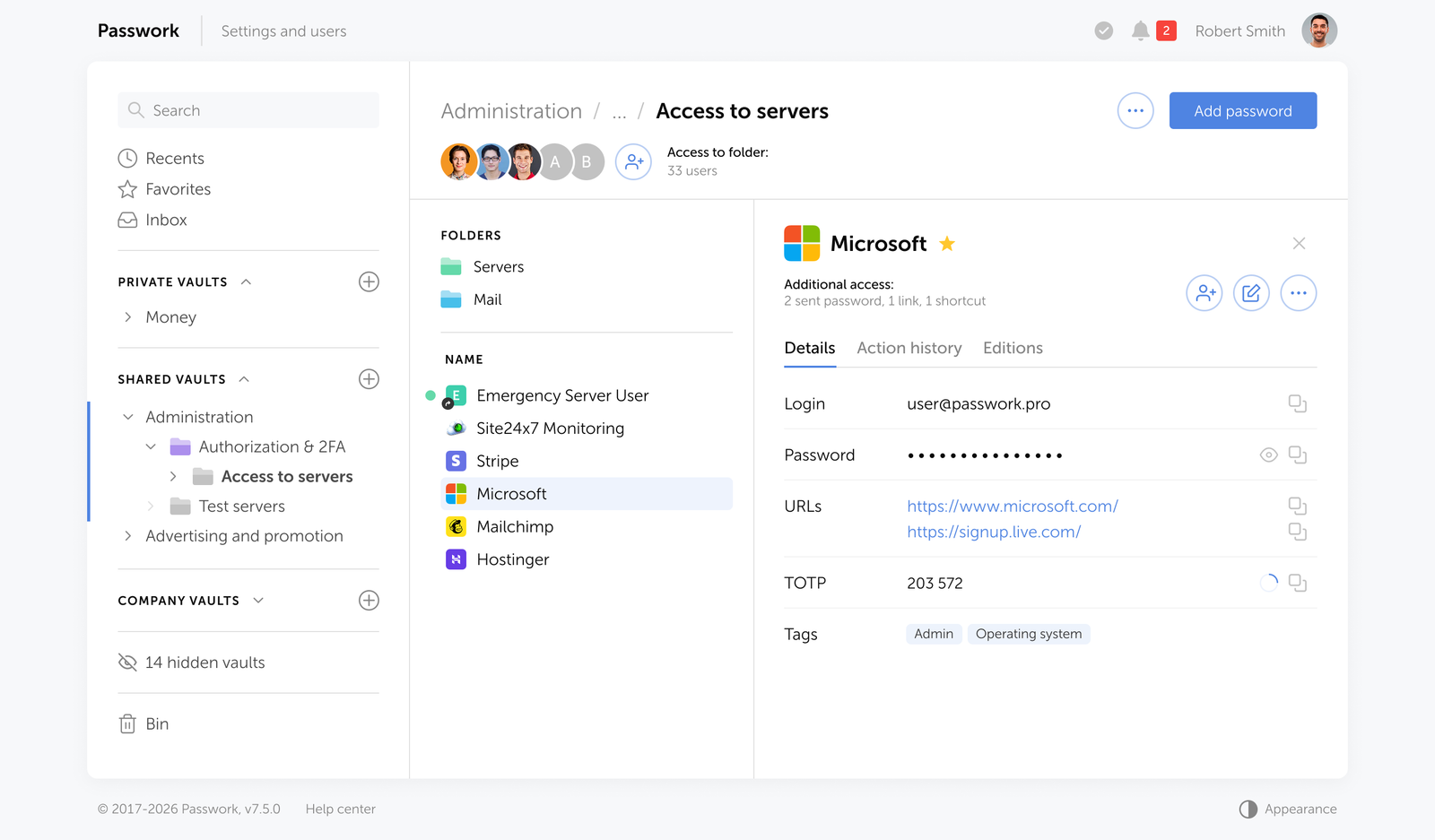
Passwork offers structured, role-based access control across all shared credentials. Admins assign permissions at the vault, folder, and individual password level. Every access event — view, copy, edit, share, deletion — is logged with a timestamp and user identity.

Access management and audit trails

This audit trail is directly relevant to NIS2 Article 21(2)(i), which requires organizations to implement "policies and procedures regarding the use of cryptography and, where appropriate, encryption" and to maintain access controls over sensitive systems. When a regulator asks for evidence of access governance, a complete, searchable log is the answer.

Continuous monitoring

NIS2 requires ongoing security monitoring. Passwork supports this through a real-time activity feed and configurable notifications for any credential event: a password viewed by an unexpected user, a shared vault accessed outside working hours, a privileged account modified without a change ticket.

NIS2 requires ongoing security monitoring.

The password security dashboard flags weak, reused, outdated, and potentially compromised credentials across the entire organization — giving security teams continuous visibility without manual auditing.

ISO 27001 certified and continuously tested

Passwork holds ISO/IEC 27001 certification — the same standard Belgium accepts as a NIS2 compliance pathway under its CyFun framework. The certification confirms a systematic, auditable approach to information security management

For organizations that need to demonstrate security posture to regulators, partners, or customers, Passwork's ISO 27001 certification provides independently verifiable evidence.

Self-hosted deployment

Passwork deploys entirely within your own infrastructure. All data is encrypted with AES-256 and never leaves your servers. There is no dependency on third-party cloud services — which matters both for NIS2 compliance and for the supply chain risk provisions that require organizations to assess the security of their service providers.

The source code is auditable. Your security team can verify there are no hidden vulnerabilities before deployment.

CTA Image

Passwork gives your team structured access control, a full audit log, and continuous credential monitoring — all within your own infrastructure. See how Passwork supports NIS2 compliance


Compliance calendar

The following table outlines the key compliance events, sorted chronologically. Uncertain or estimated dates are flagged accordingly.

Date Event
April 18, 2026 Belgium: NIS2 conformity assessment deadline for essential entities to demonstrate CyFun Basic/Important verification or ISO 27001 documentation.
May 6, 2026 Poland: Deadline for the Minister of Digital Affairs to automatically add existing key service operators to the official list of key and important entities (Wykaz KSC).
June 11, 2026 EU: Cyber Resilience Act (CRA) framework on notification of conformity assessment bodies starts to apply.
Mid 2026 (expected) Germany: BSI registration opens for newly qualifying critical entities under the KRITIS-Dachgesetz.
July 1, 2026 (expected) Netherlands: Cyberbeveiligingswet (NIS2 implementation) and Wet weerbaarheid kritieke entiteiten (CER implementation) expected to enter into force.
July 17, 2026 Germany: First registration deadline for critical entities under the KRITIS-Dachgesetz with the Federal Office of Civil Protection and Disaster Assistance (BBK).
July 17, 2026 Belgium: Important entities automatically considered as critical entities pursuant to the law on the resilience of critical entities.
July 2026 (expected) France: Expected parliamentary vote on the "Loi résilience des infrastructures critiques et renforcement de la cybersécurité" (ReCyF) for NIS2 and CER implementation.
August 2, 2026 EU: Main provisions of the Artificial Intelligence Act apply, including obligations for operators of high-risk AI systems and full enforcement powers for the AI Office.
August 18, 2026 EU: E-Evidence Regulation (EU 2023/1543) becomes applicable, enabling authorities to directly order service providers to produce or preserve electronic evidence within 10 days.

Conclusion

Conclusion

Belgium's April 18 deadline has passed. It will not be the last. Regulators across 27 member states are moving from guidance to audits, and the 16% readiness figure means the vast majority of in-scope organizations are exposed right now.

The pattern is consistent across every early enforcement action: the controls regulators examine first are access management, privileged credential governance, and audit trails. These are not the hardest requirements in NIS2 — they are the most concrete, the most documentable, and the most immediately actionable.

Getting access under control is the fastest way to close the most auditable compliance gaps. It satisfies Article 21 requirements directly, supports supply chain oversight, and generates the evidence trail that Article 20 board liability demands. A password manager with role-based access, a complete audit log, and continuous monitoring addresses all three.

Passwork is ISO/IEC 27001 certified and deploys entirely within your own infrastructure. It was designed for exactly the kind of access governance NIS2 auditors look for.

CTA Image

Passwork is a self-hosted password manager built for businesses. It enforces role-based access policies, maintains a complete audit log of all credential activity, and deploys entirely within your own infrastructure. Try Passwork in your infrastructure


Frequently Asked Questions

Frequently Asked Quistions

What is the NIS2 Directive and who does it apply to?

NIS2 (Directive EU 2022/2555) is the EU's legal framework for network and information security, replacing the original NIS Directive from 2016. It applies to medium and large organizations in 18 critical sectors — including energy, healthcare, finance, transport, digital infrastructure, and manufacturing — with at least 50 employees or €10 million in annual turnover or balance sheet total.

What are the main cybersecurity obligations under NIS2?

NIS2 Article 21 requires organizations to implement risk analysis, incident response, business continuity measures, supply chain security, access control policies, MFA, encryption, and vulnerability management. These measures must be formally approved by the management body under Article 20, with documented evidence of implementation available for regulatory inspection.

What fines can organizations face for NIS2 non-compliance?

Essential entities face fines of up to €10 million or 2% of global annual turnover, whichever is higher. Important entities face up to €7 million or 1.4% of global turnover. Several member states exceed these minimums — Germany allows fines up to €20 million for essential entities, plus individual manager fines of up to €500,000 for governance failures.

What does NIS2 require for access management and credential security?

Article 21(2)(i) requires policies covering access control, authentication, and the use of cryptography. In practice, this means role-based access to critical systems, enforced MFA, documented credential policies, and a complete audit trail of privileged access events. Shared passwords, unmanaged service accounts, and undocumented access paths are direct compliance failures under this article.

How does NIS2 address supply chain security?

Article 21(2)(d) requires organizations to assess and manage the cybersecurity posture of their direct suppliers and service providers. This includes mapping critical third-party dependencies, embedding security obligations in contracts, and monitoring supplier posture on an ongoing basis. Only around 1 in 10 businesses were adequately assessing their suppliers' security measures as recently as 2024, according to the UK NCSC.

What are the NIS2 incident reporting deadlines?

NIS2 mandates a three-stage process: a 24-hour early warning to the national authority after detecting a significant incident, a 72-hour detailed notification with an initial impact assessment, and a 30-day final report covering root cause analysis and remediation steps. These deadlines apply to both essential and important entities and require pre-tested, automated response workflows to meet reliably.

What personal liability do executives face under NIS2?

Article 20 makes management bodies directly accountable for approving cybersecurity risk-management measures, overseeing their implementation, and completing cybersecurity training. Executives can be held personally liable for governance failures. In Germany, individual managers face fines of up to €500,000 under national NIS2 implementation law, and directors can be temporarily banned from management roles for serious negligence.

Does ISO 27001 certification satisfy NIS2 requirements?

ISO 27001 certification is recognized as a compliance pathway in some member states — Belgium accepts it as evidence of NIS2 conformity, provided organizations submit the certification scope, Statement of Applicability, and the most recent internal audit report. However, certification alone does not constitute full NIS2 compliance in most jurisdictions. It significantly reduces the compliance gap and provides auditors with a recognized evidence baseline, but organizations must still demonstrate implementation of all Article 21 measures.

NIS2 latest news: May 2026 enforcement updates
Bulgaria’s full sanctions phase, Luxembourg’s new law, Netherlands’ Cyberbeveiligingswet, ENISA NIS360 2026 — NIS2 enforcement developments from May 2026.
Spring 2026 EU cybersecurity update: What changed
Spring 2026 brought the EU’s most significant institutional breach, its first cyber sanctions of the year, and four major cybersecurity regulations enforcing simultaneously. NIS2, DORA, CRA, and CSA2 now set hard deadlines — and real penalties. Here’s what changed, who’s affected, and what to do.
NIS2 compliance guide: The access management roadmap for 2026
Stolen credentials dominate breaches in 2026. NIS2 Article 21 mandates 10 security measures to eliminate credential-based attack vectors. This guide covers technical requirements, the 24-hour incident reporting obligation, ENISA’s MFA tiers, and a 5-phase roadmap to audit-ready compliance.

NIS2 latest news: What changed in 2026 and what it means for EU businesses

84% of in-scope organizations admit they're not ready. Belgium set the first conformity assessment deadline on April 18, 2026. The Netherlands is days away from enforcement. Here's where the regulatory wave stands and what IT leaders need to act on now.

Apr 3, 2026 — 14 min read
Spring 2026 EU cybersecurity update: What changed & how to prepare

Introduction

On March 24, 2026, attackers accessed the European Commission's AWS cloud accounts and exfiltrated over 350GB of data before being blocked.

The ShinyHunters extortion group claimed responsibility. The Commission confirmed the breach on March 30, making it the most significant EU institutional compromise of the year and a precise illustration of the threat environment in which four major EU cybersecurity regulations are now being enforced simultaneously.

Spring 2026 marks a convergence: the January 20 NIS2 amendments and CSA2 proposal, active DORA enforcement by national regulators, and the September 11 CRA reporting deadline approaching fast.

The EU also imposed its first cyber sanctions of the year on March 16, targeting Chinese and Iranian threat actors. These are not background events — they are the enforcement context every IT leader and compliance officer needs to understand now.


Key takeaways

  • European Commission data breach confirmed: On March 30, 2026, ShinyHunters stole over 350GB from its AWS cloud accounts, including databases, contracts, and mail server dumps.
  • First EU cyber sanctions of 2026: On March 16, the EU Council imposed restrictive measures against three entities — Integrity Technology Group, Anxun Information Technology (China), and Emennet Pasargad (Iran) — and two individuals.
  • NIS2 and CSA2 amendments proposed: On January 20, 2026, the European Commission introduced changes clarifying jurisdiction, scope, and certification obligations across both frameworks.
  • CRA reporting deadline approaching: Mandatory vulnerability and incident reporting obligations under the Cyber Resilience Act begin September 11, 2026.
  • DORA enforcement is active: Fully applicable since January 17, 2025, with BaFin and other national regulators conducting audits throughout 2026.

The threat context that made these changes necessary

The threat context that made these changes necessary

The Spring 2026 EU regulatory acceleration is a direct response to a documented surge in attacks on European institutions and critical infrastructure. The European Commission breach, the EU's first cyber sanctions of 2026, and the statistical picture from ENISA and independent incident responders all point in the same direction: the threat is real, targeted, and ongoing.

The European Commission breach (March 2026)

The March 24 attack on the Commission's AWS-hosted Europa.eu platform is the clearest recent example of cloud supply chain risk. ShinyHunters — the same extortion group behind multiple high-profile data theft campaigns — claimed to have taken over 350GB of data: mail server dumps, databases, confidential documents, and contracts.

A 90GB archive appeared on their dark web leak site. The Commission's internal systems were not affected, but the incident exposed a structural vulnerability: public-facing cloud infrastructure operated without the access controls and credential hygiene that NIS2 and DORA are designed to mandate.

"Early findings of our ongoing investigation suggest that data have been taken from those websites. The Commission's internal systems were not affected by the cyber-attack." — European Commission Press Release, March 27, 2026

This was the Commission's second breach in 2026. A February incident had already compromised the mobile device management platform used to manage staff devices. Two significant breaches in two months at a single institution is not a coincidence — it reflects a sustained targeting campaign.

EU cyber sanctions — March 16, 2026

On March 16, 2026, the EU Council imposed restrictive measures against three entities and two individuals under the EU's cyber diplomacy toolbox — the first EU cyber sanctions of the year.

The sanctioned parties:

  • Integrity Technology Group (China): Provided products used to compromise over 65,000 devices across six EU member states between 2022 and 2023.
  • Anxun Information Technology (China): Provided hacking services targeting EU critical infrastructure. Two co-founders were individually sanctioned.
  • Emennet Pasargad (Iran): Breached a French subscriber database, compromised advertising billboards during the 2024 Paris Olympics to spread disinformation, and compromised a Swedish SMS service.

All listed entities face asset freezes. The two individuals also face travel bans. The EU cyber sanctions regime now covers 19 individuals and 7 entities.

The statistical backdrop

According to the ENISA Threat Landscape 2025 report, DDoS attacks accounted for 77% of all recorded EU cyber incidents, driven primarily by hacktivist groups. Ransomware remains the most operationally damaging threat: 81.1% of cybercrime incidents targeting EU organizations involved ransomware.

Public administration was the most targeted sector, representing 38% of all incidents. State-aligned groups intensified long-term espionage campaigns against telecommunications, logistics, and manufacturing.

The picture from incident responders on the ground is equally direct. Eye Security's 2026 incident report — based on 630 investigations across Benelux and Germany — found that 70% of all cases were Business Email Compromise (BEC). More telling: 62% of classified cases since January 2025 involved MFA bypass. Attackers are not breaking encryption — they are stealing or bypassing credentials. That is the vector NIS2, DORA, and GDPR enforcement are all designed to close.

CTA Image

The European Commission breach followed a well-documented pattern: compromised cloud credentials, no audit trail, no access boundaries. Passwork gives IT teams a structured vault with role-based access, granular permissions, and a full activity log — the controls NIS2 and DORA explicitly require. Try Passwork free

NIS2 amendments: What changed on January 20, 2026

On January 20, 2026, the European Commission proposed amendments to NIS2 focused on legal certainty, streamlined compliance, and clarified jurisdictional rules. The proposal also introduced a revised Cybersecurity Act (CSA2) that expands ENISA's mandate and moves toward mandatory cybersecurity certification for products and services used in critical sectors.

The three practical changes in NIS2

The amendments address three pain points that emerged during the first year of implementation across member states:

  1. Jurisdictional clarity. The amendments specify which member state holds supervisory authority over cross-border entities — a major source of compliance uncertainty for multinational organizations operating in multiple EU jurisdictions simultaneously.
  2. Ransomware data collection. The proposal standardizes the collection of ransomware-related incident data across member states, enabling more consistent threat intelligence sharing at the EU level.
  3. Scope refinement. A new "small mid-cap" category adjusts the thresholds determining whether organizations fall under NIS2's essential or important entity classification.

CSA2: The more significant structural shift

The CSA2 revision expands both the material and subjective scope of the EU cybersecurity framework. The critical change: certification for ICT products and services used in critical sectors moves from voluntary to mandatory. Organizations that have relied on the current voluntary ENISA certification schemes will need to reassess their product portfolios and supplier contracts once CSA2 is adopted — expected late 2026 or 2027.

Germany: NIS2 implementation is already in force

Germany's NIS2 implementation law (NIS2UmsuCG) entered into force on December 6, 2025. The BSI registration deadline was March 6, 2026. Approximately 30,000 companies in Germany fall under NIS2. A survey by nis2-check.de found that 80% of affected companies were unaware of their obligations (ADVISORI, February 2026). The law introduces personal liability for management under §38 NIS2UmsuCG — a first in German cybersecurity law.

NIS2 incident reporting requirements

Report type Deadline Content
Initial notification Within 24 hours Indication of incident; whether it may be cross-border
Intermediate report Within 72 hours Updated assessment; initial severity and impact
Final report Within 1 month Full description, root cause, measures taken

DORA: Enforcement begins in 2026

DORA (Regulation EU 2022/2554) has been directly applicable since January 17, 2025. There is no national implementation law required and no postponement possible. In 2026, national regulators including Germany's BaFin are conducting active audits of financial institutions and their ICT third-party providers.

Who DORA covers

DORA applies to the entire financial sector: credit institutions, insurance companies, investment firms, payment service providers, crypto-asset service providers, and — critically — the ICT third-party providers supplying critical services to these entities.

A cloud provider hosting core banking systems falls under DORA as an ICT third-party provider, as does the bank itself. The regulation's reach extends well beyond traditional financial services.

The five compliance pillars

DORA organizes its requirements around five areas: ICT risk management, incident reporting, digital operational resilience testing, third-party risk management, and information sharing.

The most demanding requirement is Threat-Led Penetration Testing (TLPT) — mandatory for systemically important institutions. TLPT requires specialized red teams to simulate real attack scenarios based on current threat intelligence, not generic penetration testing methodologies.

Compliance gaps remain significant

Despite DORA being in force for over a year, readiness across the sector is incomplete. A Veeam survey found that 96% of EMEA financial organizations believe they need to improve their resilience to meet DORA requirements.

A Computerwoche survey found that 44% of affected companies report significant implementation problems. Specific gaps: 24% have not identified a DORA implementation lead, and 23% have not conducted digital operational resilience testing.

These numbers mean BaFin auditors are walking into organizations that have not completed basic readiness steps — with enforcement consequences that include license revocation, not just fines.

Cyber Resilience Act: The September 2026 deadline

The Cyber Resilience Act entered into force on December 10, 2024. From September 11, 2026, manufacturers and importers of digital products must report actively exploited vulnerabilities and severe incidents to ENISA within 24 hours. Full CRA requirements — including security-by-design obligations — apply from December 11, 2027.

What the September 2026 milestone covers

Two specific obligations activate on September 11:

  • Vulnerability reporting: Manufacturers must report actively exploited vulnerabilities to ENISA within 24 hours of becoming aware of them.
  • Incident reporting: Severe incidents with an impact on the security of digital products must also be reported to ENISA within 24 hours.

The full CRA requirements — security by design, software bill of materials (SBOM), ongoing vulnerability management, and CE marking for digital products — apply from December 2027. Organizations that have not started preparation by mid-2026 will struggle to meet that deadline. The maximum CRA fine is €15 million or 2.5% of global annual turnover, whichever is higher.

NIS2 vs. DORA vs. CRA vs. CSA2: Which regulation applies to you?

NIS2 vs. DORA vs. CRA vs. CSA2: Which regulation applies to you?

The lex specialis principle means that sector-specific regulations take precedence over general ones. Financial entities subject to DORA are exempt from certain NIS2 obligations where DORA provides equivalent or stricter requirements. All four regulations can overlap for large organizations operating across sectors — a cloud provider serving financial institutions while also manufacturing IoT hardware may face obligations under all four simultaneously.

Regulation comparison

Regulation Who is in scope Core duty Next critical deadline Max fine
NIS2 (amended Jan 2026) ~160,000 entities across the EU in 18 sectors; essential and important entities Cybersecurity risk management, incident reporting, registration Q1 2026 (transposition deadlines vary by member state) €10M or 2% of global revenue
DORA (in force Jan 2025) Financial sector + ICT third-party providers ICT risk management, TLPT, third-party oversight Q1–Q2 2026 (BaFin audits) Sector-specific, incl. license revocation
CRA (in force Dec 2024) Manufacturers and importers of digital products with digital elements Security by design, SBOM, vulnerability management September 11, 2026 (reporting obligations) €15M or 2.5% of global revenue
CSA2 (proposed Jan 2026) Manufacturers/providers in critical sectors; expands ENISA mandate Mandatory cybersecurity certification Expected adoption: late 2026 or 2027 TBD

Decision matrix: Does this regulation apply to you?

Question If YES If NO
Does your organization operate in one of NIS2's 18 sectors with 50+ employees and €10M+ revenue? NIS2 applies Check CSA2 if you manufacture digital products
Is your organization a financial institution, insurance company, or ICT provider to the financial sector? DORA applies (NIS2 may apply with lex specialis carve-outs)
Does your organization manufacture or import digital products with digital elements (software, hardware, IoT)? CRA applies
Does your organization provide ICT products/services to critical sectors and seek EU market access? CSA2 certification will apply
CTA Image

DORA requires documented access controls and audit trails for all privileged ICT accounts. Passwork's secure credential sharing and activity logging give compliance teams the evidence trail auditors ask for.

Practical compliance checklist for Spring/Summer 2026

With 62% of EU cyber incidents in 2025 involving MFA bypass and 70% classified as Business Email Compromise, the most immediate technical measures are identity-focused: enforce MFA everywhere, audit privileged access, and assess third-party credential exposure. Regulatory compliance and operational security point to the same controls.

Immediate actions (April – June 2026)

  1. Complete BSI registration (Germany) if not yet done. Contact BSI immediately and document the attempt — even if the March 6 deadline has passed, the record of good-faith effort matters in enforcement proceedings.
  2. Conduct a NIS2 impact analysis. Determine whether your organization and its subsidiaries, joint ventures, and critical suppliers fall under NIS2's essential or important entity classification.
  3. Establish a 24/72-hour incident reporting process. Assign clear ownership, create notification templates, and test the escalation path end-to-end before an incident forces you to use it.
  4. Enforce MFA across all remote access and privileged accounts. Given that 62% of classified EU incidents involved MFA bypass (Eye Security, 2026), this is the single highest-ROI control available.
  5. Audit third-party ICT providers. DORA requires contractual security obligations for all critical ICT suppliers. NIS2 requires supply chain security assessments. Both regulations demand documented evidence of third-party oversight.
  6. Implement a secure credential management policy. Centralize password management for privileged accounts to prevent the credential theft vector used in the ShinyHunters breach. Unmanaged shared credentials remain the most common entry point in BEC and cloud account compromise cases.

Mid-term actions (July – September 2026)

  1. Prepare for CRA reporting obligations (effective September 11, 2026). Establish a vulnerability disclosure process, designate a contact point for ENISA reporting, and confirm that your product inventory accurately reflects which items qualify as "digital products with digital elements."
  2. Conduct a DORA resilience test. At minimum, run a tabletop exercise. Systemically important institutions must plan for full TLPT with a qualified red team operating against current threat intelligence.
  3. Begin CSA2 certification assessment. Identify which products or services will require mandatory EU cybersecurity certification under CSA2 and engage a notified body early — certification timelines are long.
  4. Review GDPR compliance. The French Conseil d'État upheld a €40 million GDPR fine against Criteo on March 4, 2026. Total GDPR fines since 2018 now exceed €7.1 billion, with €1.2 billion issued in 2025 alone (Kiteworks, March 2026). Data protection enforcement is at peak intensity — treat it as a parallel track, not a separate program.

Conclusion

Conclusion

The threat and regulatory context are converging. The Spring 2026 EU cybersecurity environment is defined by simultaneous tightening of regulation and escalation of attacks. The European Commission breach and the EU's first cyber sanctions of the year are not isolated events — they are the enforcement context for NIS2, DORA, CRA, and CSA2.

Identity security is the immediate priority. Credential theft via cloud account compromise is precisely what NIS2's "appropriate technical measures" requirement is designed to prevent. With 62% of EU incidents in 2025 involving MFA bypass, enforcing MFA, auditing privileged access, and centralizing credential management are foundational controls — ones that simultaneously reduce breach risk and satisfy requirements across NIS2, DORA, and GDPR.

The deadlines are fixed. The September 11, 2026 CRA reporting deadline is six months away. DORA audits are underway. NIS2 registration in Germany closed on March 6. Organizations that treat compliance as a documentation exercise rather than a security improvement program face both regulatory penalties and operational exposure.

The common assumption across all four frameworks: organizations maintain documented, auditable control over who accesses what credentials, when, and why. That is the starting point for any serious compliance program — and the baseline regulators will test against.

CTA Image

Passwork is a self-hosted corporate password manager with role-based access control, detailed activity logs, and zero-knowledge encryption — deployed entirely within your own infrastructure. It addresses the credential management controls required under NIS2, DORA, and GDPR in a single, auditable system. Try Passwork free in your infrastructure

FAQ: EU cybersecurity regulations in Spring 2026

FAQ: EU cybersecurity regulations in Spring 2026

What changed in EU cybersecurity law in Spring 2026?

The European Commission proposed amendments to NIS2 and a new Cybersecurity Act (CSA2) on January 20, 2026. The CRA's reporting obligations begin September 11, 2026. DORA has been in active enforcement since January 2025. The EU also imposed its first cyber sanctions of 2026 on March 16, targeting Chinese and Iranian threat actors.

What is the difference between NIS2 and DORA?

NIS2 is a broad directive covering 18 sectors and focusing on cybersecurity risk management and incident reporting. DORA is a regulation specific to the financial sector, with deeper requirements for ICT risk management, resilience testing, and third-party oversight. The lex specialis principle means DORA takes precedence for financial entities where its requirements are stricter than NIS2's equivalent obligations.

What are the penalties for NIS2 non-compliance in 2026?

Essential entities face fines of up to €10 million or 2% of global annual turnover, whichever is higher. Important entities face fines of up to €7 million or 1.4% of global revenue. Germany's NIS2 implementation law (§38 NIS2UmsuCG) also introduces personal liability for management — a first in German cybersecurity law.

When does the Cyber Resilience Act take effect?

The CRA entered into force on December 10, 2024. Mandatory vulnerability and incident reporting obligations begin September 11, 2026. Full security-by-design requirements and CE marking obligations apply from December 11, 2027. Organizations that delay preparation until late 2026 will face a compressed timeline for the 2027 deadline.

Who was sanctioned under EU cyber sanctions in March 2026?

On March 16, 2026, the EU Council sanctioned Integrity Technology Group and Anxun Information Technology (both China-based) and Emennet Pasargad (Iran-based), along with two Chinese individuals. Sanctions include asset freezes; the two individuals also face travel bans. The EU cyber sanctions regime now covers 19 individuals and 7 entities total.

What is the EU Cybersecurity Act 2 (CSA2)?

CSA2 is the proposed revision to the EU Cybersecurity Act, announced January 20, 2026. It expands ENISA's mandate and introduces mandatory cybersecurity certification for ICT products and services used in critical sectors — replacing the current voluntary certification framework for those categories. Expected adoption: late 2026 or 2027.

Does NIS2 or DORA apply to cloud providers?

A cloud provider supplying critical services to financial institutions falls under DORA as an ICT third-party provider. If the same provider also operates in one of NIS2's 18 sectors with the relevant size thresholds, NIS2 applies independently. The two regulations can — and frequently do — apply simultaneously to the same organization.

What happened in the European Commission data breach of 2026?

On March 24, 2026, attackers accessed the European Commission's AWS cloud accounts hosting the Europa.eu platform. The ShinyHunters extortion group claimed responsibility and alleged theft of over 350GB of data, including databases, contracts, and confidential documents. The Commission confirmed the breach on March 30, 2026.

NIS2 password requirements: What European companies must do in 2026
Credential gaps are the leading NIS2 audit failure point in 2026. This guide covers Article 21 password requirements, NIST SP 800-63B alignment, AD hardening steps, and the audit evidence regulators ask for first.
Password Manager Deployment Models: Cloud, Self-Hosted & Hybrid
Choosing where to run your password manager matters as much as choosing which one. This guide breaks down cloud, self-hosted, and hybrid deployment — with a compliance matrix for GDPR, HIPAA, and NIS2, and a clear look at the trade-offs each model carries.
What is a passkey? Guide to passwordless authentication
A passkey is a phishing-resistant credential stored on your device. Sign in with a biometric tap — no password to remember or steal. This guide covers the technical mechanics, platform setup, real-world performance data, and what the transition means for enterprise teams.

Spring 2026 EU cybersecurity update: What changed & how to prepare

Spring 2026 brought the EU's most significant institutional breach, its first cyber sanctions of the year, and four major cybersecurity regulations enforcing simultaneously. NIS2, DORA, CRA, and CSA2 now set hard deadlines — and real penalties. Here's what changed, who's affected, and what to do.