Back

Cybersecurity

Latest — Jul 7, 2025
Common myths about password managers

Introduction

Would you trust a single key to open every door in your life? Probably not. And yet, when it comes to online security, countless people unwittingly take similar risks by using weak or easy-to-guess passwords — or by using the same password over and over again. Enter password managers — software designed to protect your digital life. But despite their growing popularity, myths about password managers persist, often deterring people from adopting them.

In this article, we’ll unravel common myths about password managers, explain how they work, and why indeed you can’t afford not to use them in order to up your cybersecurity. Let’s separate fact from fiction and give you the necessary tools to make smart choices to be safe online.

What is a password manager?

A password manager is like a digital vault that stores, generates, and manages your passwords securely. Instead of remembering dozens of complex passwords, you only need to remember one. These software products encrypt your credentials, ensuring that even if someone gains access to your device, they can’t decrypt your data without the master key.

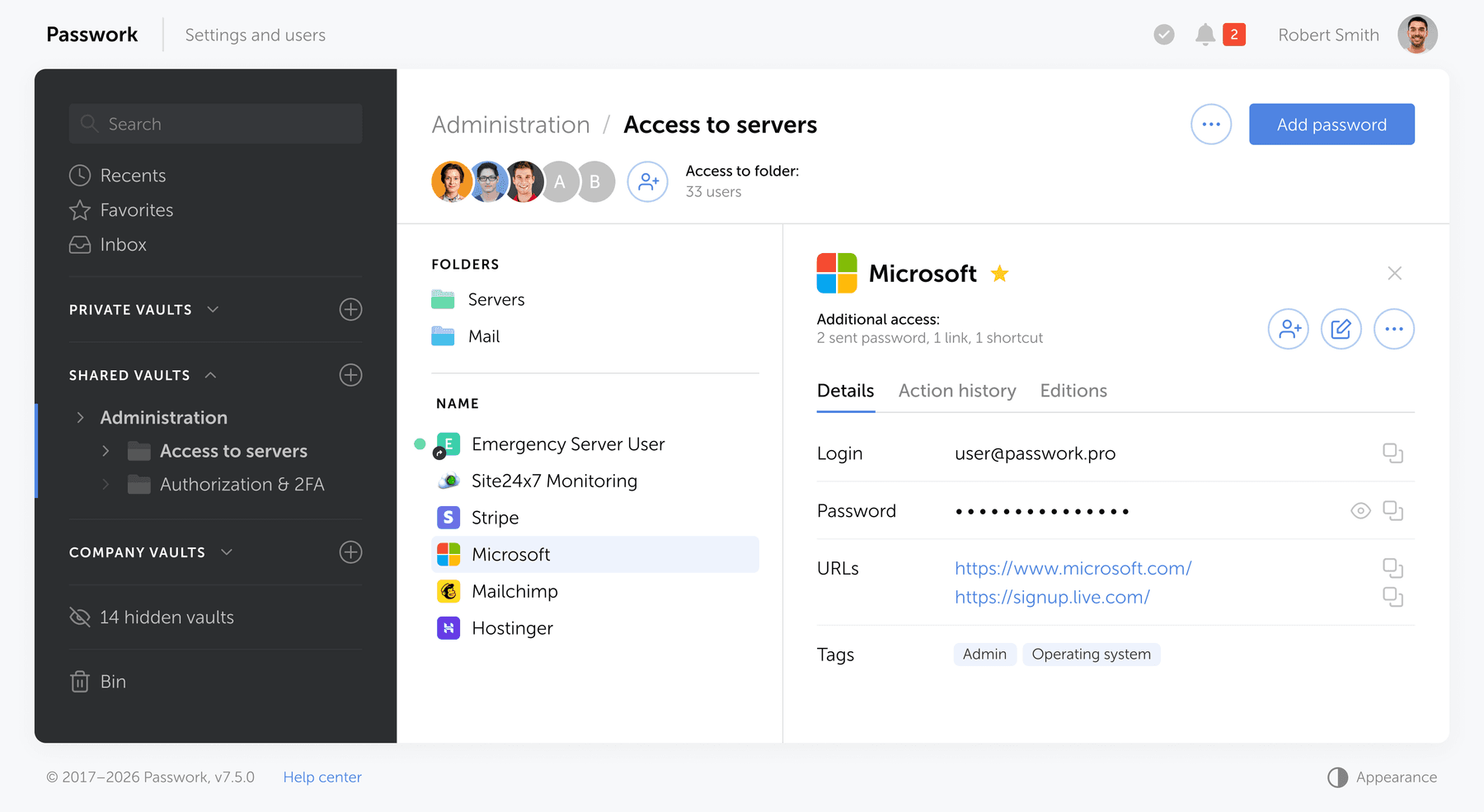
Modern password managers, like Passwork, are not limited just by storing passwords. They offer features like password sharing, secure notes, and compatibility with multi-factor authentication (MFA). Think of it as your personal cybersecurity assistant, making it easy for you to stay safe without sacrificing your online experience.

Myth 1: Password managers aren’t safe or secure

This is one of the oldest password myths out there. Many believe that storing all your sensitive information in one place is just asking for trouble, but the reality is quite the opposite. Reputable password managers use end-to-end encryption to protect your data, so even if their servers are compromised, your passwords remain unreadable without your master password. And since most password managers don’t store your master password, even the provider can’t access your information.

No security system is 100% foolproof, but dismissing password managers for this reason is like refusing to lock your door because a burglar might pick the lock. In fact, password managers greatly reduce your risk by helping you create and store strong, unique passwords for every account. Consider this: a Verizon study found that 81% of data breaches are caused by weak or reused passwords. Using a password manager is like having a bank vault for your credentials—far safer than sticky notes, spreadsheets, or browser storage. It’s a crucial layer in your cybersecurity strategy.

Real-world perspective: A study by Verizon found that 81% of data breaches are caused by weak or reused passwords. Using a password manager minimizes this risk, making it a crucial layer in your cybersecurity strategy.

Myth 2: Putting all my passwords in one place makes them easy to hack

This myth stems from the fear of a "single point of failure." However, password managers are designed to be resilient. They use zero-knowledge architecture, meaning your data is encrypted locally before it’s stored. Even if the manager’s servers are compromised, your information remains secure.

And — depending on the app or service in question — features such as biometric authentication and MFA add another layer of defense, one that can't be pierced without you there to open it.

Myth 3: Remembering all my passwords is safer than trusting technology to do it for me

Let’s face it: How many of us can be bothered to remember a unique, 16-character password for every account? The human brain simply isn’t wired for this task. This is why people frequently depend on risky practices like weak passwords or using the same password for multiple accounts.

Analogy: Would you memorize every phone number in your phone book? No, you keep them in your phone. Password managers serve the same purpose, but for your digital credentials.

Myth 4: It’s a hassle to get a password manager up and running

Some people are fed up with password managers because they think the setup process is too technical. The reality? The majority of password managers are built as user-friendly as possible.

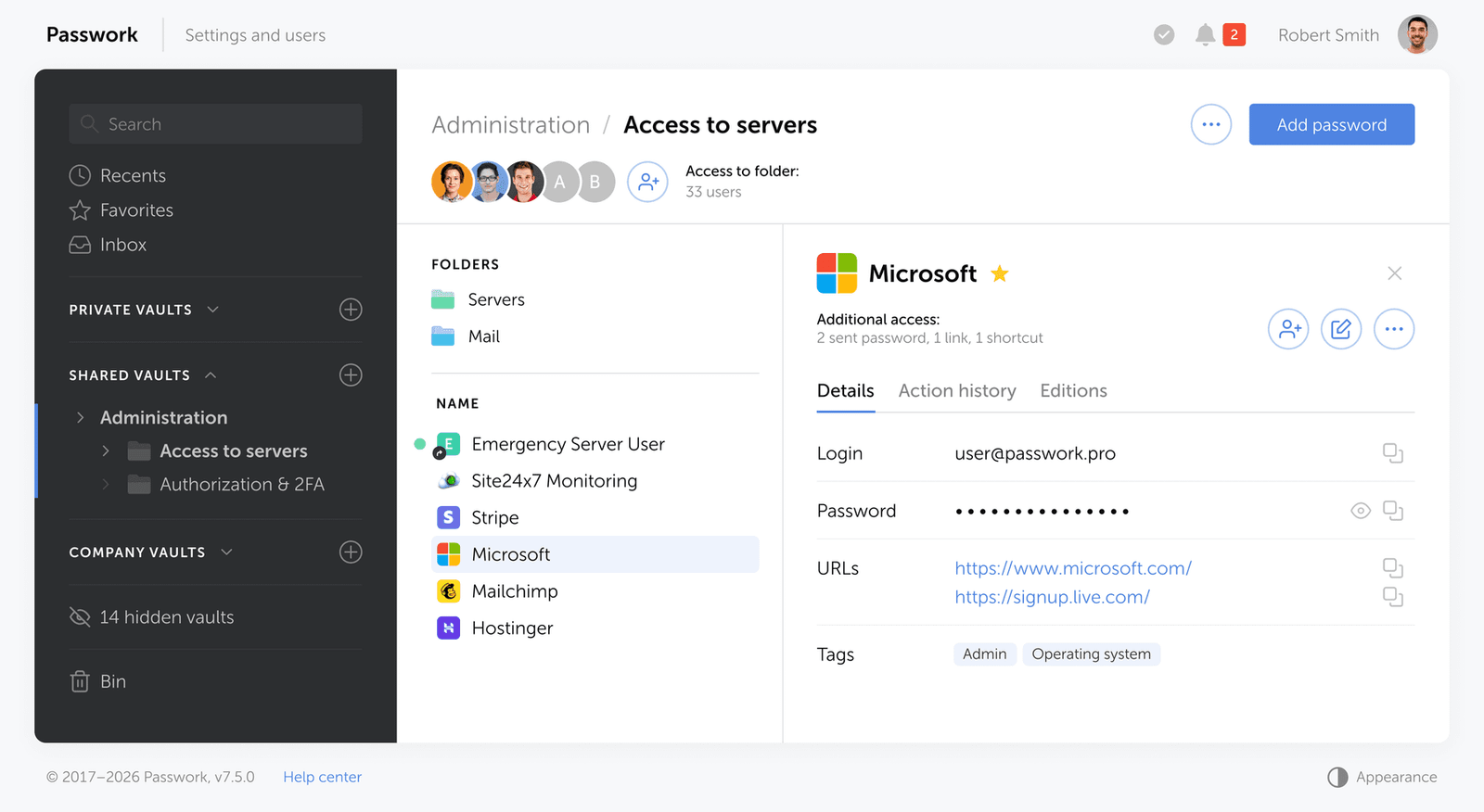
For instance, Passwork provides clear user interfaces and easy step-by-step instruction, with which absolute lay persons can't do anything wrong. Their API connector also specialise in browser extensions and mobile apps for ease of use.

Pro tip: Start small by importing passwords from your browser or manually add just a few important accounts. Once you realize how much time and strain it saves, you might even regret that you didn’t make the switch sooner.

Myth 5: Your passwords will be compromised if your computer is stolen

This is a myth, and it neglects several strong security features in modern password managers. Even if someone physically stole your device, they’d still need your master password or biometric data to access your vault.

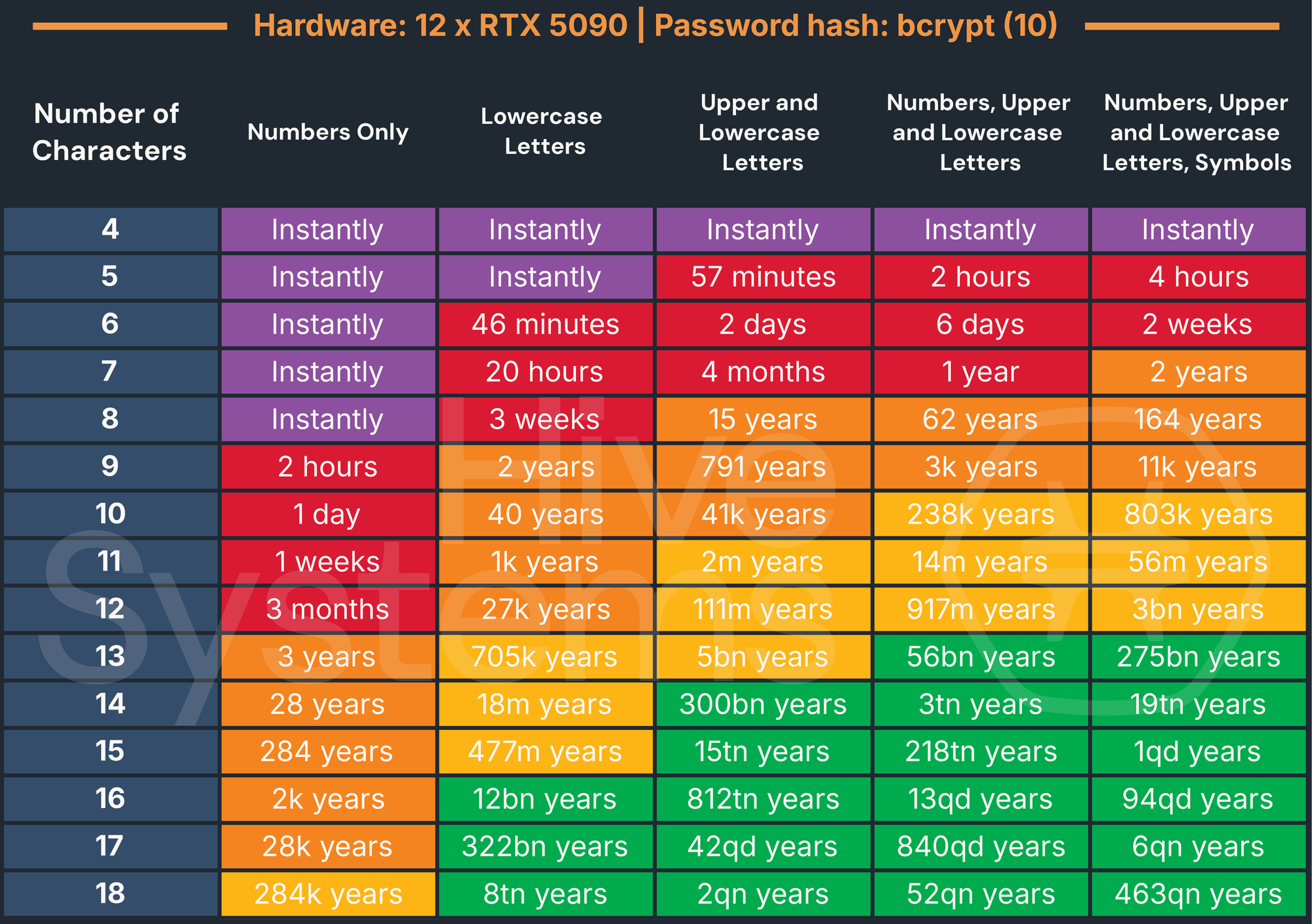
Myth 6: Password length doesn’t matter as long as it’s complex

Complexity is important, but so does length, and maybe even more so. It becomes exponentially more difficult to crack a longer password, even with the most sophisticated software.

Example: A 12-character password consisting of random words (e.g., "PurpleElephantSky") is far more secure than a shorter, complex one will ever be ("P@ssw0rd").

Myth 7: Two-factor authentication (2FA) makes passwords irrelevant

While 2FA is an excellent security measure, it’s not a replacement for strong passwords. Instead, consider it an added layer of protection. A weak or reused password is enough to get you hacked even with the added layer of 2FA protection.

Myth 8: You can reuse passwords for low-importance accounts

Even "low-importance" accounts can be exploited in credential stuffing attacks, where stolen passwords are used to break into other accounts. It also requires you to reset a lot of other passwords and, if you’ve reused a lot of passwords (which is a bad idea), might put a significant portion of your digital life at risk

This is where a password manager comes in — creating unique passwords for each and every account without determining a tier of "importance".

How Passwork improves online security

Passwork takes password management to the next level by combining robust security features with user-friendly design. Here’s how it stands out:

  • Team sharing: Share passwords with your team securely keeping everything private.
  • Customizable policies: Set password strength requirements and expiration dates to enforce best practices.
  • End-to-end encryption: Your data is encrypted locally, ensuring that only you can access it.
  • Seamless integration: Use browser extensions and mobile apps to access your credentials anytime, anywhere.

With Passwork, managing your passwords becomes effortless, freeing you to focus on what truly matters.

FAQs

  1. Are password managers safe to use?
    Yes, password managers encrypt everything, so, much safer than say browser storage.
  2. Is it possible for hackers to get into my password manager?
    Not without your master password or biometric authentication. Features like zero-knowledge architecture further enhance security.
  3. What happens if I forget my master password?
    With most password managers, you can set up recovery options, but you must safeguard your master password.
  4. I use 2FA, do I still need a password manager?
    Yes, 2FA complements strong passwords but doesn’t replace them. A password manager ensures your passwords are both strong and unique.
  5. Are password managers difficult to set up?
    Not at all! Most tools, including Passwork, are designed for ease of use and come with setup guides.
  6. Can I share passwords securely with a team?
    Yes, tools like Passwork offer features for secure password sharing within teams.

Conclusion

Password managers are no longer a luxury: they are a must-have in today’s pretty much entirely digital world. By debunking these myths, we hope to encourage more users to embrace password managers.

Still hesitant? The risks of weak or reused passwords far outweigh the few minutes it takes to set up a password manager. Be in charge of your online security today — your future self will thank you.

Ready to take the first step? Try Passwork with a free demo and explore practical ways to protect your business.

Further reading

How to protect your online business from cyberattacks
Protect your online business from cyber threats with actionable strategies, from employee education to advanced tools like Passwork. Learn about phishing, ransomware, and more while discovering how to enhance security with simple yet effective measures. Stay protected — read the full article!
Recommendations for the safe integration of AI systems
AI technologies are changing industries fast and most companies are already using or will use AI in the next few years. While AI brings many benefits — increased efficiency, customer satisfaction and revenue growth — its also introduces unique risks that need to be addressed proactively. From reputation damage to compliance violations
The art of deception: The threats hidden behind innocent notifications and how to prevent them
The art of deception: the threats hidden behind innocent notifications and how to prevent them

Common myths about password managers

Worried that password managers are risky or hard to use? It’s time to rethink. In this article, we debunk common myths about password managers, break down how they actually work, and show why solutions like Passwork are vital for your cybersecurity. Learn how these tools keep your data protected.

Jun 30, 2025 — 8 min read
How to protect your online business from cyberattacks

Introduction

Imagine waking up one morning to find your business crippled by a cyber attack — your customer data stolen, your systems locked, and your reputation hanging by a thread. It’s a nightmare scenario, but one faced by countless businesses every year. Cybersecurity is no longer optional; it’s a necessity. Whether you're running a small business or managing a large enterprise, understanding how to prevent cyber attacks is critical to staying ahead of increasingly sophisticated threats.

In this article, we’ll dive into practical strategies for protecting your business from cyber attacks, ranging from securing networks to educating employees. We’ll also explore how tools like Passwork password manager can play a pivotal role in fortifying your defenses. Ready to safeguard your business? Let’s get started.

What is a cyberattack?

A cyberattack is an intentional attempt by hackers or malicious actors to compromise the security of a system or network. These attacks come in various forms, including phishing, ransomware, denial-of-service (DoS), and malware. For businesses, the stakes are high — financial loss, data breaches, and damaged reputations are just the tip of the iceberg.

Common types of cyber attacks on businesses


Phishing

Phishing involves fraudulent emails or messages designed to trick employees into revealing sensitive information, such as login credentials or financial data.

Reports: Phishing remains one of the most prevalent and damaging forms of cyberattacks. In Q4 2024 alone, 989,123 phishing attacks were detected globally (APWG).

Example: In 2023, attackers impersonated Microsoft in a phishing campaign targeting over 120,000 employees across industries. The emails mimicked legitimate notifications, resulting in compromised credentials for several corporate accounts.

Ransomware

Ransomware attacks involve hackers encrypting your systems and demanding payment for decryption keys.

Reports: In 2024, 59% of organizations were hit by ransomware attacks, with 70% of these attacks resulting in data encryption. The average ransom demand increased to $2.73 million, a sharp rise from $1.85 million in 2023 (Varonis Ransomware Statistics).

Example: In 2024, the Colonial Pipeline ransomware attack crippled fuel supply across the eastern U.S. The company paid a $4.4 million ransom to regain access to its systems, highlighting the severe operational and financial impacts of such attacks.

DDoS (Distributed Denial of Service)

DDoS attacks aim to disrupt operations by overwhelming servers with traffic.

Reports: In 2023, the largest recorded DDoS attack peaked at 71 million requests per second, targeting Google Cloud.

Example: In 2024, the GitHub DDoS attack brought down the platform for hours, affecting millions of developers globally. The attack exploited botnets to flood GitHub’s servers with malicious traffic.

Credential stuffing

Attackers use stolen login credentials from one breach to gain access to other systems due to password reuse. Attackers use stolen credentials from one breach to gain access to other systems.

Reports: With 65% of users reusing passwords, credential stuffing remains a critical threat.

Example: In 2023, attackers used credential stuffing to breach Zoom accounts, exposing private meetings and sensitive data. The attack leveraged credentials leaked in earlier breaches of unrelated platforms.

Malware

Malware refers to malicious software, such as viruses, worms, or spyware, that infiltrates systems to steal data or cause damage.

Reports: Malware-related email threats accounted for 39.6% of all email attacks in 2024, and the global financial impact of malware exceeded $20 billion annually (NU Cybersecurity Report).

Example: The Emotet malware campaign in 2023 targeted financial institutions worldwide, stealing banking credentials and causing widespread disruptions.

Social engineering

Social engineering manipulates individuals into revealing confidential information or granting access to secure systems.

Reports: In 2024, 68% of breaches involved the human element, often through social engineering tactics like pretexting, baiting, and tailgating (Verizon DBIR).

Example: In 2023, an attacker posing as a senior executive tricked an employee at Toyota Boshoku Corporation into transferring $37 million to a fraudulent account.

Supply chain attacks

Supply chain attacks exploit vulnerabilities in third-party vendors or suppliers to infiltrate larger organizations.

Reports: In 2023, 62% of system intrusions were traced back to supply chain vulnerabilities (IBM X-Force).

Example: The SolarWinds attack remains one of the most damaging supply chain incidents. Hackers compromised the Orion software update, affecting thousands of organizations, including government agencies and Fortune 500 companies.

Data breaches

Data breaches involve unauthorized access to sensitive customer or company information.

Reports: In 2024, the average cost of a data breach reached $4.45 million, a 15% increase over three years (IBM Cost of a Data Breach Report 2024). These breaches often result from weak passwords, phishing, or insider threats.

Example: In 2023, the T-Mobile data breach exposed the personal information of 37 million customers, including names, addresses, and phone numbers, leading to significant reputational damage and regulatory scrutiny.

Understanding these threats is the first step toward prevention.

How to protect your online business from cyber attacks

Protecting your business from cyber threats requires a multi-layered approach. Below are actionable strategies to fortify your defenses.

Secure your networks and databases

Your network is the backbone of your business operations, making it a prime target for attackers. Implement these measures to secure it:

Install firewalls
Firewalls act as a barrier between your internal network and external threats.

Use VPNs
Encrypt data transfers with Virtual Private Networks to prevent interception.

Segment networks
Divide your network into smaller sections to contain breaches.

Recommendation: Reduce the risk of data breaches by segmenting your network. Isolate sensitive customer data from general operations to limit unauthorized access and minimize potential exposure in case of a breach.

Educate your employees

Your employees are your first line of defense — and often the weakest link. Training them on cybersecurity best practices can significantly reduce risks.

Conduct regular workshops
Teach employees how to recognize phishing emails and suspicious links.

Simulate cyber attacks
Run mock scenarios to test their response and improve preparedness.

Create a reporting system
Encourage employees to report potential threats immediately.

Recommendation: Since 95% of cybersecurity breaches are caused by human error, prioritize educating your team. Implement regular cybersecurity training to raise awareness and equip employees with the knowledge to identify and prevent potential threats.

Ensure proper password management

Weak passwords are an open invitation for hackers. Proper password management is essential to protecting your systems.

Use strong passwords
Encourage the use of complex passwords with a mix of letters, numbers, and symbols.

Adopt a password manager
Implement a secure solution like Passwork to simplify password management, encourage unique passwords for each account, and reduce the risk of breaches.

Change passwords regularly
Implement policies for periodic password updates.

Recommendation: Use a secure password manager to generate and store complex, unique passwords for all accounts, enforce regular password updates, and eliminate the risks associated with weak or reused credentials.

Carefully manage access and identity

Controlling who has access to sensitive data is crucial. Follow these steps:

Role-based access control (RBAC)
Assign access based on job roles.

Monitor access logs
Regularly review who accessed what and when.

Deactivate unused accounts
Immediately revoke access for former employees.

Set up multi-factor authentication (MFA)

Passwords alone aren’t enough. MFA adds an extra layer of security by requiring multiple forms of verification.

SMS or email codes
Require a code sent to the user’s phone or email.

Biometric authentication
Use fingerprint or facial recognition for secure access.

App-based authentication
Tools like Passwork 2Fa and Google Authenticator offer reliable MFA solutions.

Encrypt your data

Encryption ensures that even if data is intercepted, it remains unreadable to unauthorized users.

Encrypt files
Use advanced encryption algorithms for sensitive documents.

Secure communication channels
Encrypt emails and messaging platforms.

Adopt end-to-end encryption
Particularly important for customer-facing applications.

Create backups

Backups are your safety net in the event of a ransomware attack or accidental data loss.

Automate backups
Use cloud services to schedule regular backups.

Keep multiple copies
Store backups both online and offline.

Test recovery
Periodically test your ability to restore data from backups.

Ensure your software is kept up-to-date

Outdated software is a goldmine for hackers. Regular updates close known vulnerabilities.

Enable automatic updates
Ensure your systems update without manual intervention.

Patch management
Use tools to monitor and apply security patches.

Audit software
Regularly review third-party applications for potential risks.

Create security policies and practices

Formal policies provide a clear framework for cybersecurity.

Draft a cybersecurity policy
Include guidelines for data handling, password use, and incident response.

Conduct regular audits
Review compliance with security protocols.

Update policies
Adapt your policies to evolving threats.

Inform your customers

Transparency builds trust. Inform customers about your cybersecurity measures and educate them on protecting their data.

Send security tips
Share advice via newsletters or blogs.

Offer secure payment options
Use encrypted payment gateways.

Respond to breaches
Communicate openly and promptly if an incident occurs.

Understand what data you have and classify it

Knowing what data you store — and its value — is key to prioritizing protection.

Inventory your data
Create a list of sensitive information, such as customer details and financial records.

Classify data
Separate high-risk data from less critical information.

Limit data collection
Only collect what’s necessary for business operations.

How Passwork protects your business from cyberattacks

Passwork password manager is a game-changer for businesses aiming to strengthen their cybersecurity. Here’s how:

Centralized password management
Simplifies and secures access for teams.

Role-based permissions
Ensures employees only access what they need.

Audit trails
Tracks password usage for accountability.

Encrypted storage
Keeps passwords safe from unauthorized access.

FAQ

What’s the most common type of cyberattack on businesses?
Phishing is the most prevalent, accounting for over 80% of reported incidents.

How does Passwork enhance password security?
Passwork provides encrypted storage, role-based permissions, and audit trails for secure password management.

How often should I update my software?
Software should be updated as soon as patches are available to close vulnerabilities.

What’s the importance of encryption in cybersecurity?
Encryption ensures that intercepted data remains unreadable to unauthorized users.

Can small businesses afford cybersecurity measures?
Yes, many affordable tools and strategies cater specifically to small businesses. Passwork provides flexible and cost-effective plans tailored for small businesses.

What should I do if my business suffers a cyberattack?
Immediately contain the breach, inform stakeholders, and consult cybersecurity professionals.

How can I educate employees about cybersecurity?
Conduct regular workshops, simulate attacks, and provide easy-to-follow guidelines.

Conclusion

Cybersecurity isn’t just a technical issue — it’s a business imperative. By implementing the strategies outlined above, you can protect your online business from cyberattacks, safeguard sensitive data, and build trust with your customers. Tools like Passwork make it easier than ever to stay secure without sacrificing efficiency.

Ready to take the first step? Try Passwork with a free demo and explore practical ways to protect your business.

Further reading:

Four ways to make users love password security
Why do employees ignore cybersecurity policies?
Employees often ignore cybersecurity rules not out of laziness, but because they feel generic, irrelevant, or disconnected from real work. True change starts with empathy, leadership, and context-driven policies. Read the full article to learn how to make security stick.
Recommendations for the safe integration of AI systems
AI technologies are changing industries fast and most companies are already using or will use AI in the next few years. While AI brings many benefits — increased efficiency, customer satisfaction and revenue growth — its also introduces unique risks that need to be addressed proactively. From reputation damage to compliance violations

How to protect your online business from cyberattacks

Protect your online business from cyber threats with actionable strategies, from employee education to advanced tools like Passwork. Learn about phishing, ransomware, and more while discovering how to enhance security with simple yet effective measures. Stay protected — read the full article!

Jul 21, 2023 — 6 min read

A Security Operations Center (SOC) is a critical hub for cybersecurity within organizations. It combines people, processes, and technologies to detect, analyze, and respond to security incidents. In this article, we will delve into the components that make up a SOC, starting with its basic systems, then moving on to heavier software tools, and finally exploring emerging technologies that hold promise for the future of SOC operations.

Basic systems

The foundation of any SOC lies in its basic systems, which provide fundamental capabilities for monitoring, analysis, and incident response. These systems include:

A Security Information and Event Management (SIEM) system: A SIEM tool collects and correlates data from various sources, such as logs, network traffic, and endpoint events. It helps identify security incidents and generates alerts for further investigation. SIEM systems provide a centralized view of security events, allowing SOC analysts to detect patterns and anomalies.

Intrusion Detection Systems (IDS) and Intrusion Prevention Systems (IPS): IDS and IPS monitor network traffic, searching for suspicious patterns or known attack signatures. IDS detects intrusions, while IPS can actively block or mitigate threats in real time. These systems play a crucial role in detecting and preventing unauthorized access and malicious activities within the network.

Vulnerability management systems: Vulnerability management systems scan and assess the organization's network, applications, and systems for vulnerabilities. They enable proactive identification and remediation of security weaknesses, reducing the risk of exploitation by attackers. These systems play a vital role in maintaining a secure infrastructure.

Log management systems: Logs are critical for forensic analysis and incident response. Log management systems collect, store, and analyze logs from various sources, providing valuable insights into security events. They help SOC teams investigate incidents, identify the root cause of security breaches, and ensure compliance with regulatory requirements.

Network Traffic Analysis (NTA) tools: NTA tools analyze network traffic at a granular level, identifying anomalies and potential threats. By monitoring and analyzing network traffic patterns, these tools help SOC teams detect and respond to suspicious activities. NTA tools enhance visibility into network behavior, allowing SOC analysts to identify sophisticated threats that traditional security systems may miss.

Heavier software

As threats become more sophisticated, SOC teams require advanced software tools to combat them effectively. Let’s take a look at some examples.

Threat intelligence platforms: Threat intelligence platforms aggregate data from various sources to provide up-to-date information about known threats, vulnerabilities, and indicators of compromise. They enhance incident detection and response capabilities by enabling SOC teams to proactively identify and mitigate potential risks. Threat intelligence platforms allow organizations to stay informed about emerging threats and adopt appropriate defense measures.

Endpoint Detection and Response (EDR): EDR solutions monitor endpoint devices for suspicious activities and potential threats. They provide real-time visibility, investigation, and response capabilities, helping SOC teams swiftly identify and contain incidents. EDR tools leverage behavioral analysis and threat intelligence to detect and respond to advanced threats, such as file-less malware and insider threats, at the endpoint level.

Security Orchestration, Automation, and Response (SOAR): SOAR platforms streamline and automate SOC processes, integrating various tools and technologies. They facilitate incident triage, investigation, and response, enabling faster and more efficient security operations. SOAR platforms automate routine tasks, allowing SOC analysts to focus on high-value activities like threat hunting and incident response.

User and Entity Behavior Analytics (UEBA): UEBA tools leverage machine learning algorithms to establish baseline behaviors for users and entities within an organization. They detect anomalous activities, such as insider threats or compromised accounts, by analyzing behavior patterns. UEBA tools provide insights into user activities, helping SOC teams identify potential security incidents and mitigate risks.

Deception technologies: Deception technologies create decoys and traps within a network, luring attackers and diverting their attention. By interacting with deception assets, SOC teams can gather valuable threat intelligence and gain insights into attackers' techniques. Deception technologies complement traditional security measures by providing early detection and response capabilities.

Looking forward

The evolving threat landscape calls for constant innovation in the field of cybersecurity. Several technologies show promise for enhancing SOC capabilities in the future. Let’s take a look at a few.

Artificial Intelligence (AI) and Machine Learning (ML): AI and ML techniques are already being utilized in various aspects of cybersecurity. They can aid in threat detection, anomaly detection, and behavior analysis, enabling more proactive and accurate identification of security incidents. AI and ML algorithms can analyze vast amounts of data and identify patterns that human analysts may miss, improving the efficiency and effectiveness of SOC operations.

Advanced analytics: Advanced analytics techniques, such as predictive analytics and behavioral analytics, can provide deeper insights into security events and help identify emerging threats. By analyzing historical and real-time data, SOC teams can uncover hidden connections and predict future attack trends. Advanced analytics empower SOC analysts to make informed decisions, prioritize threats, and allocate resources effectively.

Cloud-based security: As organizations increasingly adopt cloud infrastructure, SOC operations will need to adapt accordingly. Cloud-native security solutions, including Cloud Access Security Brokers (CASBs) and Cloud Security Posture Management (CSPM) tools, are emerging to address the unique challenges of cloud environments. These solutions provide visibility, control, and compliance assurance across cloud services, ensuring that organizations can protect their data and applications effectively.

Internet of Things (IoT) security: With the proliferation of IoT devices, SOC teams will face the challenge of securing these endpoints. Future SOC technologies should incorporate specialized IoT security solutions that monitor and protect connected devices. IoT security platforms can detect and mitigate IoT-specific threats, such as device tampering, unauthorized access, and data exfiltration. These technologies enable SOC teams to secure the expanding landscape of IoT devices within organizations.

Quantum computing: Quantum computing has the potential to revolutionize cryptography and threat intelligence analysis. With its immense computational power, quantum computers may help SOC teams tackle complex cryptographic algorithms and facilitate faster threat analysis. Quantum-resistant encryption algorithms and quantum-enabled threat detection techniques may become crucial components of future SOC operations.

Conclusion

A well-equipped SOC comprises basic systems, advanced software, and future technologies. The basic systems form the foundation, providing essential monitoring and analysis capabilities. Heavier software tools enhance incident response and detection, allowing SOC teams to stay ahead of evolving threats. Looking ahead, emerging technologies like AI, advanced analytics, cloud-based security, IoT security solutions, and quantum computing hold the potential to revolutionize SOC operations, enabling organizations to protect their assets and data more effectively in an ever-changing cybersecurity landscape.


HIPAA requirements for password management
Introduction In the complex ecosystem of modern healthcare, patient data is essential for secure management. In 2024, the U.S. healthcare sector experienced over 700 large-scale data breaches, marking the third consecutive year with such a high volume of incidents. This surge compromised over 275 million patient records, a significant
Why do employees ignore cybersecurity policies?
Employees often ignore cybersecurity rules not out of laziness, but because they feel generic, irrelevant, or disconnected from real work. True change starts with empathy, leadership, and context-driven policies. Read the full article to learn how to make security stick.
Python connector 0.1.5: Automated secrets management
The new Python connector version 0.1.5 expands CLI utility capabilities. We’ve added commands that solve critical tasks for DevOps engineers and developers — secure retrieval and updating of secrets in automated pipelines. What this solves Hardcoded secrets, API keys, tokens, and database credentials create security vulnerabilities and operational bottlenecks.

Exploring the components of a Security Operations Center (SOC): Basic systems, advanced software, and future technologies

May 16, 2023 — 7 min read

In an era where cybercrime is rampant, businesses must take a proactive approach to safeguard their confidential information. In 2021 alone, over 118 million people have been affected by data breaches, and this number is expected to rise exponentially.

In this post, we’ll discuss some of the best practices for businesses to protect themselves from cyber threats.

Always have a back-up

A good backup system is one of the best ways to maintain computers’ security and protect your business’s data. Regularly backing up important files can help ensure that you don’t lose any information if a cyber incident or computer issue occurs. Here are some tips on how to effectively back up your data:

  • Use multiple backup methods. Have an effective backup system by using daily incremental backups to portable devices or cloud storage, end-of-week server backups, quarterly server backups, and yearly server backups. Remember to regularly check and test whether you can restore your data from these backups.
  • Use portable devices. Consider using external drives or portable devices such as USB sticks to store your data. Store the devices separately offsite, and make sure they are not connected to the computer when not in use to prevent malicious attacks.
  • Utilize cloud storage solutions. Cloud storage solutions are a great way of backing up all your important information. Choose a solution that provides encryption for transferring and storing your data and multi-factor authentication for access.
  • Practice safe backup habits. Make it a habit to regularly back up your data, not just once but multiple times throughout the week or month, depending on the type of information you’re backing up. Additionally, it’s important to practice safe backup habits, such as keeping your devices away from computers when not in use and regularly testing that your data is properly backed up.

Train your employees

To protect your business from cyber threats, educating your employees about the risks and how to stay safe is essential. Training should focus on identifying phishing emails, using strong passwords, and reporting any suspicious activity immediately to the IT department.

Ensure that everyone is up-to-date with the latest threats and strategies for protection by conducting regular cybersecurity training sessions with all of your employees. Provide helpful resources such as tips for creating secure passwords, methods for spotting phishing attempts, and steps for safely sharing confidential information online.

Putting this emphasis on education and training will help create an environment of alertness so that any potential risk can be identified quickly and addressed appropriately.

Password management

Weak passwords are one of the most common entry points for cyber attackers, so using a secure password and password manager is essential to keep your business safe.

A password manager is a tool that allows you to store and manage all your passwords securely, with only one strong master password needed to access them all. Here are some tips for creating strong passwords and using a reliable password manager:

  • Create strong passwords. Choose passwords that include numbers, symbols, upper-case letters, and lower-case letters. Avoid using personal information like birthdays or pet names in your passwords. Additionally, avoid using the same username/password combination for multiple accounts.
  • Use a password manager. A reliable password manager will help you create and store secure passwords. Be sure to select a trustworthy provider, as they will be responsible for protecting your data.

An on-premise password manager like Passwork is an excellent option for businesses that need to store passwords on their own servers. Passwork provides the advantage of having full control over your data and features like password sharing and a secure audit log.

  • Enable multi-factor authentication. Adding an extra layer of security to your accounts is easy with multi-factor authentication (MFA). MFA requires two or more pieces of evidence to authenticate the user's identity, such as passwords and biometric data. Most password managers can enable MFA for all your accounts, so be sure to take advantage of this feature.

Finally, make sure you update your passwords regularly and always keep them private. Following these tips will help ensure that you are protecting your business from cyber threats.

Securing your network

Using a Virtual Private Network (VPN) effectively protects your business's sensitive data and prevents unauthorized access to your network. A VPN creates an encrypted connection between your device and the internet, making it more difficult for hackers or malicious actors to intercept and access confidential information. Here are some tips on how to leverage a VPN for optimal security:

  • Research the best VPN providers for features that best suit the needs of your organization
  • Ensure that the provider meets industry standards such as AES 256-bit encryption
  • Set up two-factor authentication with users’ login credentials
  • Configure the VPN for reliable and secure connections
  • Monitor your network for any suspicious activity or unauthorized access attempts
  • Make sure to update the VPN software with new security patches regularly
  • Train users on the proper internet safety and best practices when using a VPN
  • Use an antivirus program and scan all devices connected to the network for malware threats

VPNs are not only important for protecting data and preventing unauthorized access but also for maintaining user privacy. By encrypting the data sent and received over the internet, your organization can ensure that any information stays secure and confidential.

Consistent vulnerability assessments are crucial

Organizations of all sizes must remain vigilant in mitigating cyber threats — and one of the best ways to do this is by conducting regular vulnerability assessments. This will help identify any potential weaknesses or vulnerabilities that could be used by malicious actors to gain access to your system, allowing you to patch and address them before they become a problem.

Here are a few steps to help get you started:

Develop an assessment plan for your organization

Before starting, it’s important to understand the scope and objectives of the vulnerability assessment. Define the overall goals and objectives before identifying any assets or systems that should be included in the assessment.

Identify and document threats

Once you have developed a plan, it’s time to begin searching for potential vulnerabilities within your system. You can use various open-source intelligence techniques, such as scanning public databases and researching known security issues with similar software versions or operating systems that are present in your system.

Create a testing environment

After potential threats have been identified and documented, you should create a safe testing environment to validate the vulnerability assessment results. Doing so will help ensure that any tests conducted do not adversely affect production systems.

Run automated scans

Following the creation of your secure test environment, it’s time to run automated scans on your organization's target systems or assets. This should include both internal and external scanning tools, such as port scanners, web application scanners, or configuration management tools, depending on the scope of the assessment.

Analyze scan results

Once the automated scans have been completed, it’s time to analyze the results and identify any potential issues or vulnerabilities. Assess any weaknesses present in order to prioritize and address them more effectively.

Develop a remediation plan

After identifying potential security issues, you should develop a remediation plan based on the risk level of each issue. This could include patching vulnerable systems, implementing new security measures, or restricting access to certain areas of your system, depending on the severity of the threat.

By conducting regular vulnerability assessments, organizations can stay ahead of cyber threats and ensure their systems remain secure.

Bottom line

Protecting your business from cyber threats should be a top priority for any organization. With the increasing prevalence of cybercrime and data breaches, implementing effective cybersecurity practices is more important than ever.

By regularly backing up important files, training employees on identifying and reporting potential threats, using a secure password manager, utilizing a VPN, and conducting consistent vulnerability assessments, businesses can significantly reduce their risk of falling victim to cyber-attacks.


Passwork 7: Security verified by HackerOne
Passwork has successfully completed the penetration testing, carried out by HackerOne — the world’s largest platform for coordinating bug bounty programs and security assessments. This independent evaluation confirmed Passwork’s highest level of data protection and strong resilience against modern cyber threats. What the pentest covered Security architecture and data
Insider threats: Prevention vs. privacy
Insider threats are a major cybersecurity risk, often overlooked. Prevention requires balancing trust and security focus on monitoring risk-based behaviors, not constant surveillance. Use AI for early detection, educate staff, and be transparent to foster trust while protecting data.
Passwork: Secrets management and automation for DevOps
Introduction In corporate environment, the number of passwords, keys, and digital certificates is rapidly increasing, and secrets management is becoming one of the critical tasks for IT teams. Secrets management addresses the complete lifecycle of sensitive data: from secure generation and encrypted storage to automated rotation and audit trails. As

5 ways to keep your business safe from cyber threats

Feb 6, 2023 — 5 min read

We have made enormous leaps forward in terms of technology over the past decade. However, the growth of cyberspace brings with it new challenges for cybersecurity; cybercriminals have adapted their techniques to the new environment. Nevertheless, there is a solution to every challenge.

In light of this, let's take a look at some of the most serious cybersecurity threats and the solutions that have been offered for them in 2023.

The biggest threats to cybersecurity today and how to combat them

Adaptation to a remote workforce

Employees encounter one of the most common security threats when working from home. Employees may mistakenly let hackers access their computers or corporate files due to inattention, weariness, or ignorance. However, protecting remote and hybrid working environments will remain the most difficult tasks in the world of cyber security.

Cloud-based cybersecurity solutions that safeguard the user's identity, devices, and the cloud are essential for secure remote working.

Blockchain and cryptocurrency attacks

Attacks on blockchain-based systems can be launched by both outsiders and insiders. Many of these assaults use well-known tactics such as phishing, social engineering, data-in-transit attacks, and those that focus on coding faults.

To defend organizations against cyberattacks, stronger technological infrastructure may be constructed using blockchain-powered cybersecurity controls and standards. Combining the blockchain with other cutting-edge technologies like AI, IoT, and machine learning may also be required.

Ransomware development

Ransomware is a type of virus that encrypts files on a victim's computer until a ransom is paid. Historically, organizations could keep their data fairly safe by using a standard backup procedure. The organization may be able to restore the data held hostage without paying the ransom, but this does not guarantee that the bad guys will not try to take over the data.

As a result, users must prioritize frequently backing up their devices, employing cutting-edge anti-malware and anti-phishing solutions, and keeping them up to date at all times

BYOD policies

Personal devices are more likely to be used to breach company networks, whether or not BYOD is permitted by IT, because they are less secure and more likely to contain security weaknesses than corporate devices. As a result, businesses of all sizes must understand and address BYOD security.

Among the management options are BYOD services, and the process begins with enrollment software that adds a device to the network. Company-owned devices can be configured individually or in bulk.

The dangers involved with serverless apps

For some developers, the event-driven nature of serverless computing and the lack of permanent states are drawbacks. Developers that need persistent data may encounter problems since the values of local variables may not survive between instantiations.

Enlisting the support of your company's cybersecurity expertise may be the best line of action for those who use serverless architectures.

Supply chain attacks are increasing

An attack on the supply chain happens when someone breaches your digital infrastructure by leveraging an external supplier or partner who has access to your data and systems. This type of attack is known as a supply chain assault.

Upkeep and maintenance of a highly secure build infrastructure, fast software security upgrades, and the creation of safe software updates as part of the software development life cycle are all essential.

Preventive social engineering measures

Cybercriminals use social engineering to get critical information from their targets by influencing their psychology. It causes users to make security mistakes and steal sensitive information such as banking passwords, login information, system access, and other similar information.

To avoid cyberattacks, organizations should employ a technology-and-training-based strategy. There is no one-size-fits-all solution to defeating these social engineers; instead, you must adopt an integrated approach that includes multi-factor authentication, email gateways, respected antivirus software, staff training, and other components to thwart such social engineering assaults.

Cyber security challenges in different industries

Cybersecurity issues are common anywhere cyberspace is used. Some significant industries that face specific cybersecurity challenges in business are listed below.

Vehicular communications

As Vehicle-to-Everything (V2X) communication technologies evolve and current cars are able to interface with external infrastructure, the necessity of securing communications becomes increasingly apparent. There is a very real possibility that the vehicles of today may be the targets of cyberattacks that are directed at vehicular communications.

Cybersecurity challenges in the healthcare industry

Cybercriminals continue to develop new methods to attack healthcare cybersecurity policies, whether it be high-value patient data or a low tolerance for downtime that might interfere with patient care. Both of these vulnerabilities present opportunities for cybercriminals. Hackers now have access to a market worth $13.2 billion thanks to the 55% rise in cyberattacks on healthcare providers that have occurred over the past several years. This has turned the healthcare industry into a veritable gold mine.

Banking

Threats are constantly evolving and the cybersecurity landscape is constantly changing. With huge sums of money and the potential for significant economic shocks at stake in the banking and financial business, the stakes are high in this area. A significant hacking assault on banks and other financial institutions might result in severe economic consequences.

Online retailing

Retailers present a favorable and low-risk target environment for those who commit cybercrime. These businesses are responsible for the processing, storage, and protection of the data and sensitive information of their customers. This information may include financial credentials, usernames, and passwords. These details are susceptible to being attacked because of the ease with which they might be utilized in both online and offline operations.

Conclusion

Recent years have demonstrated how the key cyber security issues and threat actors are adapting their techniques to a changing global environment. The greatest strategy to safeguard your organization and plan for cybersecurity in 2023 is to be proactive. A single data breach can cost millions of dollars in lost data, penalties, and regulatory action. Understanding the hazards that are on the horizon will allow you to account for them in your procedures and stay one step ahead of attackers.


Incident response planning: Preparedness vs. reality
Discover key insights from Passwork webinar on incident response planning. Why teamwork and tools drive real cybersecurity resilience.
Common myths about password managers
Worried that password managers are risky or hard to use? It’s time to rethink. In this article, we debunk common myths about password managers, break down how they actually work, and show why solutions like Passwork are vital for your cybersecurity. Learn how these tools keep your data protected.
How to protect your online business from cyberattacks
Protect your online business from cyber threats with actionable strategies, from employee education to advanced tools like Passwork. Learn about phishing, ransomware, and more while discovering how to enhance security with simple yet effective measures. Stay protected — read the full article!

The most serious cybersecurity threats and solutions in 2023

Jan 10, 2023 — 6 min read

Ransomware assaults are something that all of us have been keeping an eye on for some time. According to the most recent findings, over 21 percent of companies throughout the world were victims of ransomware attacks in 2022. 43% of these had a substantial influence on the way in which their business activities were carried out.

It’s true that cybercrime is on the rise, and those who commit these crimes are going after both individuals and businesses. In order to maintain a competitive advantage, it is essential to have a solid understanding of the types of cyber threats that will be prevalent in 2023.

The purpose of this article is to familiarize you with the most important developments in the field of cybersecurity that are expected to take place in 2023. There are a lot of different things to keep an eye on here, from emerging malware to security solutions based on artificial intelligence. In this section, we will discuss the potential effects of these trends on the future of cybersecurity and the steps you can take to better defend yourself.

1. The Internet of Things (IoT) and cloud security

It's critical to stay up to date on the newest cybersecurity developments in an ever-changing technological context. As more firms utilize cloud computing and Internet of Things (IoT) technology, the importance of adequate security measures grows.

When it comes to IoT and cloud security, it is critical to recognize the particular dangers that these technologies entail. One of the most serious concerns about IoT devices, for example, is that they are frequently "always on," leaving them exposed to external assaults. Similarly, if security mechanisms are not adequately established, cloud services might be accessible to hackers.

It is critical to have robust security procedures for your IoT devices and cloud services in order to keep your organization secure. This includes adopting strong passwords on all devices, enabling multi-factor authentication for access control, and ensuring that any data saved in the cloud is encrypted.

As businesses and consumers rely more on cloud computing and software solutions, the requirement for effective security becomes even more critical. When compared to traditional on-premises solutions, SaaS security solutions provide rapid scale-up or scale-out based on demand and cost savings. These solutions are also well suited for working with remote or dispersed teams where several business components may be located all over the world.

Data protection, identity and access management, web application firewalls, and mobile device security are all available through Security as a Service (SECaaS) solutions. They also provide managed services, which allow customers to delegate the monitoring and maintenance of their cloud security systems to qualified specialists. This helps guard against dangers like malware and ransomware while also keeping businesses up to date on the newest security developments.

3. Increased security for remote and hybrid employees

As the world continues to migrate to remote and hybrid work arrangements, cybersecurity must change to meet these new needs. Organizations must safeguard their systems and train their staff with cyberthreat defenses as their dependence on technology and access to sensitive data grows.

Multi-factor authentication (MFA), which requires multiple authentication stages to validate a user's identity before giving access to systems or data, is one security protocol that organizations should consider using. MFA can offer an extra degree of security against attackers who use stolen credentials to gain access to accounts.

Businesses should also consider adopting rules and processes to ensure the security of their workers' devices. This may involve offering safe antivirus software and encrypted virtual private networks (VPNs) for remote connectivity to employees. Employees must also be trained on the significance of using strong and unique passwords for each account, alongside the risks of connecting to public networks.

4. Machine learning and artificial intelligence

Artificial intelligence and machine learning have grown in popularity in the realm of cybersecurity in recent years. AI and machine learning (ML) offer automated threat detection and enhanced security processes, making them effective instruments in the battle against cyberattacks. Organizations may employ AI and machine learning to proactively detect and avoid dangers as these technologies evolve.

AI and machine learning can assist in the rapid and accurate analysis of vast volumes of data, enabling more effective threat identification and prevention. For example, AI may detect harmful or suspicious network activities, such as increased traffic from a certain source or trends in user behavior. Organizations can also use machine learning algorithms to identify abnormalities and prioritize warnings that may signal a possible breach.

Furthermore, AI and machine learning can automate key cybersecurity operations like patch management, malware detection, and compliance checks. Organizations can save time and money that would otherwise be spent on manual processes. Furthermore, the application of AI and machine learning may assist businesses in lowering the risk of false positives and ensuring that only the most critical security incidents are highlighted.

5. Creating a Safe Culture

Businesses in today's environment must cultivate a culture of safety. Security cannot be handled after the fact or as a one-time job. It should be the organization's fundamental value, ingrained in all parts of its operations. This implies that everyone in the business must be informed of current cybersecurity trends and understand how to secure their data.

Employee training and checks and balances should be part of a safe culture. All personnel should be trained in the fundamentals of Internet security, as well as how to utilize systems and software safely. Policies, systems, and processes should be evaluated on a regular basis to ensure they are in compliance with the most up-to-date security guidelines.

Conclusion

As technology advances, cybersecurity risks and patterns will alter. Businesses must keep ahead of the curve by monitoring emerging trends and updating their security measures as needed. Organizations can secure their data and networks from intruders by staying up to date with the newest 5 cybersecurity trends in 2023.

Organizations may maintain the security of their data by keeping with the times on trends and implementing the required safeguards. Furthermore, they should work to educate their personnel on the need to adhere to best practices in cybersecurity. This will aid in the creation of a secure environment and reduce the likelihood of hacking.


Passwork: Secrets management and automation for DevOps
Introduction In corporate environment, the number of passwords, keys, and digital certificates is rapidly increasing, and secrets management is becoming one of the critical tasks for IT teams. Secrets management addresses the complete lifecycle of sensitive data: from secure generation and encrypted storage to automated rotation and audit trails. As
Passwork 7.2 release
The new version introduces customizable notifications with flexible delivery options, enhanced event logging descriptions, expanded CLI functionality, server-side PIN code storage for the browser extension, and the ability to enable client-side encryption during initial Passwork configuration. Notification settings We’ve added a dedicated notification settings section where you can choose notification
Private password breach checking: A new algorithm for secure password validation
Introduction Data breaches have become routine: millions of users worldwide face the consequences of compromised passwords. The scale is staggering: billions of credentials are exposed, fueling automated attacks and credential stuffing on a massive scale. Services like “Have I Been Pwned” now track over 12 billion breached accounts, and that

5 key cybersecurity trends to watch in 2023

Nov 10, 2022 — 7 min read

Multi-factor authentication (often known as MFA for short), refers to the process of confirming the identity of a user who is attempting to log in to a website, application, or another type of resource using more than one piece of information. Indeed, multi-factor authentication is the difference between entering a password to gain access to a resource and entering a password plus a one-time password (OTP), or a password plus the answer to a security question. Another example of multi-factor authentication is entering a password plus the answer to a security question.

Multi-factor authentication provides greater assurance that individuals are who they claim to be by requiring them to confirm their identity in more than one way. This, in turn, reduces the risk of unauthorised access to sensitive data. Multi-factor authentication requires individuals to confirm their identity in more than one way. After all, entering a stolen password to get access is one thing; it is quite another to enter a stolen password and then be needed to additionally input an OTP that was sent to the smartphone of the real user.

Multi-factor authentication can be achieved through the use of any combination of two or more factors. Two-factor authentication is another name for the practice of using only two factors to verify a user's identity.

How Does MFA work?

MFA is effective because it necessitates the collection of extra verification information (factors). One-time passwords are one of the multi-factor authentication mechanisms that consumers encounter most frequently (OTP). OTPs are the four-digit to eight-digit codes that you frequently receive through email, SMS, or a mobile application of some kind. When using OTPs, a fresh code will be created at predetermined intervals or whenever an authentication request is sent in. The code is created based on a seed value that is assigned to the user when they first register and some other component, which might simply be a counter that is incremented or a time value. This seed value is used in conjunction with some other factor to generate the code.

The three categories of multi-factor authentication methods

Generally speaking, a technique of multi-factor authentication will fall into one of these three categories:

• Something you are familiar with: a PIN, password, or the solution to a security question

• Something you own: an OTP, a token, a trusted device, a smart card, or a badge

• Something you are, such as your face, fingerprint, retinal scan, or other biometric information

Methods of multi-factor authentication

In order to accomplish multi-factor authentication, you will need to utilize at least one of the following methods in addition to a password.

Biometrics

A method of verification that depends on a piece of hardware or software being able to recognize biometric data, such as a person's fingerprint, facial characteristics, or the retina or iris of their eye.

Push to approve

A notice is shown on someone's smartphone that prompts the user to tap their screen in order to accept or deny a request for access to their device.

One-time password (OTP)

A collection of characters that are created automatically and are used to authenticate a user for a single login session or transaction only.

An SMS

A method for sending a One-Time Password (OTP) to the user's smartphone or other devices.

Hardware token

A compact, portable OTP-generating device that is sometimes referred to as a key fob.

Software token

A token that does not exist in the form of a physical token but rather as a software program that can be downloaded onto a smartphone or other device.

The advantages of multi-factor authentication

Enhancing the level of safety

Authentication that takes into account many factors is more secure. After all, when there is only one mechanism defending a point of access, such as a password, all a malicious actor needs to do to get admission is figure out a means to guess or steal that password. This is the only thing that needs to be done in order to acquire access. However, if admittance additionally needs a second (or perhaps a second and a third) element of authentication, then it becomes far more difficult to obtain access, particularly if the requirement is for something that is more difficult to guess or steal, such as a biometric characteristic.

Providing support for various digital initiatives

Multi-factor authentication is a key enabler in today's business world, where more companies are keen to deploy remote workforces, more customers want to purchase online rather than in shops, and more companies are migrating apps and other resources to the cloud. In this day and age, it can be difficult to ensure the safety of organisational and e-commerce resources. Multi-factor authentication can be an extremely useful tool for assisting in the protection of online interactions and financial transactions.

Are there any disadvantages to multi-factor authentication?

It is feasible to establish a less easy-to-access environment while building a more secure one — and this might be a disadvantage (this is especially true as zero trust, which sees everything as a possible threat, including the network and any apps or services running on it, gains acceptance as a safe access basis). No employee wants to spend additional time each day dealing with several impediments to getting on and accessing resources, and no consumer wants to be slowed down by multiple authentication procedures. The objective is to strike a balance between security and convenience so that access is secure but not so onerous that it causes excessive hardship for those who legitimately require it.

The role of risk-based authentication in multi-factor authentication

One technique to achieve a balance between security and convenience is to increase or decrease authentication requirements based on the risk associated with an access request. This is what risk-based authentication entails. The risk might be associated with either what is being accessed or who is requesting access.

The risk presented by what is accessed

For example, if someone seeks digital access to a bank account, is it to initiate a money transfer or simply to verify the status of an existing transfer? Or, if someone interacts with an online shopping website or app, is it to place an order or to monitor the progress of an existing purchase? For the latter, a username and password may be sufficient, but multi-factor authentication makes sense when a high-value item is at stake.

The risk is presented by the person requesting access

When a remote employee or contractor seeks access to the corporate network from the same city, on the same laptop, day after day, there's little reason to assume it's not that person. But what happens when a request from Mary in Minneapolis arrives from Moscow unexpectedly one morning? A request for extra authentication is warranted due to the possible danger – is it really her?

The future of Multi-Factor Authentication: AI, Machine Learning and more

Multi-factor authentication is always improving to provide enterprises with access that is both more secure and less unpleasant for individuals. Biometrics is an excellent example of this concept. It's more secure, since stealing a fingerprint or a face is difficult, and it's more convenient because the user doesn't have to remember anything (such as a password) or make any other substantial effort. The following are some of the current advancements in multi-factor authentication.

Machine learning (ML) and artificial intelligence (AI)

AI and ML may be used to identify characteristics that indicate if a particular access request is "normal" and as such, does not require extra authentication (or, conversely, to recognize anomalous behaviour that does warrant it).

Online Quick Identity (FIDO)

The FIDO Alliance's free and open standards serve as the foundation for FIDO authentication. It facilitates the replacement of password logins with safe and quick login experiences across websites and applications.

Authentication without a password

Rather than utilizing a password as the primary means of identity verification and complementing it with alternative non-password methods, passwordless authentication does away with passwords entirely.

Be certain that multi-factor authentication will continue to evolve and develop in the pursuit of methods for individuals to show they are who they say they are — reliably and without having to jump through an endless number of hoops.


HIPAA requirements for password management
Introduction In the complex ecosystem of modern healthcare, patient data is essential for secure management. In 2024, the U.S. healthcare sector experienced over 700 large-scale data breaches, marking the third consecutive year with such a high volume of incidents. This surge compromised over 275 million patient records, a significant
Private password breach checking: A new algorithm for secure password validation
Introduction Data breaches have become routine: millions of users worldwide face the consequences of compromised passwords. The scale is staggering: billions of credentials are exposed, fueling automated attacks and credential stuffing on a massive scale. Services like “Have I Been Pwned” now track over 12 billion breached accounts, and that
Cloud security: Shared responsibility or shared confusion?
Introduction Cloud security remains one of the most debated topics in modern IT. As organizations continue their migration to cloud platforms, the question of “Who is responsible for what?” grows increasingly complex. In our latest Passwork webinar, cybersecurity lecturer David Gordon joined host Turpal to unpack the realities behind the

What exactly is multi-factor authentication (MFA) and how does it work?

Oct 1, 2022 — 51 min read

1. Basic Information about SSL

1.1 What Are ‘Certificates’ and Why Are They Needed?

Certificates are text files on a web server, the placement and content of which confirms the identity of the responsible owner of a web resource. Owner confirmation is carried out by specially authorized companies or divisions of an organization – Certification Centers (also referred to as the CC, Certificate Authority, CA).

Additionally, certificates contain the public key required to establish an encrypted connection to work on a network in order to prevent data interception by intruders. The protocols by which this connection is established end with the letter "S", from the English word "Secure" — see HTTP(S), FTP(S), etc. This means that standard internet protocols, such as HTTP and FTP, are used over an encrypted TLS connection, whereas ordinary messages are exchanged over TCP/IP without encryption. TLS (which stands for Transport Layer Security is a protocol that ensures secure data transfer based on SSL (Secure Sockets Layer), which is another cryptographic protocol. This uses asymmetric cryptography to authenticate exchange keys so that a session can be established, symmetric encryption to further preserve the confidentiality of the session, and the cryptographic signature of messages to guarantee the delivery of information without loss. Despite the fact that it is the only TLS protocol that is actually used, due to habit, the entire family of these protocols is called SSL, and the accompanying certificates are SSL certificates.

The use of SSL certificates primarily allows you to prevent data theft by using clones of sites of well-known services, when attackers duplicate the main pages of said sites, employ similar domain names, and forge personal information forms. The user may input personal information about themselves, their documents, and payment details on fake websites. As a result, users' personal information may subsequently be used to gain unauthorized access to other resources or social networks so it can be resold, or used to steal funds from a bank account. Service owners can help customers avoid these problems by configuring HTTPS on their resource and demonstrating the authenticity of their web pages to their users directly in the browser address bar.

As mentioned above, TLS/SSL is used to encrypt traffic from the client to the web server, and this prevents intruders from intercepting traffic on public unsecured networks.

1.2 How Do They Work?

When it comes to TLS /SSL, three parties are involved: the client – the consumer of services or goods on the internet; the server – the provider of these services or goods; and the Certification Center, whose duties include ensuring that the domain name and resource belong to the organization specified in the registration information of the certificate.

The TLS/SSL algorithm works as follows:

1. The owners of the service contact the Certification Center through partners and provide information about themselves.

2. The Certification Center makes inquiries about the owners of the service. If the primary information is verified, the Certification Center issues the owners of the service with a certificate which includes the verified information and a public key.

3. The user launches a browser on a personal device and goes to the service page.

4. The browser, along with other standard operations, requests the SSL certificate while the service page is loading.

5. The service sends the browser a copy of the certificate in response.

6. The browser checks the validity period and validity of the copy of the certificate using the Certificate Centers’ pre-installed root certificates. If everything is approved, the browser sends the corresponding response to the service, signed with the client's key.

7. The service receives confirmation of the client’s verification with their digital signature and they begin an encrypted session.

Session encryption is carried out using PKI (Public Key Infrastructure). PKI is based on the following principles:

1. There is a related pair of non-interchangeable control sequences of almost random characters called keys: public or public and private, also referred to as private.

2. Any dataset can be encrypted with a public key. Because of this, the public key can be freely transmitted over the network, and an attacker will not be able to use it to harm users.

3. The private key is known only to its owner and can decrypt the received data stream into structured information that has been encrypted with a public key paired with it. The private key should be stored on the service and used only for local decryption of messages that have been received. If an attacker is able to gain access to a private key, then procedures for revoking and reissuing the certificate must be initiated to make the previous certificate useless. A leak of a private key is called a compromise.

An SSL certificate from a Certificate Authority is one way of distributing a server’s public key to clients in unsecured networks. After verifying the validity of the certificate, the client encrypts all outgoing messages with the public key attached to the certificate and decrypts incoming messages with the private one, thereby ensuring a secure communication channel.

1.3 Who Releases Them?

Certificates are issued by Certification Centers upon the request of customers. The Certification Center is an independent third–party organization that officially verifies the information specified in a certificate request: i.e. whether the domain name is valid, whether a network resource with this name belongs to a specific company or individual to whom it is registered; whether the site of the company or individual to whom the SSL certificate was issued is genuine, and other checks. The most famous international Certification Centers are Comodo, Geotrust, GoDaddy, GlobalSign, Symantec. The root SSL certificates of these Certification Authorities are pre-installed as trusted in all popular browsers and operating systems.

It is often more cost-effective to purchase certificates not directly from the Certification Center but from their partners instead, as they offer wholesale discounts. In Russia, many companies and hosting providers that have their own tariffs for the SSL certificate service sell certificates from well-known Certification Centers.

2. Advanced Information about Certificates

2.1 Which Crypto Algorithms Are Used?

The following algorithms are used to establish a secure connection:

  • Encryption algorithm
  • Hashing algorithms
  • Authentication algorithms

The most commonly used encryption algorithms for cryptographic operations in TLS/SSL are combinations of the algorithms RSA (an initialism of the names of the creators Rivest, Shamir and Adleman), DSA (which stands for Digital Signature Algorithm, patented by the National Institute of Standards and Technology of the USA) and several variations of the Diffie–Hellman algorithm or DH, such as a one-time DH (Ephemeral Diffie–Hellman, EDH) and DH based on elliptic curves (Elliptic curve Diffie–Hellman, ECDH). These Diffie-Hellman variations, unlike the original algorithm, provide progressive secrecy, i.e. when previously recorded data cannot be decrypted after a certain amount of time — even if it was possible to obtain the server's secret key — because the original parameters of the algorithm are generated again when the channel is re-established after a forced break when the connection has timed out.

Hashing algorithms are based on a family of mathematical functions for calculating the hash SHA (Secure Hash Algorithm). The hash function allows you to convert the original data array into a string of a certain length, and this length determines the amount of processing time and the computing power required. All encryption algorithms today support the SHA2 hashing algorithm, most often SHA-256. SHA-512 has a similar structure, but in it the word length is 64 bits rather than 32, the number of rounds in the cycle is 80 rather than 64, and the message is divided into blocks of 1024 bits rather than 512 bits. Previously, SHA1 and MD5 algorithms were used for the same purpose, but today they are considered vulnerable to attack. Modern services use keys 64 bits long and higher. The current version of the SHA-3 algorithm (Keccak), uses an amount necessary to verify the integrity of the transmitted data — MAC (Message Authentication Code). The MAC uses the mapping function to represent message data as a fixed length value, and then hashes the message.

In modern versions of the TLS protocol, HMAC is used (Hashed Message Authentication Code), which uses a hash function immediately with a shared secret key. This key is transmitted along with the flow of information, and to confirm authenticity, both parties must use the same secret keys. This provides greater security.

The General Algorithm of SSL Operation

1. Handshake protocol. The connection confirmation (handshake) protocol is the order of operations performed directly during the initialization of the SSL connection between the client and the server. The protocol allows the server and client to carry out mutual authentication, determine the encryption algorithm and MAC, as well as secret keys to protect data during a further SSL session. The handshake protocol is used by participants at the stage before data exchange. Each message transmitted as part of the handshake protocol contains the following fields:

  • Type is the category of messages. There are 10 categories of messages.
  • Length refers to the length of each message in bytes.
  • The content is the message itself and its parameters.

During the handshake, the following stages take place:

1.1 Determination of supported algorithms. At the first stage, the connection between the client and the server is initiated and the encryption algorithms are selected. First, the client sends a welcome message to the server, before entering response-waiting mode. After receiving the client's welcome message, the server returns its own welcome message to the client to confirm the connection. The client's welcome message includes the following data:

  • The maximum SSL version number that the client can support
  • A 32-byte random number used to generate the master secret
  • Session ID
  • A list of cipher suites
  • A list of compression algorithms

The format of the list of cipher suites is as follows:

<1>_<2>_<3>_<4>

Wherein lies:

  • The name of the protocol, for example, "SSL" or "TLS".
  • Key exchange algorithm (with an indication of the authentication algorithm).
  • The encryption algorithm.
  • Hashing algorithm. For example, the entry "SSL_DHE_RSA_WITH_DES_CBC_SHA" means that the fragment "DHE_RSA" (temporary Diffie-Hellman with RSA digital signature) is defined as a key exchange algorithm; the fragment "DES_CBC" is defined as an encryption algorithm; and the fragment "SHA" is defined as a hashing algorithm. As will be discussed later in TLSv1.3, the key exchange and encryption protocols are combined into an authenticated encryption algorithm with attached data (AEAD), so the entry there will be shorter. Example: TLS_AES_256_GCM_SHA384. The server response includes the following fields:
  • The SSL version number. On the client side, the lowest version number supported by the client and the largest version number supported by the server are compared. Depending on the server’s settings, selection priority can be given to either the client or server.
  • A 32-byte random number used to generate the master secret.
  • Session ID.
  • A set of ciphers from the list of ciphers supported by the client.
  • Compression method from the list of compression methods supported by the client.

1.2 Server authentication and key exchange

At the second stage, all messages are sent by the server. This stage is divided into 4 steps:

  • The sending of a digital certificate to the client so they can use the server's public key for authentication purposes.
  • Key exchange on the server. Depending on the established algorithm, this step may be skipped.
  • Client certificate request. Depending on the settings, the server may require the client to send their own certificate.
  • A message confirming that the server authentication and key exchange stage is complete, before moving on to the next stage.

1.3 Client authentication and key exchange:

At the third stage, all messages are sent by the client. This stage is divided into 3 steps:

  • The sending of the certificate to the server — if the server requested it (this depends on the established algorithm). If the algorithm includes this, the client can authenticate on the server. For example, in IIS, you can configure mandatory authentication of the client certificate.
  • Client key exchange (Pre-master-secret) – the sending of the master key to the server, which will later be encrypted using the server key. The client knows the master key and in case of server substitution will be able to terminate the connection.
  • Signing a random number to confirm ownership of the certificate's public key. This stage also depends on the algorithm chosen.

1.4 Server shutdown

At the fourth stage, messages are exchanged directly and errors are monitored. If an error is detected, the alarm protocol comes into effect. This stage consists of exchanging session messages: the first two messages come from the client, and the last two come from the server.

2. The Key Generation Process

To ensure the integrity and confidentiality of information, SSL requires six encryption secrets: four keys and two values of the initialization vector (IV, see below). The information’s authenticity is guaranteed by an authentication key (for example, HMAC). The data is then encrypted by a public key, and data blocks are created based on IV. The keys required by SSL are unidirectional, so when a client is hacked, the data obtained cannot be used to hack the server.

3. Record Agreement (Record Protocol)

The recording protocol is used after a connection between the client and the server has been successfully established, and when the client and server have passed mutual authentication and have determined the algorithm they will use to exchange information about the algorithms used. The recording protocol implements the following functions:

  • Confidentiality by using the secret key defined at the handshake stage;
  • Integrity by analyzing the MAC defined at the handshake.

4. Alarm Protocol

When the client and server detect an error, they send a message recognizing this. If it is a critical error, the algorithm immediately closes the SSL connection, and both sides first delete the session details: the identifier, secret, and key. Each error message is 2 bytes long. The first byte indicates the type of error. If the connection fails, the value is 1, while if a critical error is detected, it is 2. The second byte indicates the nature of the error.

2.2 Versions of SSL (SSL, TLS) — and How They Differ

During the initial installation of a secure connection between the client and the server, the protocol is selected from those supported by both sides from the set of SSLv3, TLSv1, TLSv1.1, TLSv1.2 or TLSv1.3.

Earlier versions of the SSL protocol are not used. The SSLv1 version was never made public. The SSLv2 version was released in February 1995, but it contained many security flaws that led to the development of SSLv3. Various IT companies have begun to attempt to implement their own versions of secure data transfer protocols. In order to prevent disunity and monopolization in the field of network security, the international community of designers, scientists, network operators, and providers (The Internet Engineering Task Force [IETF]), which was created by the Internet Architecture Council in 1986, is involved with developing protocols and organizing the internet, specifically regarding the standardized TLS protocol version 1, slightly different from SSL 3.0.

The technical details of the protocol are recorded by the release of a document called RFC (Request for Comments, working proposal). These documents can be found on the IETF website: www.ietf.org/rfc/rfcXXXX.txt , where XXXX is a four-digit RFC number. Thus, the TLSv1 version is fixed in RFC 2246, the TLSv1.1 version is fixed in RFC 4346, the TLSv1 version.2 in RFC 5246, and the TLSv1 version.3 in RFC 8446. In addition, RFC 3546 defines several extensions for cases when TLS is used in systems with limited bandwidth, such as wireless networks; RFC 6066 defines a number of additional TLS changes made to the extended client greeting format (presented in TLSv1.2); RFC 6961 defines a method for reducing traffic when a client requests information about the status of a certificate from the server; and, finally, RFC 7925 defines what happens to TLS (and DTLS) when it is used in IoT (Internet Of Things) to exchange data between hardware and other physical objects without human intervention.

As mentioned above, the TLSv1 protocol was released as an update to SSLv3. RFC 2246 states that "the differences between this protocol and SSLv3 are not hugely significant, but they are significant enough to exclude interaction between TLSv1 and SSLv3."

In contrast to the TLS Version 1.0, the TLSv1.1 protocol provides:

  • Added protection against attacks using CBC (Cipher Block Chaining), when each block of plaintext is associated with the previous block of ciphertext before encryption.
    1. The implicit initialization vector (the original pseudorandom number initiating the calculation of the further cipher, IV) was replaced by an explicit one which is not secret, but nonetheless cannot be predicted in a reasonable timeframe.
    2. A change in the handling of block filling errors when a data packet is expanded to a fixed block size.
  • Support for registering server IP address parameters and other network information.

The TLS 1.2 protocol is based on the TLS 1.1 specification. This is the most common at the moment. The main differences include:

  • The combination of MD5–SHA-1 hashing algorithms in a pseudorandom function (PRF) has been replaced by the more secure SHA-256, with the possibility of using a set of ciphers, the specified function.
  • The hash size in the finished message has become at least 96 bits.
  • The combination of MD5–SHA-1 hashing algorithms in the digital signature has been replaced by a single hash agreed upon during the handshake, which is SHA-1 by default.
  • The implementation of the function of selecting encryption and hashing algorithms for the client and server.
  • The extension of support for authenticated encryption ciphers used mainly for Galois/Counter mode (GCM) and CCM mode for Advanced Encryption Standard (AES).
  • The addition of TLS extension definitions and AES cipher suites.
  • The ending of backward compatibility with SSLv2 as part of the 6176 RFC. Thus, TLS sessions have ceased to negotiate the use of SSL version 2.0.

The TLS 1.3 protocol is based on the TLS 1.2 specification. Internet services are gradually transitioning to this protocol. The main differences include:

  • The separation of key matching and authentication algorithms from cipher suites.
  • The ending of support for unstable and less-used named elliptic curves.
  • The ending of support for MD5 and SHA-224 cryptographic hash functions.
  • The need for digital signatures even when using the previous configuration.
  • The integration of the HMAC-based key generation function and a semi-ephemeral DH sentence.
  • The introduction of support for a one-time resumption of the receive-transmit session (Round Trip Time or 1-RTT) handshakes, and initial support for zero time for resuming the receive-transmit session (the name of the 0-RTT mode).
  • Session keys obtained using a set of long-term keys can no longer be compromised when attackers gain access to them. This property is called perfect direct secrecy (PFS) and is implemented through the use of ephemeral keys during the DH key agreement.
  • The ending of support for many insecure or outdated functions, including compression, renegotiation, ciphers other than AEAD-block encryption modes (Authenticated Encryption with Associated Data), non-PFS key exchange (including static RSA key exchange and static DH key exchange), configurable EDH groups, elliptic curve point ECDH format negotiation, encryption modification specification protocol, UNIX time welcome message, etc.
  • The prevention of SSL or RC4 negotiation that was previously possible to ensure backward compatibility.
  • The ceasing of use of a record-level version number and fixing the number to improve backward compatibility.
  • The addition of the ChaCha20 stream cipher with the Poly1305 message authentication code.
  • The addition of digital signature algorithms Ed25519 and Ed448.
  • The addition of the x25519 and x448 key exchange protocols.
  • The addition of support for sending multiple responses to the Online Certificate Status Protocol, OCSP.
  • The encryption of all confirmations of receiving and transmitting a block of data after calling the server.

2.3 What Is PKI (Public Key Infrastructure)?

Public Key Infrastructure (PKI) is a system of software, hardware and regulatory methods that solve cryptographic tasks based on a pair of private and public keys. The PKI is based on the exclusive trust of the exchange participants in the certifying center in the absence of information about each other. The certifying center, in turn, confirms or refutes the ownership of the public key to the specified person who owns the corresponding private key.

The main components of PKI:

  • The certifying center or Certification Center is an organization that performs, among other things, legal verification of data on participants in a network interaction (client or server). From a technical point of view, the Certification Center is a software and hardware complex that manages the lifecycle of certificates, but not their direct use. It is a trusted third party.
  • A public key certificate (most often just ‘certificate’) consists of client or server data and public key signed with the electronic signature of the Certifying Center. The issuance of a public key certificate by a Certification Authority ensures that the person specified in the certificate also owns the private part of a single key pair.
  • Registration Center (RC) is an intermediary of the Certification Center that acts on the basis of trust in the root Certification Center. The Root Certification Center trusts the data received by the Registration Center while verifying the information about the subject. After verifying the authenticity of the information, the Registration Center signs it with its own key and transmits the data it has received to the root Certification Center. The Root Certification Authority verifies the registration authority’s signature and, if successful, issues a certificate. One Registration Center can work with several Certification Centers (in other words, it can consist of several PKIs), just as one Certification Center can work with several Registration Centers. This component may not be present in the corporate infrastructure.
  • Repository – a repository of valid certificates and a list of revoked certificates that are constantly updated. The list of revoked certificates (Certificate Revocation List, CRL) contains data on issued certificates whose paid period or validity period have elapsed, as well as certificates of resource owners that have been compromised or have not been authenticated.
  • A Certificate Archive is a repository of all certificates ever issued (including expired certificates) within the current PKI. The certificate archive is used for security incident investigations, which include verifying all data that has ever been signed.
  • The Request Center is the personal account of the Certification Center’s clients, where end users can request a new certificate or revoke an existing one. It is implemented most often in the form of a web interface for the registration center.
  • End users are clients, applications, or systems that own a certificate and use the public key management infrastructure.

3. How the Browser Works with SSL Certificates

3.1 What Happens in the Browser When the Certificate Is Checked?

Regardless of any extensions, browsers should always check a certificate’s basic information, such as the signature or the publisher. Steps for verifying Certificate Information:

1. Checking the integrity of the certificate. This is done with the cryptographic Verify operation with a public key. If the signature is invalid, then the certificate is considered fake: it has been modified after it was issued by a third party, so it is rejected.

2. Verifying the validity of the certificate. This is done with the cryptographic Decrypt operation, and by reading the accompanying information. The certificate is considered valid as long as the period for which the client has paid has not elapsed, or the expiration date has not passed. The expiration date of the certificate is the length of time for which the owner’s identity is validated by the Certifying Center that issued the certificate. Browsers reject any certificates with an expiration date that has expired before or started after the date and time of verification.

3. Checking the certificate revocation status. This is done with the cryptographic Decrypt operation, and loading and reconciliation with CRL. A number of circumstances, for example, law enforcement agencies’ appeals, the identification of a change in the source information or confirmation of the fact that the server's private key has been compromised, can make the certificate invalid before its expiration date. To do this, the certificate is added to the CRL on the side of the Certifying Center.

Certification authorities periodically release a new version of the signed CRL, and it is distributed in public repositories. Browsers access the latest version of the CRL when verifying the certificate. The main drawback of this approach is that it limits verification to the CRL issuance period. The browser will be informed of the revocation only after it receives the current CRL. Depending on the policy of the signing Certification Authority, the CRL update period can be calculated in weeks.

When working with TLSv2 and TLSv3, the browser can use the OCSP Network Certificate Status detection protocol described in RFC 6960. OCSP allows the browser to request the revocation status of a particular certificate online (the reply operation). If the OCSP is configured correctly, the verification of certificates in the CRL is much faster and avoids the use of actually revoked certificates until the next CRL update. There is an OCSP Stapling technology that allows you to include a copy of the response to the certificate status request from the Certifying Center in the headers of the HTTP responses of the web server, which in turn increases the performance and speed of data exchange.

4. Verification of the certificate publisher by the certificate chain.

Certificates are usually associated with several Certification Authorities: the root authority, which is the owner of the public key for signing certificates, and a number of intermediary ones, which refer to previous owners of the public key all the way up to the root one.

Browsers check the certificates of each Certifying Authority for being in the chain of trust with the root at the head. For added security, most PKI implementations also verify that the public key of the Certifying Authority matches the key with which the current certificate was signed. Thus, self-signed certificates are determined, because they have the same publisher only on the server where they were issued, or were added to the list of root certificates.

The X.509 v3 format allows you to determine which chain certificates should be checked. These restrictions rarely affect the average Internet user, although they are quite common in corporate systems at the development and debugging stage.

5. Checking the domain name restriction

The certification authority may restrict the validity of the certificate on a server with a specific domain name or a list of the organization's child domains. Domain name restrictions are often used for intermediate Certification Authority certificates purchased from a publicly trusted Certification Authority to exclude the possibility of issuing valid certificates for third-party domains.

6. Checking the certificate issuance policy

The Certificate Issuance Policy is a legal document published by the Certification Authority, which describes in detail the procedures for issuing and managing certificates. Certification authorities can issue a certificate in accordance with one or more policies, links to which are added to the information of the issued certificate so that the verifying parties can validate these policies before deciding whether to trust this certificate. For example, restrictions may be imposed on the region or time frame (for the period of technological maintenance of the Certification Center software).

7. Checking the length of the certificate chain

The X.509 v3 format allows publishers to define the maximum number of intermediate certification authorities that can support a certificate. This restriction was introduced after the possibility of forgery of a valid certificate was demonstrated in 2009 by including a self-signed certificate in a very long chain.

8. Verifying the public key assignment

The browser checks the purpose of the public key contained in the certificate encryption, signatures, certificate signature and so on. Browsers reject certificates, for example, if a server certificate is found with a key intended only for CRL signing.

9. Checking the rest of the chain certificates

The browser checks each certificate of the chain. If the verification data was completed without errors, then the entire operation is considered valid. If any errors occur, the chain is marked as invalid and a secure connection is not established.

3.2 How to View Certificate Information and Check that Everything Is Working Correctly

The security certificate can be checked directly in the browser. All modern browsers display certificate information visibly in the address bar. If a secure connection with a web resource is established, a lock icon is displayed on the left of the browser address bar. In case of an error, the crossed-out word "HTTPS" or an open lock icon will be displayed. Depending on the type of browser and its version, the type of icons and behavior when working with SSL certificates may differ. Below are examples of images for different versions of modern browsers:

Google Chrome

Mozilla Firefox

Opera

Microsoft Edge

Chrome for Android

Safari for iOS

To view the details of the certificate, click on the lock icon and in the subsequent menu, click on the option that outlines the security details. Information about the certificate will appear after clicking on the appropriate button or information link.

Google Chrome

Mozilla Firefox

Microsoft Edge

Chrome for Android

3.3 A Message that the Browser Does Not Trust the Certificate

Most browsers display a security warning. These warnings inform you that the certificate has not been verified by a trusted certificate authority.

There are a number of reasons why an SSL certificate may be considered invalid in the browser. The most common reasons are:

  • Errors in the certificate chain installation process, the intermediate certificate is missing;
  • The SSL certificate has expired;
  • The SSL certificate is valid only for the primary domain, not for subdomains;
  • A self-signed SSL certificate has been used, or the root certificate of the Certification Authority has not been added to the trusted list on the current device.

4. Certification Centers

4.1 More Details about the Certification Centers

As mentioned above, the main task of the Certification Center is to confirm the authenticity of encryption keys using electronic signature certificates. The overarching operating principle can be described by the phrase "users do not trust each other, but everyone trusts the Certifying Center."

Any HTTPS interaction is based on the fact that one participant has a certificate signed by the Certification Authority, and the other attempts to verify the authenticity of this certificate. Verification will be successful if both participants trust the same Certification Authority. To solve this problem, the Certification Center’s certificates are preinstalled in operating systems and browsers. If the Certification Authority itself has issued a certificate, it is called a root certificate. A certificate issued by a partner of the Certification Authority with which it has a trust relationship is called an intermediate certificate. As a result, a tree of certificates is formed with a chain of trust between them.

By installing the certificate of the Certifying Center in the system, you can trust the certificates that have been signed with it. A certificate (particularly for HTTPS) that is issued but not signed by a root or intermediate Certification authority is called a self-signed certificate and is considered untrusted on all devices where this certificate is not added to the root/intermediate lists.

According to the distribution level of certificates, the Certification Center can be international, regional, and corporate. The public key management infrastructure’s activities are carried out in accordance with the regulations of the appropriate level: i.e. public directives recorded by the international community of Internet users, the legislation of the region, or the relevant provisions of the organization.

The main functions of the certification center are:

  • verifying the identity of future certificate users;
  • issuing certificates to users;
  • revoking certificates;
  • maintaining and publishing lists of revoked certificates (Certificate Revocation List/CRL), which are used by public key infrastructure clients when they decide whether to trust a certificate.

Additional functions of the certification center are:

  • Generating key pairs, one of which will be included in the certificate.
  • Upon request, when resolving conflicts, the UC can verify the authenticity of the electronic signature of the owner of the certificate issued by this UC.

Browsers and operating systems of devices fix the trust of the Certifying Center by accepting the root certificate into their storage – a special database of root certificates of Certifying centers. The storage is placed on the user's device after installing the OS or browser. For example, Windows maintains its root certificate store in operating systems, Apple has a so-called trust store, Mozilla (for its Firefox browser) creates a separate certificate store. Many mobile operators also have their own storage. Regional and corporate should be added either at the stage of software certification in the country, or by contacting the technical support of the organization.

Regional representatives of the world Certification Centers have the authority to make legal requests for the activities of organizations related to the publication of web resources. For corporate Certification Centers, this is not necessary, since they usually have access to the internal information of the organization. For security purposes, Certification Authorities should not issue digital certificates directly from the root certificate transmitted to operators, but only through one or more Intermediate Certificate Authority, ICA. These intermediate Certification Authorities are required to comply with security recommendations in order to minimize the vulnerability of the root Certification authority to hacker attacks, but there are exceptions. For example, GlobalSign is one of the few certification authorities that have always (since 1996) used ICA.

Certificates come in different formats and support not only SSL, but also the authentication of people and devices, as well as certifying the authenticity of code and documents.

The universal algorithm for obtaining a certificate from the Certification Center:

1. Private key generation
2. Creation of a certificate signing request (CSR request)
3. Procurement of a certificate signed by the Certificate Authority’s root certificate after passing the checks
4. Configuration of the web server for your resource

Since browsers have a copy of the international Certification Authority’s root certificate, as well as a number of intermediate certificates from the chain of trust, the browser can check whether a certificate was signed by a trusted certification authority. When users or an organization create a self-signed certificate, the browser does not trust it as it knows nothing about the organization, so the root certificate of the organization must be manually added to all controlled devices. These certificates will become trusted after this.

4.2 What Are Root Certificates?

A root certificate is a file that contains service information about the Certification Authority. Special software or a library that verifies, encrypts and decrypts information is called a crypto provider (a provider of cryptographic functions). The cryptographer gets access to the encrypted information, thereby confirming the authenticity of the personal electronic signature.

A chain of trust for the certificates is then built based on the certifying center’s root certificate. Any electronic signature issued by the Certifying Center only works if there is a root certificate.

The root certificate stores information with the dates of its validity. The cryptographic provider can also get access to the organization's registry through the root certificate.

4.3 What Is a Certificate Chain?

Historically and technologically, certain Certification Centers are widely recognized among SSL users, and as a result, it was agreed that the certificates they issued would be considered root certificates, and they would always be trusted. Regional Certifying certificates, in turn, can be confirmed by the root Certifying center. In turn, they can confirm other certificates, forming a chain of trust to certificates. The Certifying Center acts as a guarantor-certifier which issues an SSL certificate at the request of the owner of a web resource.

The certificate and the web resource to which it is issued are certified by an electronic digital signature (EDS). This signature indicates who the owner of the certificate is and records its contents, that is, it allows you to check whether it has been changed by someone after it was issued and signed.

The list of certificates of root Certifying centers and their public keys is initially placed in the operating system’s software storage on the users' workstation, in the browser, and in other applications that use SSL.

If the chain of sequentially signed certificates ends with the root certificate, all certificates included in this chain are considered confirmed.

Root certificates located on the user's workstation are stored in a container protected by the operating system from accidental access. However, the user can add new root certificates themselves, and this is a source of potential security problems.

By carrying out certain actions and accessing an attacked workstation, an attacker can include their own certificate among the root certificates and use it to decrypt the data that is received.

The Root Certification Center can be formed by the government of a particular country or the leaders of an organization. In these cases, root Certification Centers will not operate everywhere, but they can nonetheless be used quite successfully in a specific country or within a specific enterprise.

At present, the list of root certification authorities on the user's computer can be automatically changed when updating the operating system, software products, or manually by the system administrator.

Certification centers can issue a variety of SSL certificates linked by what is known as a tree structure. The root certificate is the root of the tree, with the secret key with which other certificates are signed. All intermediate certificates that are at a lower level inherit the degree of trust that the root certificate has. SSL certificates located further down the structure receive trust in the same way from the Certifying Centers located higher up the chain. Using the example of the Comodo Certification Center, the structure of SSL certificates can explained as follows:

1. The root certificate of the Comodo Certification Authority: AddTrustExternalCARoot

2. Intermediate Certificates: PositiveSSL CA 2, ComodoUTNSGCCA, UTNAddTrustSGCCA, EssentialSSLCA, Comodo High-Assurance Secure Server CA

3. SSL certificates for individual domains

5. General Information about Certificate Types

5.1 Paid Trusted Certificates

The purchase of trusted certificates, except in some cases, is a paid service.

5.1.1 Where and How to Buy

In most cases in Russia, web resource hosting companies or partner organizations of international Certification centers provide SSL certificate services. It is possible to purchase certificates directly from Certification Centers, but such certificates are usually more expensive than from partners who purchase them in bulk.

The procedure for purchasing an SSL certificate is no different from purchasing other internet services. It entails:

1. Selecting a supplier and going to the SSL certificates order page.

2. Selecting the appropriate SSL certificate and clicking the purchase button.

3. Entering the name of your domain and selecting the protection option — for one domain or Wildcard certificate for a group of subdomains.

4. Paying for the service in whichever way is most convenient.

5. Continue configuring the service in accordance with the following parameters:

a. The number of domains that the certificate protects (i.e. one or more).
b. Subdomain support.
c. The speed of release. Certificates with domain-only validation are issued the quickest, while certificates with EV validation are issued the slowest.
d. Most Certifiers offer unlimited certificate reissues. This is required if there are mistakes in the organization data.
e. Warranty – for some certificates there is a $10,000 warranty. This is a guarantee not for the certificate buyer, but rather for the visitor of a site that installs a certificate. If a site visitor with such a certificate suffers from fraud and loses money, the Certification Center undertakes to compensate the stolen funds up to the amount specified in the guarantee. In practice, such cases are extremely rare.
f. Free trial period – Symantec Secure Site, Geotrust Rapidssl, Comodo Positive SSL, Thawte SSL Web Server certificates have paid certificates. There are also free certificates.
g. Refund – almost all certificates have a 30-day refund policy, although there are certificates without this.

5.1.2 Approximate Cost

SSL certificates can be separated into different groups based on their properties.

1. Regular SSL certificates. These are issued instantly and confirm only one domain name. Cost: from $20 per year.

2. SGC certificates. These support customers with increasing the level of encryption. Server Gated Cryptography technology allows you to forcibly increase the encryption level to 128 bits in older browsers that supported only 40 or 56 bit encryption. Cryptography is used to solve this problem, but it cannot cope with the other vulnerabilities present in unsecure browsers, so there are a number of root Certification centers that do not support this technology. Cost: from $300 per year.

3. Wildcard certificates. They provide encryption of all subdomains of the same domain by mask. For example, there is a domain domain.com; if the same certificate must be installed on support.domain.com, forum.domain.com and billing.domain.com, customers can issue a certificate for *.domain.com. Depending on the number of subdomains that need the certificate, it may be more cost-effective to purchase several ordinary SSL certificates individually. Examples of wildcard certificates: Comodo PositiveSSL Multi-Domain Wildcard and Comodo Multi-Domain Wildcard SSL. Cost: from $180 per year.

4. SAN Certificates Subject Alternative Name technology allows customers to use one certificate for several different domains hosted on the same server. Such certificates are also referred to as UCC (Unified Communication Certificate), MDC (Multi-domain certificate) or EC (Exchange Certificate). Generally, one SAN certificate includes up to 5 domains, but this number can be increased for an additional fee. Cost: from $395 per year.

5. Certificates with IDN support Certificates with national domain support (International Domain Name, such as *.US, *.CN, *.UK). Not all certificates can support IDN. This must be clarified with the Certification Center. Certificates supporting IDN include:

  • Thawte SSL123 Certificate;
  • Thawte SSL Web Server;
  • Symantec Secure Site;
  • Thawte SGC SuperCerts;
  • Thawte SSL Web Server Wildcard;
  • Thawte SSL Web Server with EV;
  • Symantec Secure Site Pro;
  • Symantec Secure Site with EV;
  • Symantec Secure Site Pro with EV.

As is mentioned above, partners of Certification Centers can provide significant discounts on prices — starting at $10 — or offer service packages.

5.1.3. Certificate Validation

Certificates are divided into the following levels of validation:

1. DV

Domain Validation, or certificates with domain validation. The certification authority verifies that the client who requests the certificate controls the domain that needs the certificate. A network service for verifying the ownership of WHOIS web resources is used to do this. This type of certificate is the cheapest and most popular, but it is not completely secure, since it contains only information about the registered domain name in the CN field (CommonName is the common domain name of a web resource).

2. OV

Organization Validation, or certificates with organization verification. The certification center verifies the affiliation of a commercial, non-profit or government organization to the client, who must provide legal information when purchasing. This type of certificate is seen as more reliable, since it meets the RFC standards and also confirms the registration data of the owner company in the following fields:

  • O (Organization – name of the organization);
  • OU (Organizational Unit – name of the organization's division);
  • L (Locality – name of the locality of the organization’s legal address);
  • S (State or Province Name – name of the territorial and administrative unit of the organization’s legal address);
  • C (Country Name – the name of the organization's country).

The certification center can contact the company directly to confirm this information. The certificate contains information about the person that confirmed it, but not data about the owner. An OV certificate for a private person is called IV (individual validation/ individual verification) and verifies the identity of the person requesting the certificate.

3. EV

Extended validation, or a certificate with extended validation. The Certification Center verifies the same data as the OV, but in accordance with stricter standards set by CA/Browser Forum. CA/Browser Forum (Certification Authority Browser Forum)is a voluntary consortium of certification authorities, developers of Internet browsers and software for secure email, operating systems, and other applications with PKI support. The Consortium publishes industry recommendations governing the issuing and management of certificates. This type of certificate is considered the most reliable. Previously, when using these certificates in a browser, the color of the address bar changed and the name of the organization was displayed. It is widely used by web resources that conduct financial transactions and require a high level of confidentiality. However, many sites prefer to redirect users to make payments to external resources confirmed by certificates with extended verification, while using OV certificates which are secure enough to protect the rest of the user data.

5.1.4. The Setup Process (General Information, What Is CSR?)

To initiate the certificate issuing process, a CSR request must be made. Technically, a CSR request is a file that contains a small fragment of encrypted data about the domain and the company to which the certificate is issued. The public key is also stored in this file.

The CSR generation procedure depends entirely on the software used on your server, and is most often performed using the settings in the administrative panel of your hosting. If your hosting does not provide this, then you can use online services to generate a CSR request, or alternatively you can turn to specialized software, such as OpenSSL, GnuTLS, Network Security Services, etc. After generating the CSR, the private key will also be generated.

To successfully generate a CSR, you need to enter data about the organization that has requested the certificate. The information must be entered in the Latin alphabet. The following parameters are sufficient:

  • Country Name — the country of registration of the organization in two-letter format. For the USA — US;
  • State or Province Name — region, region of registration of the organization. For New York — New York;
  • Locality Name — the city where the organization is registered. For New York — New York;
  • Organization Name — the name of the organization. For individuals, "Private Person" is indicated;
  • Common Name — the domain name of those who have requested the certificate;
  • Email Address — the administrator’s email address. Acceptable values:
    • admin@domain_name;
    • administrator@domain_name;
    • hostmaster@domain_name;
    • postmaster@domain_name;
    • webmaster@domain_name.

5.2. Self-Signed Certificates

Self–signed certificates are SSL certificates created by the service developers themselves. A pair of keys for them is generated through specialized software, for example, OpenSSL. Such a communication channel may well be used for internal purposes, i.e. between devices within your network or applications at the development stage.

5.3. Let’s Encrypt

Let's Encrypt is an Authentication Center that provides free X.509 cryptographic certificates for encrypting HTTPS data transmitted over the Internet and other protocols used by servers on the Internet. The process of issuing certificates is fully automated. The service is provided by the public organization Internet Security Research Group (ISRG).

The Let's Encrypt project was started to translate most of the Internet sites to HTTPS. Unlike commercial Certification centers, this project does not require payment, reconfiguration of web servers, use of e-mail, or the processing of expired certificates. This simplifies the installation and configuration of TLS encryption. For example, on a typical Linux-based web server, you need to run two commands that will configure HTTPS encryption, receive and install a certificate in about 20-30 seconds.

Let's Encrypt root certificates are installed as trusted by major software vendors, including Microsoft, Google, Apple, Mozilla, Oracle and Blackberry.

The Let's Encrypt Certification Authority issues DV certificates with a validity period of 90 days. It has no plans to start issuing OV or EV Certificates, although it began providing support for Wildcard certificates some time ago.

The key to the root certificate of the RSA standard has been stored in the HSM hardware storage since 2015 and is not connected to the network. This root certificate is signed by two intermediate root certificates, which were also signed by the IdenTrust certification authority. One of the intermediate certificates is used to issue sites’ final certificates, while the second is kept as a backup in storage that is not connected to the Internet, in case the first certificate is compromised. Since the root certificate of the IdenTrust center is preinstalled in most operating systems and browsers as a trusted root certificate, the certificates issued by the Let's Encrypt project are verified and accepted by clients — despite the absence of the ISRG root certificate in the trusted list.

The Automated Certificate Management Environment (ACME) authentication protocol is used to automatically issue a certificate to the destination site. In this protocol, a series of requests are made to the web server that seeks a signature for the certificate to confirm the ownership of the domain (DV). To receive requests, the ACME client configures a special TLS server, which is polled by the ACME server using Server Name Indication (Domain Validation using Server Name Indication, DVSNI).

Validation is carried out repeatedly, using different network paths. DNS records are pulled from a variety of geographically distributed locations to prevent DNS spoofing attacks. This is when domain name cache data is changed by an attacker in order to return a false IP address and redirect the intermediary to the attacker's resource (or any other resource on the network)1.

6. Paid Trusted Certificates

6.1 Usage on Windows Server and IIS

6.1.1 What Are the Formats of the Private Key?

These are today’s private key formats:

1. PEM format

This format is most often used by Certification Authorities. PEM certificates most often have extensions *.pem, *.crt, *.cer or *.key (for private keys) and others. For example, the package file SSL.com The CA available in the download table in the order of the certificate has the extension *.ca-bundle. The contents of the files are encrypted using Base64 and contain the strings "--BEGIN CERTIFICATE--" and "--END CERTIFICATE--".

This certificate format is common in Linux OS. Multiple PEM certificates and even a private key can be included in one file, one under the other. But most servers, such as Apache, expect the certificate and private key to be in different files.

2. PKCS#7/P7B format

PKCS#7 or P7B format certificates are usually saved in Base64 ACVII format and have the extension *.p7b or *.p7c. The P7B certificate contains the strings "--BEGIN PKCS7--" and "--END PKCS7--". This format contains only the certificate and certificate chain, but not the private key. Several commonly-used platforms support this format, including Microsoft Windows and Java Tomcat.

3. PKCS#12/PFX format

PKCS#12 or PFX format is a binary format for saving a certificate, any intermediate certificates, and a private key in one encrypted file. PFX files are usually saved with the extension *.pfx or *.p12. As a rule, this format is used on Windows certificates to export/import the certificate and private key 2.

6.1.2 How to Generate a CSR Request

To generate a CSR request in IIS 10, perform the following operations:

1. Run IIS from the iis.msc command line or from the visual interface.

2. Select your server from the Connections list and click the Server Certificates button.

3. On the Server Certificates page, click the Create Certificate Request link in the Actions block.

4. In the Request Certificate window of the wizard, fill in the CSR fields and click Next.

5. In the Cryptographic Service Provider Properties window of the wizard, select the required cryptographic provider, depending on the desired algorithm and the key length, and then click Next.

6. In the File Name window of the wizard, specify the path to the CSR being created, and then click Finish.

To send the finished CSR to the Certification Center, open the file in a text editor and copy the contents to the web form of the certificate provider.

6.1.3 How to Create a Private Key

As a result of creating the CSR, the private key will be created automatically by IIS. Viewing is available on the Certificates console snap-in in the Personal or Web Hosting points of the certificate tree.

The snap-in can be hidden in the console. To add it, run the mmc command in Start menu > Run and in the window that appears, add the Certificates snap-in to the list available on the local machine:

6.1.4 How to Export It

To export a private key for backup purposes or to configure a new server, follow these steps:

1. Find the certificate in the Certificates snap-in of the management console, and right-click on it. In the context menu that appears, click on the menu item All Tasks > Export;

2. In the Welcome to the Certificate Export wizard window of the Certificate Export Wizard, click Next and then in the Export Private Key window, set the switch to Yes, export the private key, and then click Next;

3. In the Export File Format window of the wizard, select the type item Personal Information Exchange – PKCS #12 (.PFX) and select the checkbox Include all certificates in the certification path if possible. Then click Next. Be aware that if the Delete the private key if the export is successful checkbox is checked, the private key created on the current server will be deleted after export;

4. In the Security wizard window, fill the Password checkbox and enter the password twice to protect the private key. It will be required for the subsequent import. Additionally, it is recommended that Active Directory users or groups that have the ability to use a private key are restricted. To do this, fill the Group or User Name checkbox and select Required Groups or Users, then click Next;

5. In the File to Export window of the wizard, specify the path to the exported file with the private key and its name. To do this, enter it manually or use the system file search dialog box, then click Next;

6. In the File to Export window of the wizard, specify the path to the exported file with the private key and its name. To do this, enter it manually or use the system file search dialog box, and then click Next. In the next window Completing the Certificate Export Wizard, a list of the installed settings will appear. Click Finish. The exported file will appear in the specified directory.

6.1.5 How to Configure SSL on IIS

To configure SSL in IIS, follow these steps:

1. Run IIS from the iis.msc command line or from the visual interface.

2. Select your server from the Connections list and click on the Bindings... link in the Actions block.

3. In the Site Bindings window, click Add.

4. In the Add Site Bindings window, fill in the following fields and click OK.

  • IP address – select the IP addresses of the servers with which the certificate will be associated from the drop-down list or click the All Unassigned button to associate the certificate with all servers.
  • Port – leave the value 443. This is a standard SSL port.
  • SSL certificate – select the required SSL certificate from the drop-down list.

The setup is finished, you can check the operation of the web service. If the private key is missing, then import it in the Certificates snap-in of the Management console. To do this, select the desired resource and right-click on it. Then, in the context menu that appears, click on the menu item All Tasks > Import, and follow the instructions of the wizard.

6.2 Usage on Linux

6.2.1 How to Create a Private Key

The private key that has been created can be obtained in the interface of the SSL certificate provider after sending the CSR or using specialized software, such as OpenSSL, for example.

Below is a fragment of private key generation in the web interface of the SSL certificate provider.

If the private key was created in the web interface, then the export is carried out by clicking the button there. After clicking on the button, the browser starts downloading the archive with the key file in the desired format.

To create a private RSA key using OpenSSL, one command is enough:

openssl genrsa -out rsaprivkey.pem 2048

This command generates the PEM private key and stores it in the rsaprivkey.pem file. In our example, a 2048-bit key is created, which is suitable for almost all situations.

To create a DSA key, you need to perform two steps:

openssl dsaparam -out dsaparam.pem 2048
openssl gendsa -out dsaprivkey.pem dsaparam.pem

The first step creates a DSA parameters file (dsaparam.pem), which in this case contains instructions for OpenSSL to create a 2048-bit key in step 2. The dsaparam.pem file is not a key, so it can be deleted after the public and private keys are created. In the second step, a private key is generated (dsaprivkey.pem file), which must be kept secret.

To create a file in the PKCS#12 format used in Windows OS, use the following command:

openssl pkcs12 -export -out certificate.pfx -inkey privateKey.key -in certificate.crt -certfile CACert.crt

Where:

  • pkcs12 – private key format;
  • export – the operation of exporting the private key to the required format;
  • out – the directory in the file system where the resulting file should be placed;
  • inkey – private key file in PEM format;
  • in – file of the certificate received from the Certifying Center;
  • certfile is a copy of the root certificate and intermediate certificates in the chain. In the example above, they are missing.

6.2.2 How to Generate a CSR Request

To generate a CSR, fill in the suggested fields in the web form of the SSL certificate service provider. The figure above demonstrates an example of this. The set of minimum required fields is the same and is given in the section about CSR description, but some vendors can add their own or change the input method.

To generate CSR using OpenSSL, use the following command:

openssl req -new -key private.key -out domain_name.csr -sha256

Where:

  • new – creating a new CSR request by direct input in the console. Without this option, the OpenSSL configuration file data will be used;
  • key – the name of the private key required for generation. If the option is not specified, a new private key will be created according to the default algorithm;
  • out – the path to the CSR file being created;
  • sha256 is an encryption algorithm.

After executing the command, a request to fill in the required fields will appear in the console.

Then send the resulting CSR to the Certifying Center. In response, a personal certificate must be returned.

6.2.3 How to Configure SSL for Apache

Follow these steps to configure SSL in Apache:

1. Add the personal certificate issued by the Certification Authority, the private key, and the root certificate to the /etc/ssl/ directory — along with the rest of the certificates in the chain.

2. Open the Apache configuration file with any text editor: vim, for example. Depending on the server OS, the file may be located in one of the following locations:

  • for CentOS: /etc/httpd/conf/httpd.conf;
  • for Debian/Ubuntu: /etc/apache2/apache2.conf;

3. If you are installing an SSL certificate on an OpenServer, use the path to its root folder. At the end of the file, create a copy of the "VirtualHost" block. Specify port 443 for the block and add the following lines inside:

SSLEngine on
SSLCertificateFile /etc/ssl/domain_name.crt
SSLCertificateKeyFile /etc/ssl/private.key
SSLCertificateChainFile /etc/ssl/chain.crt

4. Check the Apache configuration before restarting with the command: apachectl configtest, then restart Apache.

6.2.4 How to configure SSL for Nginx

Follow these steps to configure SSL in Nginx:

1. Open a text editor and add the contents of the personal certificate issued by the Certification Authority, and the root certificate — along with the rest of the certificates in the chain. The resulting file should look like this:

----BEGIN CERTIFICATE-----
#Your certificate#
----END CERTIFICATE-----
----BEGIN CERTIFICATE-----
#Intermediate certificate#
----END CERTIFICATE-----
----BEGIN CERTIFICATE-----
#Root certificate#
----END CERTIFICATE-----


2. Save the resulting file with the *.crt extension to the /etc/ssl/ directory. Please note: the second certificate should come directly after the first, without any empty lines.

3. Save the your_domain file.key with the certificate's private key in the /etc/ssl directory.

4. Open the Nginx configuration file and edit the virtual host of your site that you want to protect with a certificate. Perform the minimum setup for the job by adding the following lines to the file:

server {
listen 443 ssl;
server_name your_domain.com;
ssl_certificate /etc/ssl/your_domain.crt;
ssl_certificate_key /etc/ssl/your_domain.key;
}

Where:

  • your_domain.com — the domain name of the site;
  • /etc/ssl/your_domain.crt — the path to the file created with three certificates;
  • /etc/ssl/your_domain.key — the path to the file with the private key.

The names of files and directories can be arbitrary.

Additionally, you can configure the operation of the site over HTTP, the type of server cache, the cache update timeout, and the operating time of a single keepalive connection. You can also configure the supported protocols and their level of priority (server set or client set), as well as OCSP responses for certificate validation. Details are given in the Nginx user manual.

5. For the changes to take effect, restart the Nginx server with the following command:

sudo /etc/init.d/nginx restart

7. Self-Signed Certificates

7.1 Usage on Windows Server and IIS

7.1.1 How to Create a Private Key

You can create a private key with IIS by creating a CSR and then actioning the above instructions.

7.1.2 How to Create a Self-Signed Root Certificate

To generate a self-signed root certificate in IIS 10, perform the following operations:

1. Run IIS from the iis.msc command line or from the visual interface.

2. Select your server from the Connections list and click on the Server Certificates button.

3. On the Server Certificates page, click the Create Domain Certificate link in the Actions block.

4. In the Distinguished Name Properties window of the Create Certificate wizard, fill in the Common Name field (the server name specified in the browser), the remaining fields that were filled when creating the CSR, and click Next.

5. In the Online Certification Authority window of the wizard, specify in the Specify Online Certification Authority field the repository where you want to place the root certificate. In the Friendly Name field, specify the name of the certificate, and then click Finish.

7.1.3 How to Create an SSL Certificate Signed by the Root

To generate a self-signed SSL certificate in IIS 10, perform the following operations:

1. Run IIS from the iis.msc command line or from the visual interface.

2. Select your server from the Connections list and click on the Server Certificates button.

3. On the Server Certificates page, click the Create Self-Signed Certificate link in the Actions block.

4. In the ‘Create Self-Signed Certificate’ window in the ‘Friendly Name’ field, specify the name of the certificate in the ‘Select a Certificate Store for the New Certificate’ field. Then, select the repository in which the self-signed certificate will be stored, and click OK.

7.1.4 How to Configure IIS for a Self-Signed Certificate

IIS configuration for Configuring IIS for a self-signed certificate requires the same process as a certificate issued by a Certification Authority.

7.2 Usage on Linux

7.2.1 How to Create a Private Key

Creating a private key using the genrsa command and other similar ones in OpenSSL is described above.

7.2.2. How to Create a Self-Signed Root Certificate

To generate a self-signed root certificate in OpenSSL, run the following command:

openssl req -x509 -new -nodes -key rootCA.key -sha256 -days 1024 -out rootCA.pem

Where:

  • key – a private key created earlier;
  • out – root certificate file;
  • days – the number of days the certificate is valid, starting from the current day.

7.2.3. How to Create an SSL Certificate Signed by the Root

To generate a self-signed SSL certificate in OpenSSL, follow these steps:

1. Create a CSR according to the instructions above.

2. Issue a self-signed certificate:

openssl x509 -req -in org.csr -CA rootCA.pem -CAkey rootCA.key -CAcreateserial -out org.crt -days 365 -sha256

Where:

  • req – create a signature request;
  • in – file of the CSR request;
  • CA file of the root certificate;
  • CAkey – private key of the root certificate;
  • out – output CRT file;
  • days – the number of days of the action.

7.2.4. How to Configure Apache for a Self-Signed Certificate

Apache configuration for a self-signed certificate is performed in the same way as for a certificate issued by a Certification Authority.

7.2.5. How to Configure Nginx for a Self-Signed Certificate

Nginx configuration for a self-signed certificate requires the same process as a certificate issued by a Certification Authority.

7.3 How to Make Self-Signed Certificates Trusted

7.3.1 On Windows

To make a self-signed certificate trusted, follow these steps:

1. Find the repository of trusted certificates in the Certificates snap-in of the management console. Right-click on it, and then in the Context Menu that appears, click on the menu item All Tasks > Import;

2. In the Welcome to the Certificate Import wizard window of the Certificate Import wizard, click Next. Then, in the File to Import window, specify the path to the imported file with the self-signed certificate. To do this, either enter it manually or use the system file search dialog box. Afterwards, click Next.

3. In the Private Key Protection window of the wizard, enter the password specified when creating the self-signed certificate. Set the checkboxes Mark this key as exportable to allow further export of the certificate for backup purposes, and Include all extended properties, then click Next. Further export will only work if the private key is available.

4. In the Certificate Store window of the wizard, turn on Place all certificates in the following store, select the Trusted Root Certification Authorities repository, and then click Next. In the next window Completing the Certificate Import Wizard, you will see a list of the installed settings. Click Finish. The imported file will appear in the specified repository.

7.3.2 On macOS

To add a self-signed certificate to trusted certificates, follow these steps:

1. Open the Keychain Access application by clicking on the icon below and go to the All Items menu item.

2. Use Finder to find the self-signed certificate file (*.pem, *.p12 or other).

3. Drag the file to the left side of the Keychain Access window.

4. Go to the Certificates menu item, find the self-signed certificate that has been added and double-click on it.

5. Click on the Trust button in the drop-down menu and set the When using this certificate field from System Defaults to Always Trust.

7.3.3 On Linux

To add a self-signed certificate to trusted ones in Linux OS (Ubuntu, Debian), follow these steps:

1. Copy the root self-signed certificate file to the /usr/local/share/ca-certificates/ directory. To do this, run the command sudo cp foo.crt /usr/local/share/ca-certificates/foo.crt, where foo.crt is the personal certificate file.

2. Run the sudo update-ca-certificates command.

To add a self-signed certificate to trusted certificates in Linux OS (CentOS 6), follow these steps:

1. Install the root certificates using the command: yum install ca-certificates.

2. Enable the dynamic configuration mode of root certificates: update-ca-trust force-enable.

3. Add the certificate file to the directory /etc/pki/ca-trust/source/anchors/: cp foo.crt /etc/pki/ca-trust/source/anchors/.

4. Run the command: update-ca-trust extract.

7.3.4 On iOS

To add a self-signed certificate to trusted certificates, follow these steps:

1. Install any web server and place the certificate file in the root of the application directory.

2. Go to the URL of the web server, after which the file will be downloaded to the profile of the current user.

3. Open the Profiles menu and click Install.

4. Go to Settings > General > About-> Certificate Trust Settings and set the switch for the certificate to Enabled.

7.3.5 On Android

To make a self-signed certificate trusted, follow these steps:

1. Download the file to the device.

2. Go to Settings > Security > Credential Storage and tap Install from Device Storage.

3. Find the *.crt that has been downloaded and enter its name in the Certificate Name field. After it has been imported, the certificate will be displayed in Settings > Security > Credential Storage > Trusted Credentials > User.

7.3.6 How to Make a Root Certificate Trusted in Windows AD Group Policies

To make a root certificate trusted in Windows Active Directory Group Policies, follow these steps:

1. Run the Group management snap-in from the gpmc.msc command line.

2. Select the desired domain, right-click on it, and select Create a GPO in this domain and link it here.

3. Specify the name of the group policy in the window that appears and click OK.

4. Right-click on the created group policy and click Edit.... On the next screen, go to Computer Configuration > Policies > Administrative Templates > Windows Components > Windows Update. Select Allow signed content from intranet Microsoft update service location and click Edit Policy Settings.

5. Set the switch to Enabled and click OK.

6. Go to Computer Configuration>Windows Settings >Security Settings>Public Key Policies and trust the required certificate in accordance with the instructions above.

7. Repeat step 4 and close the Group Policy Editor. The policy will be applied shortly. To apply it immediately, run gpupdate /force on the command line.

8. Let’s Encrypt

8.1 Usage on Windows Server and IIS

8.1.1 How to Issue a Certificate

To install the Let's Encrypt certificate, an ACME client must be installed on the server. The following implementations are common for Windows:

  • The Windows ACME Simple Utility (WACS) is a command–line utility for interactively issuing a certificate and binding it to a specific site on your IIS web server;
  • The ACMESharp Powershell module is a Powershell library. It has many commands for interacting with Let's Encrypt servers via the ACME API;
  • Certify is a graphical SSL certificate manager for Windows that allows you to interactively manage certificates via the ACME API.

To issue a Let's Encrypt certificate using WACS, follow these steps:

1. Download the latest release of the WACS client from the project page on GitHub https://github.com/PKISharp/win-acme/releases and unpack it onto a directory on the server.

2. Open a command prompt and run the client wacs.exe from the specified location.

3. Press the N key. This will create a certificate for IIS.

4. Select the certificate type: DV for one domain, DV for all domains in IIS (SAN), domains corresponding to Wildcard, or a manual list of domains in IIS.

5. Depending on the choice, WACS.exe will display a list of sites running on the IIS server and will prompt you to select the desired site.

6. After selecting the site, provide an email address to receive information about problems including site certificate updates (several addresses can be given if they are separated by commas).

7. Agree to the terms of use by pressing the Y key, after which Windows ACME Simple will connect to Let's Encrypt servers and try to automatically generate a new SSL certificate for the site 3.

8.1.2 How to Configure IIS for Let's Encrypt Certificate

The WACS utility saves the certificate's private key (*.pem), the certificate itself, and a number of other files to the directory C:\Users\%username%\AppData\Roaming\letsencrypt-win-simple . It will then install the generated Let's Encrypt SSL certificate in the background and bind it to your IIS site.

For more details, see here https://www.win-acme.com/manual/getting-started

8.2 Usage on Linux

8.2.1 How to Issue a Certificate

To install the Let's Encrypt certificate, the ACME client must be installed on the server. For Linux, this is the Certbot utility.

To issue a Let's Encrypt certificate using Certbot, follow these steps:

1. Install Certbot according to the instructions on the website https://certbot.eff.org / to the server.
2. Execute the certificate issue command: certbot --nginx or certbot --apache. When launching for the first time, an email address for receiving information about problems site certificate updates and other alerts may be required.

Certbot will analyze the ServerName directive that corresponds to the domain name with the requested certificate in the web server’s configuration files. If you need to specify multiple domains or wildcard, use the command line key -d.

For more details, see: https://certbot.eff.org/instructions

8.2.2 How to Configure IIS for a Let's Encrypt Certificate

After executing the certbot command, the web server configuration will be updated automatically. The certbot client will display a successful completion message, and will also show the path to the directory where the certificates are stored.

9. Certificate Renewal for Linux and Windows

9.1 Paid Trusted

When extending the validity of the SSL/TLS certificate, creating a new CSR request is recommended. Generating a new request will create a new unique key pair (public/private) for the updated certificate.

The web interface of many SSL certificate providers allows you to renew the certificate manually or automatically. After renewing, the user will receive a new reissued certificate. This needs to be reconfigured again in accordance with the instructions above.

9.2 Self-Signed

Self-signed certificates are renewed by recreating and configuring the web server in accordance with the instructions described above.

9.3 Let’s Encrypt

9.3.1 On Windows

Windows ACME Simple creates a new rule in the Windows Task Scheduler (called win-acme-renew) to automatically renew the certificate. The task is started every day, and the certificate renewal itself is performed after 60 days. When extending, the scheduler runs the command:

C:\\<path to the WACS directory>\\wacs.exe --renew --baseuri "<https://acme-v02.api.letsencrypt.org >"

You can use the same command to manually update the certificate.

9.3.2 On Linux

To renew the certificate via certbot, you need to run the following command:

certbot Renew --force-Renewal

To specify a specific domain, use the -d parameter.

10. Testing

10.1 Services (SSL Checkers) that Allow You to Check SSL Tinctures on a Public Server

SSL verification is carried out using online services provided by Certification Centers, as well as third-party developers such as:

These services allow you to gain information about certificates, domains, organizations, cities, serial numbers, algorithms used, their parameters (such as key length) and details about the certificate chain.

10.2 Verification of the Entire Certificate Chain

The entire certificate chain is verified by SSL Shopper, Symantec SSL Toolbox and SSL Checker. The links are given above.

10.3 Checking on iOS (via a Special App)

To check certificates on iOS devices, install the SSL Checker app from the App Store. With this application, you can check the current status and validity of the SSL certificate of any server, including self-signed certificates. The application can detect changes in the certificate parameters and send notifications about it.

10.4 Checking on Android

To check certificates on Android devices, install the SSL Certificate Checker application from Google Play. Using this application, you can check the current status and attributes of the SSL certificate of any server, including the certificate chain.


Why Zero-Knowledge Encryption is the best
In this year of our lord, 2022, the term ‘Zero-Knowledge Encryption’ equates to best-in-class data insurance. We’ve already written an article named “What is Zero-Knowledge Proof? [https://blog.passwork.club/zero-knowledge-proof/]”, so we’re not going to look at definitions here, but rather, we’re going to explore the
Python connector 0.1.5: Automated secrets management
The new Python connector version 0.1.5 expands CLI utility capabilities. We’ve added commands that solve critical tasks for DevOps engineers and developers — secure retrieval and updating of secrets in automated pipelines. What this solves Hardcoded secrets, API keys, tokens, and database credentials create security vulnerabilities and operational bottlenecks.
Cyber insurance: A false sense of security?
Introduction As cyber threats and data breaches become more frequent and sophisticated, many organizations are looking to cyber insurance as a way to manage risk. But is cyber insurance a true safety net — or is it just a false sense of security? This question was at the core of the

Complete guide for SSL, TLS and certificates

Jun 9, 2022 — 5 min read

Are you sure that your home is protected in the way that you think? Sure, you can secure it with modern locks or an alarm system to protect yourself from robbers who want to steal your money or furniture, but what about those who are looking at your home as a means of stealing your privacy?

As the number of smart electronic devices we use every day increases, we have to make sure that the personal information that is recorded by these devices is safe.

So let’s talk about home security and how to protect yourself from those that are looking for ways to hack your smart devices.

Which smart devices can be hacked?

Almost every smart system used with modern devices is potentially dangerous as hackers know hundreds of ways to obtain remote access to them. But still, some devices seem too ordinary and primitive to be hacked. Perhaps a robot vacuum cleaner or a smart baby monitor. But there are more sophisticated technologies like a smart TV or smart house security system. They're all vulnerable since they're connected to the internet and are frequently part of your home Wi-Fi network. Recent research showed that every one of them has several serious security flaws.

What are the risks?

Many experts note that when it comes to smart home devices, you should be thinking about ‘when’ they will be hacked, not 'if,' because many are notoriously easy to hack and provide no protection whatsoever. Scientists from the European watchdog Eurovomsumers examined 16 regularly used devices from a variety of manufacturers and discovered 54 vulnerabilities that exposed consumers to hacker attacks, with potential implications ranging from security system deactivation to personal data theft.

According to the results of research, hackers can gain access to highly sensitive information such as banking credentials or even utilise many linked devices to stage enormous distributed denial of service (DDOS) operations, which allows them to ruin banking or other service networks.

Whenever most internet users realise the vulnerabilities associated with the usage of computers connected to the Internet, many people still do not pay enough attention to the fact that their home smart devices also present the same danger. As all home devices are commonly connected to the same Wi-Fi network, it gives an opportunity for hackers to get access to all domestic technologies at the same time.

Security gaps

One of the most significant dangers that are presented by smart home devices is the potential for a ‘deauthentication attack’, in which a hacker orders the device to disconnect from the house Wi-Fi. It may cause the blocking of systems and devices, which won’t be able to respond to users’ requests as a result. It was also discovered that some apps designed for home appliances are able to transfer unencrypted data. It means that if hackers break into their system, they’ll gain access to the owner's personal information, such as Wi-Fi passwords or even listen to what happens around the device if it’s equipped with a microphone. A stolen WiFi password may provide hackers access to phones or computers connected to this network and lead to an eventual data leak.

Due to the gaps in security systems, smart devices often have flaws that make them vulnerable to attack. Designers of these devices focus on the comfort of exploitation and multifunctionality of their products, but not on their security. But now, when almost everything from house alarms to refrigerators can be hacked, it becomes a paramount point.

Recent research that took place in America and Europe has shown that about a half of interviewees use smart home devices, but most of them do nothing to protect themselves from being compromised. Thus, even though people know about the risks, they still do nothing to minimize them. One of the possible reasons for such behavior is the lack of knowledge and accessible information about how to make the usage of smart home devices secure.

How can you secure your home devices?

Of course, the most basic way to protect yourself from the hacking of your smart home devices is just not to use them and replace them with less functional but safer options. But what if you can’t go without such a pleasure? Well, Euroconsumers — one of the most well-known private organizations for consumers — developed a list of recommendations that can help people who want to maintain their privacy while using smart devices:

1. Use an ethernet cable instead of Wi-Fi to connect your devices to the network where possible;

2. Create strong multilayered passwords for your devices and Wi-Fi;

3. After installing your Wi-Fi network, always change the default name;

4. Always keep your devices up-to-date and switch them off if you’re not using them at a certain moment;

5. When you use a device for the first time, always finish the setup procedure;

6. Do not buy cheap devices with a low level of protection.

Conclusion

When we’re talking about smart devices, we’re not just talking about full smart house systems such as alarms. Rather, we’re talking about smart appliances such as TVs, doorbell systems, vacuum cleaners, and other common household things. Using them makes our lives more comfortable and saves time and energy. However, they each have their own flaws, and many are vulnerable when it comes to hacking. So, consumers should pay attention to this point of using smart devices and consider all possible ways to protect their privacy without refusing to exploit such useful appliances. If you use one of these devices, try to get more information regarding what manufacturers pay more attention to regarding the security of their goods. Moreover, make sure to protect your own devices from hacking. It won’t take a lot of time or effort, but it will save your sensitive data and protect you from being compromised.


Why do employees ignore cybersecurity policies?
Employees often ignore cybersecurity rules not out of laziness, but because they feel generic, irrelevant, or disconnected from real work. True change starts with empathy, leadership, and context-driven policies. Read the full article to learn how to make security stick.
Passwork: Secrets management and automation for DevOps
Introduction In corporate environment, the number of passwords, keys, and digital certificates is rapidly increasing, and secrets management is becoming one of the critical tasks for IT teams. Secrets management addresses the complete lifecycle of sensitive data: from secure generation and encrypted storage to automated rotation and audit trails. As
How to teach children about password security: Tips for parents
We live in a digital age, and children must learn about internet safety as a first port of call. They are constantly on their phones and tablets, and many of them complete their coursework online. To secure personal information, all of these services require a password, but the passwords are

How secure are smart home devices?

Mar 31, 2022 — 15 min read
Password-cracking techniques used by hackers

Which words pop into your head when creating a password for your new account on a website or on a social network? Safety? Privacy? Well, there’s some bad news — hackers are clued-up on hacking any kind of password that you can think into existence, and as a matter of fact, it’s a global problem.

According to recent Kaspersky analysis of 193 million real-world passwords, 59% can be cracked in under one hour using a modern GPU and smart guessing algorithms. Even more alarming, 45% of those passwords fall in under one minute. This data underscores a harsh reality for enterprise security teams: traditional password complexity rules are failing.

Attackers no longer rely solely on manual guessing. They deploy industrialized, AI-assisted tools and Malware-as-a-Service platforms to harvest credentials at an unprecedented scale. The leak of 16 billion credentials from 30 data sources and the exposure of 184 million credentials on underground markets demonstrate the sheer volume of data available to threat actors.

This article explains how each major password cracking technique works, the real-world scale of these threats, and what organizations must do to defend against them. Understanding the attacker’s toolkit is the first step in securing your enterprise infrastructure.

What is password cracking?

Password cracking is the process by which attackers attempt to recover or bypass authentication credentials — either by decrypting stolen password hashes offline or by guessing credentials directly against live systems. Techniques range from automated brute-force and dictionary attacks to AI-powered guessing, phishing, and infostealer malware.

Security professionals divide these techniques into two primary categories: online and offline attacks:

  • Online attacks involve interacting directly with a live authentication system, such as a website login portal or an SSH gateway. These attacks are inherently constrained by network latency, rate-limiting, and account lockout policies.
  • Offline attacks pose a far greater enterprise threat. When attackers steal a database of hashed passwords, they can attempt to crack them on their own hardware without triggering any network alarms. Unconstrained by rate limits, attackers leverage immense computational power. A single modern GPU, such as an NVIDIA RTX 4090, can process 164 billion MD5 hashes per second. Against this level of hardware, weak passwords are mathematically trivial to break.

Top 12 Password cracking techniques hackers use in 2025

1. Brute force attack

Brute force attack

A brute force attack relies on exhaustive enumeration. The attacker’s software systematically tries every possible combination of characters — letters, numbers, and symbols — until it finds the correct match. It is the most fundamental password cracking technique, guaranteeing success eventually, provided the attacker has enough time and computing power.

The scale of brute force attacks has expanded massively due to cloud computing. Attackers can rent massive GPU clusters for a few dollars per hour, bringing supercomputer-level cracking capabilities to anyone.

To defend against brute force attacks, organizations must enforce minimum length requirements of at least 12 characters. Length provides exponentially more protection than complexity. Implement strict account lockout policies for online portals to stop live guessing.

For stored data, ensure all passwords are hashed using computationally expensive algorithms like bcrypt or Argon2, which intentionally slow down the verification process and neutralize hardware advantages.

2. Dictionary attack

Dictionary attack

A dictionary attack uses a precompiled list of likely passwords to guess credentials. Attackers leverage massive wordlists, such as the infamous RockYou dataset, Have I Been Pwned dumps, and custom lists derived from Open-Source Intelligence (OSINT). They combine these base words with rule-based mutations, adding common numbers, capitalization, and “leet speak” substitutions (e.g., replacing “a” with “@”).

This method is highly efficient because we are predictable. We favor memorable words and patterns. Kaspersky’s analysis revealed that 57% of all analyzed passwords contain a dictionary word or a common symbol combination. Instead of trying every possible character, a dictionary attack tests the passwords people actually use, drastically reducing the time required to breach an account.

Defense requires blocking common passwords at the point of creation. Integrate a breached password monitoring service into your Active Directory or identity provider to prevent users from selecting known compromised terms. Enforce true randomness in password generation, moving away from simple substitutions that dictionary rules easily anticipate.

3. Credential stuffing

Credential stuffing

Credential stuffing exploits the human habit of password reuse. Attackers take massive lists of usernames and passwords exposed in one breach and systematically test them across hundreds of other services using automated botnets. If a user utilizes the same password for their personal email and their corporate VPN, a breach of the former immediately compromises the latter.

The 2025 Verizon Data Breach Investigations Report (DBIR) highlights the dominance of this technique. Compromised credentials served as the initial access vector in 22% of all confirmed breaches. Credential stuffing accounted for a median 19% of all daily authentication attempts across monitored networks, spiking to an overwhelming 44% on the worst days. The 2023 breach of 23andMe stands as a canonical example of how devastating this attack vector can be when users recycle credentials.

Defending against credential stuffing requires eliminating password reuse entirely. The only reliable way to prevent credential stuffing is to use unique, complex passwords for every corporate service.

Since employees cannot memorize dozens of unique credentials, companies must implement an enterprise password manager like Passwork. It automatically generates and securely stores unique credentials, eliminating the practice of password reuse. Deploy Multi-Factor Authentication (MFA) across all external-facing portals. Security teams must monitor authentication logs for anomalous login patterns.

4. Password spraying

Password spraying

Password spraying is the inverse of a traditional brute force attack. Instead of trying thousands of passwords against a single account, an attacker tries one highly probable password — such as "“Password1!” or “Welcome2025” — against thousands of different accounts. This “low and slow” approach is specifically designed to evade account lockout policies and intrusion detection systems.

This technique remains highly effective against large organizations. SSH.com notes that Single Sign-On (SSO) environments are particularly vulnerable, as one successful guess grants access to a wide array of corporate resources. Attackers often time their spraying campaigns to coincide with corporate events, seasonal changes, or new employee onboarding, using passwords relevant to the context.

To stop password spraying, organizations must block commonly sprayed passwords globally. Implement MFA to ensure that a guessed password alone is insufficient for access. Security Information and Event Management (SIEM) systems should be configured to monitor for distributed, low-frequency login failures across the network, which often indicate an ongoing spray attack.

5. Rainbow table attack

Rainbow table attack

A rainbow table attack uses massive, precomputed tables of hash-to-plaintext pairings to reverse cryptographic hashes instantly. Instead of calculating hashes on the fly, the attacker simply looks up the stolen hash in their database to find the corresponding password. This technique is devastatingly effective against older, unsalted hashing algorithms like LM, NTLM, and MD5.

The effectiveness of rainbow tables relies entirely on the absence of a cryptographic “salt” — a random string of data added to the password before hashing. If two users have the same password, an unsalted hash will look identical for both. A rainbow table exploits this predictability. Defending against rainbow tables is straightforward: ensure all password storage uses salted hashing. When a unique salt is added to every password, the precomputed tables become useless.

6. Phishing and spear phishing

Phishing and spear phishing

The easiest and most common way of hacking someone’s password is phishing. There are plenty of techniques here: phishing can take the form of an email, an SMS, a direct message on a social media platform, or a public post on a website.

Phishing bypasses the technical challenge of cracking a password by simply tricking the user into handing it over. Attackers deploy fake login pages, deceptive email lures, and sophisticated Adversary-in-the-Middle (AiTM) proxy attacks. AiTM attacks are particularly dangerous because they sit between the user and the legitimate service, capturing session cookies and MFA tokens in real time.

Adversary-in-the-Middle (AiTM) is a type of cyberattack where an attacker secretly intercepts and relays communication between a user and a legitimate service in real time.

Phishing takes many forms. Spear phishing targets specific individuals with highly personalized lures. Smishing uses SMS messages, vishing relies on voice calls, and whaling targets C-suite executives. The IBM Cost of a Data Breach Report 2025 identified phishing as the most common initial attack vector, responsible for 16% of breaches at an average cost of $4.88 million per incident.

Phishing and spear phishing

Defense requires a multi-layered approach. Regular security awareness training helps employees recognize deceptive tactics. Deploy strict email filtering and DMARC authentication to block malicious messages before they reach the inbox. Most importantly, organizations must transition to phishing-resistant MFA, such as FIDO2 security keys or passkeys, which mathematically bind the authentication token to the specific legitimate domain, rendering stolen credentials useless.

When an employee navigates to a login page, the Passwork browser extension analyzes the underlying URL before offering to autofill any credentials. If an attacker uses a deceptive domain — such as “micros0ft.com” instead of “microsoft.com” — that visually impersonates a legitimate corporate service, Passwork will not recognize the site and will refuse to insert the password.

7. Keylogger and infostealer malware

While traditional keyloggers simply recorded keystrokes, modern attackers utilize highly sophisticated infostealer malware. Families like Lumma, Acreed, and StealC V2 operate silently, extracting saved browser passwords, active session cookies, cryptocurrency wallets, and MFA tokens in a single sweep.

The scale of this threat is staggering. According to Vectra AI and DeepStrike, infostealers stole 1.8 billion credentials from 5.8 million devices in 2025 — representing an 800% year-over-year increase. This explosion is driven by the Malware-as-a-Service (MaaS) model. Sophisticated infostealer platforms are available on dark web forums for as little as $200 per month, lowering the barrier to entry for cybercriminals.

infostealer malware

To defend against infostealers, organizations must deploy robust Endpoint Detection and Response (EDR) solutions. Implement privileged access management to restrict the execution of unauthorized software. Employees must be strictly prohibited from saving corporate credentials in built-in browser password managers. Using a dedicated, encrypted vault like Passwork isolates credentials from malicious endpoint processes and prevents mass theft by infostealers.

8. Man-in-the-Middle (MitM) attack

Man-in-the-Middle (MitM) attack

A Man-in-the-Middle (MitM) attack occurs when an attacker intercepts communication between a user and a legitimate service. This can happen on unsecured public Wi-Fi networks, through rogue access points, or via DNS cache poisoning. The attacker captures the traffic, extracting plaintext passwords or session tokens as they travel across the network.

The modern evolution of this technique is the Adversary-in-the-Middle (AiTM) proxy attack. Attackers use reverse proxies to seamlessly relay traffic between the victim and the real authentication server. When the user enters their password and MFA code, the proxy captures the resulting authenticated session cookie, allowing the attacker to bypass MFA entirely.

Defense relies on robust encryption and network security. Enforce HTTPS and TLS 1.3 across all internal and external communications. Require the use of corporate VPNs when employees connect from public or untrusted networks. To defeat AiTM attacks, deploy phishing-resistant FIDO2 authentication, which validates the origin of the request and prevents session token theft.

9. Social engineering

Social engineering

Social engineering attacks target the human layer of security. Attackers use pretexting, impersonation, and psychological manipulation to bypass technical controls. A common tactic involves calling the IT service desk, impersonating a legitimate employee, and requesting an urgent password reset.

Research from Specops Secure Service Desk highlights that helpdesk agents are frequent targets for these attacks. Attackers gather personal information from LinkedIn or other public sources to answer basic security questions, convincing the agent to hand over temporary credentials or reset an MFA device.

Defending against social engineering requires strict, verifiable protocols. Service desks must implement rigorous identity verification procedures that do not rely on easily discoverable public information. Security awareness training should extend to IT staff, focusing on the tactics used to manipulate support personnel. Implement Zero Trust access policies to limit the blast radius if an account is compromised through human error.

10. Hybrid attack

Hybrid attack

A hybrid attack combines the speed of a dictionary attack with the thoroughness of a brute force approach. Attackers take a known base word — often a company name, a season, or a previously leaked password — and append or prepend numbers, symbols, and years.

This technique is exceptionally effective against post-breach password resets. When forced to change a compromised password like “Atlanta2024!”, a user will predictably change it to “Atlanta2025!”. Attackers know this behavior and configure their cracking tools to test these incremental variations automatically.

Defense requires strict password history policies. Active Directory and identity providers must be configured to block incremental variations of previous passwords. Organizations should move away from arbitrary password expiration policies, which encourage users to create predictable, iterative passwords, and instead focus on continuous breached password monitoring.

11. Pass-the-Hash (PtH) and Kerberoasting

Pass-the-Hash (PtH) & Kerberoasting

Pass-the-Hash (PtH) and Kerberoasting are advanced techniques specifically targeting enterprise Active Directory environments. In a PtH attack, an adversary extracts the NTLM hash of a user’s password from a compromised machine’s memory using tools like Mimikatz. They then use this hash to authenticate to other network resources without ever needing to crack the plaintext password.

Kerberoasting targets service accounts. Any authenticated domain user can request a Kerberos service ticket for a Service Principal Name (SPN). The attacker extracts this ticket and takes it offline, attempting to crack the service account’s password hash at their leisure. Because service accounts often have high privileges and rarely change their passwords, they are prime targets.

Defending against these lateral movement techniques requires strict control over privileged accounts. Adhere to the principle of least privilege. Passwork allows teams to securely manage shared administrative passwords using a Role-Based Access Control (RBAC) model, ensuring that critical hashes are not compromised due to careless storage. Monitor network traffic for unusual Kerberos ticket requests. Transition to Group Managed Service Accounts (gMSAs), which automatically rotate complex passwords, eliminating the risk of offline Kerberoasting.

12. AI-powered password guessing

AI-powered password guessing

Artificial Intelligence has fundamentally altered the password cracking landscape. Tools like PassGAN use Generative Adversarial Networks (GANs) trained on massive datasets of leaked credentials. Instead of relying on static wordlists or rigid mutation rules, these neural networks learn the underlying psychology of how humans construct passwords. They generate statistically likely candidates with terrifying accuracy.

When AI generation is combined with high-speed hashing tools like Hashcat, the overall success rate of cracking campaigns increases dramatically. AI tools complement traditional methods, filling the gaps where dictionary rules fail.

Defense against AI-powered guessing requires passwords that lack human patterns entirely. Organizations must mandate the use of password managers to generate and store passwords of 15 or more characters with true cryptographic randomness. Combine this with robust MFA and continuous breached password monitoring to mitigate the threat of AI-generated guesses.

How hackers prioritize their targets

Attackers operate with a clear economic model, prioritizing techniques based on efficiency, scale, and the value of the target. Credential stuffing and phishing are the preferred methods for mass exploitation. Because stolen credentials sell for as little as $10 on criminal markets, the return on investment for automated stuffing campaigns is exceptionally high.

When attackers acquire a database of hashed passwords, they turn to dictionary attacks and AI-powered guessing, reserving resource-intensive brute force attacks for high-value administrative accounts. Infostealer malware is deployed selectively against targets likely to yield access to corporate networks, cryptocurrency assets, or proprietary source code.

Time is always on the attacker’s side. Check Point found that organizations take an average of 94 days to remediate compromised credentials exposed in GitHub repositories. Attackers exploit this window aggressively, using automated scripts to validate and weaponize leaked secrets within minutes of exposure. Understanding this prioritization helps defenders allocate their resources effectively, focusing on the attack vectors that present the highest statistical risk.

How to protect your organization against password cracking

Securing an enterprise against modern password cracking requires a comprehensive, layered defense strategy. Technical controls must align with human behavior to create a resilient authentication environment.

  1. Enforce strong, unique passwords
    Length matters more than complexity. Following NIST SP 800-63B guidance, organizations should require passwords of at least 12 characters. Because humans cannot memorize dozens of long, random strings, provide an enterprise password manager to generate and store truly random credentials for every service.
  2. Deploy Multi-Factor Authentication (MFA)
    MFA is mandatory, but not all MFA is equal. Prioritize phishing-resistant authentication methods like FIDO2 security keys or passkeys. Move away from SMS-based One-Time Passwords (OTPs), which are highly vulnerable to SIM swapping and AiTM proxy attacks.
  3. Monitor for breached credentials
    The Verizon 2025 DBIR notes that only 3% of passwords meet NIST complexity requirements. Organizations must continuously check employee passwords against known breach databases. If a credential appears in a public dump, the system should force an immediate reset.
  4. Implement privileged access management
    Protect service accounts and shared credentials, which are the primary targets for lateral movement attacks like Pass-the-Hash and Kerberoasting. Restrict administrative access and log all privileged sessions.
  5. Conduct security awareness training
    Social engineering and phishing remain the most common initial access vectors. Regular, contextual training and simulated phishing tests measurably reduce employee susceptibility to credential harvesting lures.
  6. Deploy a centralized enterprise password manager
    Security policies work effectively when employees have convenient tools to follow them. Implementing an enterprise password manager like Passwork solves the human factor problem.

Passwork provides teams with an encrypted vault featuring granular Role-Based Access Control (RBAC), detailed audit logs, and seamless Active Directory/SSO integration. For companies with strict compliance requirements, Passwork offers an on-premise version, allowing organizations to host all encrypted data exclusively on their own servers and eliminate the risks associated with cloud breaches.

Conclusion

The threat landscape has shifted fundamentally. Password cracking has evolved from a niche technical skill into an industrialized, AI-assisted, and MaaS-enabled attack category. The 2025 data is unambiguous: stolen credentials drive the vast majority of corporate breaches, and the tools available to attackers have never been more powerful or accessible. Relying on outdated complexity rules and manual password management is a guaranteed path to compromise.

The most effective organizational response requires a holistic approach. It combines strong password hygiene, phishing-resistant MFA, continuous breach monitoring, and a centralized password management platform.

Are you ready to protect your corporate infrastructure against modern cracking techniques? Discover how Passwork helps enterprise teams securely store, generate, and manage corporate passwords with complete control over their data.

Ready to take the first step? Start your free Passwork trial to get complete control, automated credential management, and enterprise-grade data protection.

Frequently asked questions

What is the most common password cracking technique in 2025?

Credential stuffing is the most prevalent technique at scale, accounting for a median 19% of all daily authentication attempts according to the Verizon 2025 DBIR. Phishing was the most common initial breach vector, responsible for 16% of confirmed breaches, as reported in the IBM 2025 Cost of a Data Breach Report.

How long does it take to crack a password?

It depends entirely on length, complexity, and the hashing algorithm used. Kaspersky’s analysis of 193 million real-world passwords found that 59% could be cracked in under one hour using a modern GPU and smart guessing algorithms. An 8-character alphanumeric password can be cracked by an RTX 4090 in approximately 17 seconds. Passwords of 15 or more truly random characters would take centuries to crack with current hardware.

To guarantee the use of such cryptographically strong passwords without sacrificing productivity, organizations should rely on built-in password generators provided by solutions like Passwork.

What is the difference between a brute force and a dictionary attack?

A brute force attack tries every possible character combination systematically, which is thorough but slow. A dictionary attack uses a precompiled list of likely passwords, including common words, leaked credentials, and OSINT-derived terms. Dictionary attacks are far faster in practice because most real-world passwords follow predictable human patterns.

Can AI crack passwords?

Yes. AI-powered tools like PassGAN use neural networks trained on real password datasets to generate statistically likely guesses. Research shows PassGAN can crack 51% of common passwords in under one minute and 65% within one hour — significantly outperforming traditional dictionary attacks on their own.

Does multi-factor authentication prevent password cracking?

MFA significantly raises the bar, but it is not a complete defense. Adversary-in-the-Middle (AiTM) attacks can intercept MFA tokens in real time. Phishing-resistant FIDO2 or passkey authentication is the current gold standard for preventing credential-based attacks.

The 2025 small business cybersecurity checklist: A complete guide | Passwork
Passwork’s 2025 cybersecurity checklist, based on the NIST framework, provides actionable steps to prevent data breaches and financial loss.
Passwork 7.1: Vault types
Vault types Passwork 7.1 introduces a robust vault types architecture, providing enterprise-grade access control for enhanced security and management. Vault types address a key challenge for administrators: controlling data access and delegating vault management across large organizations. Previously, the choice was limited to two types. Now, you can create
Passwork 7: Security verified by HackerOne
Passwork has successfully completed the penetration testing, carried out by HackerOne — the world’s largest platform for coordinating bug bounty programs and security assessments. This independent evaluation confirmed Passwork’s highest level of data protection and strong resilience against modern cyber threats. What the pentest covered Security architecture and data

Password-cracking techniques used by hackers

Dec 30, 2021 — 6 min read

Many times, we’ve mentioned self-signed certificates and their most common use cases in our blog. After all, the main difference between a regular certificate and a self-signed one is that in the latter case, you act as the CA (Certificate Authority). But there are a variety of services that provide CA services for free, with the most popular being ‘Let’s Encrypt’, which is going to be the subject of this article.

What’s that?

Let’s Encrypt’ is a free certificate authority developed by the Internet Security Research Group (ISRG).

It provides free TLS/SSL certificates to any suitable client via the ACME (Automatic Certificate Management Environment) protocol. You can use these certificates to encrypt communication between your web server and your users. ‘Let's Encrypt’ provides two types of certificates. Single-domain SSL and Wildcard SSL, which covers a single domain and all of its subdomains. Both types of SSL certificates have a 90-day validity period. These domain-validated certificates do not require a dedicated IP address. They accomplish this by delivering the client a unique token and then retrieving a key generated from that token via an HTTP or DNS request.

There are dozens of clients available which can be easily integrated with a variety of standard administrative tools, services, and servers. They also come written in a range of different computer languages.

We'll use the win-acme client in this tutorial because it's a basic, open-source, and constantly updated command-line application. It not only produces certificates but also automatically installs and renews them. And yes, this tutorial is for Windows users.

How does it work?

‘Let's Encrypt’ verifies the ownership of your domain before issuing a certificate. On your server, the Let's Encrypt client creates a temporary file (a token) with the required information. The Let's Encrypt validation server then sends an HTTP request to get the file and validates the token, ensuring that your domain's DNS record resolves to the ‘Let's Encrypt’ client-server.

In an HTTP-based challenge, for example, the client will generate a key from a unique token and an account token, then save the results in a file that the web server will serve. The file is then retrieved from the Let's Encrypt servers at: http://passwork.com/.well-known/acme-challenge/token.

The client has demonstrated that it can control resources on example.com if the key is correct, and the server will sign and provide a certificate.

How do I set it up?

Before we start:

  • Make sure that you’ve downloaded the latest version of the application on the server from its Github release page;
  • Scroll down to ‘assets’ and download the zip package named win-acme.v2.x.x.x.zip from the release page. If you're having difficulty with Internet Explorer, you may install Chrome on the server following this approach. Once the application has been downloaded, unpack it and save it somewhere safe for future use.

Now let’s Generate the Let’s Encrypt Certificates

Simply run wacs.exe to generate the Let's Encrypt certificates. Because we downloaded the application via the internet, you may receive a notification from Windows Defender claiming that "Windows protected your PC". Because of this, after clicking the "More Info" link, click the "Run Anyway" option. Because it’s open-source and widely utilized, the application is completely safe to use.

Follow these simple steps once the application has started:

  • Choose N in the main menu to create a new certificate with default settings;
  • Choose how you want to determine the domain name(s) that you want to include in the certificate. These may be derived from the bindings of an IIS site, or you can input them manually;
  • A registration is created with the ACME server if no existing one can be found. You will be asked to agree to its terms of service and to provide an email address that the administrators can use to contact you;
  • The program negotiates with the ACME server to try and prove your ownership of the domain(s) that you want to create the certificate for. By default, the http validation mode is picked and handled by our self-hosting plugin. Getting validation right is often the most tricky part of getting an ACME certificate. If there are problems, please check out some of the common issues for an answer;
  • After the proof has been provided, the program gets the new certificate from the ACME server and updates or creates IIS bindings as required, according to the logic documented here;
  • The program remembers all choices that you made while creating the certificate and applies them for each subsequent renewal.

For advanced instructions, visit this page.

And that’s pretty much it. It will successfully generate an SSL certificate for you if your domain is pointing to your server. It will also include a scheduled task that will renew the certificate when it expires. The SSL certificate will be installed automatically by the application.

Are there other options?

‘Certbot’ is the most widely used kind of ‘Let's Encrypt’ client. We didn’t give it much light in this article because it's “designed for Linux” and also a little more advanced. It comes with easy-to-use automatic configuration features for Apache and Nginx. And yes, there is a Windows version as well.

There are many other clients to choose from – the ACME protocol is open and well-documented. On their website, ‘Let's Encrypt’ keeps track of all ACME clients.

Here’s a list of the best options (n.b. most are for Linux):

  • lego. Lego is a one-file binary installation written in Go that supports many DNS providers;
  • acme.sh. Acme.sh is a simple shell script that can run in non-privileged mode and interact with more than 30 different DNS providers;
  • Caddy. Caddy is a full web server written in Go with built-in support for Let’s Encrypt.

‘Let’s Encrypt’ is just great, there are no other ways to put it. It’s a free, automated, and open certificate authority, run for the public’s benefit. It can be accessed via a variety of tools and services. The best part is, they really keep their motto close to heart:

“We give people the digital certificates they need in order to enable HTTPS (SSL/TLS) for websites, for free, in the most user-friendly way we can. We do this because we want to create a more secure and privacy-respecting Web for all.”


Insider threats: Prevention vs. privacy
Insider threats are a major cybersecurity risk, often overlooked. Prevention requires balancing trust and security focus on monitoring risk-based behaviors, not constant surveillance. Use AI for early detection, educate staff, and be transparent to foster trust while protecting data.
5 ways to keep your business safe from cyber threats
In an era where cybercrime is rampant, businesses must take a proactive approach to safeguard their confidential information. In 2021 alone, over 118 million people have been affected by data breaches, and this number is expected to rise exponentially. In this post, we’ll discuss some of the best practices
The 2025 small business cybersecurity checklist: A complete guide | Passwork
Passwork’s 2025 cybersecurity checklist, based on the NIST framework, provides actionable steps to prevent data breaches and financial loss.

An Overview of ‘Let's Encrypt’

Nov 3, 2021 — 7 min read

Introduction

Let's imagine that you decided to google ‘best sauces for Wagyu steak’. You went through several web pages, and then on page two of the search results, you get this notification from your Chrome browser:

Something went wrong, that's for sure. What happened? Should you proceed to the page without a private connection?

An IT expert would surely reply:

The error that you got here was probably because of an SSL/TLS handshake failure.

SSL? TLS?? Acronyms you’ve no doubt heard before, but ones that nevertheless evoke a dreary sense of confusion in the untrained mind. In this article, we’ll try to explain what SSL/TLS is, how it works and at the very least, you’ll understand what that lock icon on the address bar is.

Where did TLS originate?

TLS stands for Transport Layer Security, and it is right now the most common kind of Web PKI. It’s used not only to encrypt internet browsing but also for end-to-end connection (video calling, messaging, gaming, etc.).

As for now, we expect almost any kind of connection on the internet to be encrypted, and if something is encrypted, we get an alert similar to that seen in figure A. But that wasn't always the case. If you go back to the mid-90s – very little on the internet was encrypted. Maybe that was because fewer people were using the internet back then, or maybe it was because there weren’t credit-card details flying all over the place.

The history of TLS starts with Netscape. In 1994, it developed Secure Socket Layer 1 – the grandfather of modern TLS. Technically, it fits between TCP and HTTP as a security layer. While version 1 was used only internally and was full of bugs, very quickly, they fixed all the issues and released SSL 2. Then, Netscape patented it in 1995 with a view to stopping other people patenting it so they could release it for free. This was a very odd yet generous move, considering what the real-life patent practice was at that time.

In 1995, the world was introduced to Internet Explorer, a browser that used a rival technology called PCT (Private Communications Technology), which was very similar to SSL. But as with any rivalry – there could only be one winner. In November 1996, SSL 3 was released, which, of course, was an improvement on SSL 2. Right after that, the Internet Engineering Task Force created the Transport Layer Security Working Group to decide what the new standard for internet encryption would be. It was subsequently renamed from SSL to TLS (as far as we know, this was because Microsoft didn't want Netscape to have dibs on the name). It actually took three years for the group to release TLS 1. It was so similar to SSL 3 that people began to name it SSL 3.1. But over time, through updates, the security level rose massively; bugs were terminated, ciphers were improved, protocols were updated etc.

How does TLS actually work?

TLS is a PKI protocol that exists between two parties. They effectively have to agree on certain things to identify each other as trustworthy. This process of identification is called a 'handshake'.

Let’s take a look at a TLS 1.2 handshake, as an example.

First, let's load any webpage, then, depending on your browser, press the lock icon near the web address text field. You’ll be shown certificate info and somewhere between the lines you'll find a string like this:

This is called a Cipher Suite. It’s a string-like representation of our 'handshake' recipe.

So, let’s go through some of the things shown here:

  • First, we have ECDHE (Elliptic-curve Diffie–Hellman), which is a key agreement protocol that allows two parties, each having an elliptic-curve public–private key pair, to establish a shared secret over an insecure channel. In layman’s terms, this is known as key exchange;
  • The RSA is our Public Key authentication mechanism (remember, we need a Public Key for any PKI);
  • AES256 refers to the cipher that we’re going to use (AES) and its' key size (256);
  • Lastly, SHA384 is effectively a building block that is used to perform hash functions.

Now, the trick is to exchange all that data in just several messages via our 'handshake'.

What exactly happens when we go to a new web page?

After we establish a TCP (Transmission Control Protocol) connection, we start our handshake. As always on the web, the user (Client) is requesting data from the Server – so he sends a 'Client Hello' message, which contains a bunch of data including:

  • The max TLS version that this Client can support so that both parties are able to 'speak the same language;
  • A random number to protect from replay attacks;
  • List of the cipher suites that the Client supports.

Assuming the Server is live, it responds with 'Server Hello', containing the Cipher Suite and TLS version it chose to connect with the Client + a random number. If the server can't choose a Suite or TLS version due to version incompatibility – it sends back a TLS Alert with a handshake failure. At this point, both the User and the Server know the communication protocol.

Keep in mind that the server is sending a Public key and a Certificate containing an RSA key. It’s important to know that the Certificate has an expiration date. You’ll understand why by the end of the article.

On top of that, the Server is sending a Server Key Exchange Message containing parameters for ECDHE with a public value. Very importantly, this Exchange Message also contains a digital signature (all previous messages are summarized using a hash function and signed using the private key of the Server). This signature is crucial because it provides proof that the Server is who they say they are.

When the Server is done transmitting all the above-mentioned messages, it sends a 'Server Hello Done' message. In Layman’s terms, that’s an ‘I’m done for the day, I’ll see you at the pub’ kind of message.

The Client, on the other hand, will look at the Certificate and verify it. After that, it will verify the signature using the Certificate (you can't have one without the other). If all goes well, the Client is assured of the Server’s authenticity and sends a Client Key Exchange Message. This message doesn't contain a Certificate but does contain a Premaster Secret. It is then combined with the random numbers that were generated during the ‘Hello’ messages to produce a Master Secret. The Master Secret is going to be used for encryption at the next step.

It may seem very complicated now, but we’re almost done!

The next stage involves the Client sending the ‘Change Cipher Spec’ message, which basically says "I’ve got everything, so I can begin encryption – the next message I'll send you is going to be encrypted with parameters and keys".

After that, the Client proceeds to send the ‘Finished’ message containing a summary of all the messages so far encrypted. This helps to ensure that nobody fiddled with the messages; if the Server can't decrypt the message, it leaves the 'conversation'.

The Server will reply in the same way – with a Change Cipher Spec and a Finished message.

Handshaking is now done, parties can exchange HTTP requests/responses and load data. By the way, the only difference between HTTP and HTTPS is that the last one is secure – that's what the 'S' stands for there.

As you can see, it's incredibly difficult to crack this system open. However, that's exactly what we need to ensure security. Moreover, those two round trips that the data travels take no time at all, which is great; nobody wants their GitHub to take a month and a half to load up. By the way, the more advanced TLS 1.3 does all that in just one round trip!

Your connection is not private

When something goes wrong with TLS, you’ll see the warning that we demonstrated at the very beginning of this article. Usually, those are issues associated with the Certificate and its expiration date. That’s why your internet will refuse to work if you’ve messed around with the time and date settings on your device. But, if everything with the date and time is in check – never proceed to a website that triggers this warning, because most likely, between you and the server, somebody is parsing your private data.


The 2025 small business cybersecurity checklist: A complete guide | Passwork
Passwork’s 2025 cybersecurity checklist, based on the NIST framework, provides actionable steps to prevent data breaches and financial loss.
Passwork 7: Security verified by HackerOne
Passwork has successfully completed the penetration testing, carried out by HackerOne — the world’s largest platform for coordinating bug bounty programs and security assessments. This independent evaluation confirmed Passwork’s highest level of data protection and strong resilience against modern cyber threats. What the pentest covered Security architecture and data
Python connector 0.1.5: Automated secrets management
The new Python connector version 0.1.5 expands CLI utility capabilities. We’ve added commands that solve critical tasks for DevOps engineers and developers — secure retrieval and updating of secrets in automated pipelines. What this solves Hardcoded secrets, API keys, tokens, and database credentials create security vulnerabilities and operational bottlenecks.

What is Transport Layer Security (TLS) & how does it work?

Nov 2, 2021 — 6 min read

Let’s imagine that somehow you’re in the driver’s seat of a start-up, and a successful one too. You’ve successfully passed several investment rounds and you’re well on your way to success. Now, big resources lead to big data and with big data, there’s a lot of responsibility. Managing data in such a company is a struggle, especially considering that data is usually structured in an access hierarchy – Excel tables and Google Docs just don’t cut the cake anymore. Instead, the company yearns for a protocol well equipped to manage data. The company yearns for LDAP.

What is LDAP?

The story of LDAP starts at the University of Michigan in the early 1990s when a graduate student, Tim Howes, was tasked with creating a campus-wide directory using the X.500 computer networking standard. Unfortunately, accessing X.500 records was impossible without a dedicated server. Additionally, there was no such thing as a ‘client app’. As a result, Howes co-created DIXIE, a directory client for X.500. This work set the foundations for LDAP, a standards-based version of DIXIE for both clients and servers – an acronym for the Lightweight Directory Access Protocol.

It was designed to maintain a data hierarchy for small bits of information. Unlike ‘Finder’ on your Mac, or ‘Windows Explorer’ on your PC, the ‘files’ inside the directory tree, although small, are contained in a very hierarchical order – exactly what you need to organize, for example, your HR structure, or when accessing a file. Compared to good old Excel, it is not a program, but rather a protocol. Essentially, a set of tools that allow users to find the information that they need very quickly.

Importantly, this protocol answers three key questions regarding data management:

Who? Users must authenticate themselves in order to access directories.
How? A special language is used that provides for query or data manipulations.
Where? Data is stored and organized in a proper manner.

Let’s now go through these key questions in greater detail.

Who?

It’s bad taste to provide internal data to any old Joe. That’s why LDAP users cannot access information without first proving their identity.

LDAP authentication involves verifying provided usernames and passwords by connecting with a directory service that uses the LDAP protocol. All this data is stored in what is referred to as a core user. This is a lot like logging into Facebook, where you’re only able to access a user’s feed and photos if they’ve accepted your friend request, or if their profile has been set to public.

Some companies that require advanced security use a Simple Authentication and Security Layer (SASL), for example, Kerberos, for the authentication process.

In addition, to ensure the maximum safety of LDAP messages, as soon as data is accessed via devices outside the company’s walls, Transport Layer Security (TLS) may be used.

How?

The main task of a data management system is to provide “many things to many users”.

Rather than creating a complex system for each type of information service, LDAP provides a handful of common APIs (LDAP commands) to do this. Supporting applications, of course, have to be written to use these APIs properly. Still, the LDAP provides the basic service of locating information and can thus be used to store information for other system services, such as DNS, DHCP, etc.

Basic LDAP commands

Let’s look at the ‘Search’ LDAP command as an example, if you’d like to know which group a particular user is a part of, you might need to input something like this:

(&(objectClass=user)(sAMAccountName=BradleyC)
(memberof=CN=Perohouse,OU=Users,DC=perohouse,DC=com))

Isn’t it beautiful? Not quite as simple as performing a Google search, that’s for sure. So, your employees will perform all their directory services tasks through a point-and-click management interface like Varonis DatAdvantage.

All those interfaces may vary depending on their configuration, which is why new employees should be trained to use them, even if they’ve used LDAP before.

Where?

As we mentioned before, LDAP has the structure of a tree of information. Starting with the roots, it contains hierarchical nodes relating to a variety of data, by which the query may then be answered.

The root node of the tree doesn't really exist and can't be accessed directly. There is a special entry called the root directory specific entry, or rootDSE, that contains a description of the whole tree, its layout, and its contents. But, this really isn't the root of the tree itself. Each entry contains a set of properties, or attributes, in which data values are stored.

The tree itself is called the directory information tree (DIT). Branches of this tree contain all the data on the LDAP server. Every branch leads to a leaf in the end – a data entry, or directory service entry (DSE). These entries contain actual records that describe objects such as users, computers, settings, etc.

For example, such a tree for your company could start with the description of a position held, starting with you at the top as the director, finishing at the bottom with Joe Bloggs, the intern.

Each position would be tied to a person with a set of attributes, complete with links to subordinates. The attributes for a person may include their name, surname, phone number, email, in addition to their responsibilities. Each attribute would have a value inside, like ‘Joe’ for name and ‘Bloggs’ for surname.

The actual data contents may vary, as they totally depend on use. For example, you could have data issuing rights to certain people regarding the coffee machine. So, no Frappuccino for our intern Joe.

Sure, you can add more sophisticated data regarding each individual – their personal family trees, or even voice samples for instance, but typically, the LDAP would just point to the place where such data can be found.

Is it worth it?

LDAP is able to aggregate information from different sources, making it easier for an enterprise to manage information. But as with any type of data organization, the biggest difficulty is creating a proper design for your tree. There is always trial and error involved while building a directory for a specific corporate structure. Sometimes this process is so difficult that it even results in the reorganization of the company itself in favor of the hierarchical model. Despite this, for almost thirty years, the LDAP has held its title as the most efficient solution for the organization of corporate data.

Global password patterns: enterprise security culture analysis
The most frequently-used password globally is “123456”. However, analyzing passwords by country can yield some quite fascinating results. We frequently choose weak passwords such as “123456” since they are easy to remember and input. The differences between such passwords can sometimes be found in the language itself. For example, if
8 Things You Should Consider Before Selecting A Corporate Password Manager
A couple of guesses... your mother’s maiden name, your date of birth, your pet’s name. And Bam! It’s stolen. Password theft has become increasingly common.
Why do I need a password manager?
Password managers protect your accounts by encrypting credentials, generating strong passwords, and blocking phishing attacks. They help individuals and businesses streamline password management, minimizing risks from weak or reused passwords. Discover their key features in the full article.

What is LDAP and how does LDAP authentication work?

Oct 26, 2021 — 6 min read

Imagine you’re a system administrator at Home Depot. Just as you’re about to head home, you notice that your network has just authorized the connection of a new air-conditioner. Nothing too peculiar, right? The next morning, you wake up to find that terabytes of data including logins, passwords and customer credit card information have been transferred to hackers. Well, that’s exactly what happened in 2014, when a group of hackers, under the guise of an unassuming HVAC system, landed an attack that cost Home Depot over $17.5 million dollars, all over an incorrectly configured PKI. In this article, we’ll be conducting a crash course in PKI management.

So, what’s a PKI?

‘Public key infrastructure’ is a term that relates to a set of measures and policies that allow one to deploy and manage one of the most common forms of online encryption – public-key encryption. Apart from being a key-keeper for your browser, the PKI also secures a variety of different infrastructures, including internal communication within organizations, Internet of Things (IoT), peer to peer connection, and so on. There are two main types of PKIs:

The Web PKI, also known as the “Internet PKI”, has been defined by RFC 5280 and refined by the CA/Browser Forum. It works by default with browsers and pretty much everything else that uses TLS (you probably use it every day).

An Internal PKI – is the one you run for your own needs. We’re talking about encrypted local networks, data containers, enterprise IT applications or corporate endpoints like laptops and phones. Generally speaking, it can be used for anything that you want to identify.

At its core, PKI has a public cryptographic key that is used not to encrypt your data, but rather to authenticate the identities of the communicating parties. It’s like the bouncer outside an up-market club in Mayfair – you’re not getting in if you’re not on the list. However, without this ‘bouncer’, the concept of trustworthy online communication would be thrown to the wind.

So, how does it work?

PKI is built around two main concepts – keys and certificates. As with an Enigma machine, where the machine’s settings are used to encrypt a message (or establish a secure protocol), a key within a PKI is a long string of bits used to encrypt or decrypt encoded data. The main difference between the Enigma machine and a PKI is that with the latter, you have to somehow let your recipient know the settings used to encode the encrypted message.

The PKI gets its name because each party in a secured connection has two keys: public and private. A generic cipher protocol on the other hand, usually only uses a private one.

The public key is known to everyone and is used throughout the network to encode data, but the data cannot be accessed without a private key, which is used for decoding. These two keys are bound by complex mathematical functions which are difficult to reverse-engineer or crack by brute force. By the way, this principle is an epitome of asymmetrical cryptography.

So, this is how data is encrypted within a public key infrastructure. But let’s not forget that identity verification is just as important when dealing with PKIs – that’s where certificates come into play.

Digital Identity

PKI certificates are most commonly seen as digital passports containing lots of assigned data. One of the most important pieces of information in such a certificate relates to the public key: the certificate is the mechanism by which that key is shared – just like your Taxpayer Identification Number (TIN) or driver’s license, for instance.

But it’s not really valid unless it has been issued by some kind of entrusted authority. In our case, this is the certificate authority (CA). Here, there is an attestation from a trusted source that the entity is who they claim to be.

With this in mind, it becomes very easy to grasp what the PKI consists of:

• A certificate authority, which issues digital certificates, signs them with its public key and stores them in a repository for reference;

• A registration authority, which verifies the identities of those requesting digital certificates. A CA can act as its registration authority or can use a third party to do so;

• A certificate database that stores both the certificates, their metadata and, most importantly, their expiration dates;

• A certificate policy outlining the PKI's procedures (this is basically a set of instructions that allows others to judge how trustworthy a PKI is).

What is a PKI used for?

A PKI is great for securing web traffic – data flowing through the open internet can be easily intercepted and read if it isn't encrypted. Moreover, it can be difficult to trust a sender’s identity if there isn’t some kind of verification procedure in place.

But even though SSL/TLS certificates (that secure browsing activities) may demonstrate the most widespread implementation of PKI, the list doesn’t end there. PKI can also be used for:

• Digital signatures on software;

• Restricted access to enterprise intranets and VPNs;

• Password-free Wi-fi access based on device ownership;

• Email and data encryption procedures.

PKI use is taking off exponentially; even a microwave can connect to Instagram nowadays. This emerging world of IoT devices brings us new challenges and even devices seemingly existing in closed environments now require security. Taking the ‘evil air conditioner’ that we spoke about in the introduction as an example – gone are the days where we can take a piece of kit for face value. Some of the most compelling PKI use cases today center around IoT. Auto manufacturers and medical device manufacturers are two prime examples of industries currently introducing PKI for IoT devices. Edison’s Electronic Health Check-up System would be a very good example here, but we’ll save that for a future deep-dive.

Is PKI a cure-all?

As with any technology – execution is sometimes more important than the design itself. A recent study by the Ponemon Institute surveyed nearly 603 IT and security professionals across 14 industries to understand the current state of PKI and digital certificate management practices. This study revealed widespread gaps and challenges, for example:

73% of security professionals admit that digital certificates still cause unplanned downtime and application outages;

71% of security professionals state that migration to the cloud demands significant changes to their PKI practices;

76% of security professionals say that failure to secure keys and certificates undermines the trust their organization relies upon to operate.

The biggest issue, however, is that most organizations lack the resources to support PKI. Moreover, only 38% of respondents claim they have the staff to properly maintain PKI. So for most organizations PKI maintenance becomes a burden rather than a cure-all.

To sum up, PKI is a silent guard that secures the privacy of ordinary online content consumers. However, in the hands of true professionals, it becomes a power tool that creates an encryption infrastructure that is almost infinitely scalable. It lives in your browser, your phone, your Wi-fi access point, throughout the web and beyond. Most importantly, however, a correctly-configured PKI is the distance between your business and an imposter air conditioner that wants your hard-earned cash.


Why do employees ignore cybersecurity policies?
Employees often ignore cybersecurity rules not out of laziness, but because they feel generic, irrelevant, or disconnected from real work. True change starts with empathy, leadership, and context-driven policies. Read the full article to learn how to make security stick.
Passwork: Secrets management and automation for DevOps
Introduction In corporate environment, the number of passwords, keys, and digital certificates is rapidly increasing, and secrets management is becoming one of the critical tasks for IT teams. Secrets management addresses the complete lifecycle of sensitive data: from secure generation and encrypted storage to automated rotation and audit trails. As
Cyber insurance: A false sense of security?
Introduction As cyber threats and data breaches become more frequent and sophisticated, many organizations are looking to cyber insurance as a way to manage risk. But is cyber insurance a true safety net — or is it just a false sense of security? This question was at the core of the

What is PKI? A Public Key Infrastructure definitive guide

Oct 11, 2021 — 7 min read
Why do I need a password manager?

Why password managers matter and how they work

Password managers are a game-changer when it comes to security, convenience and efficiency. If you're new to them, you might be wondering what is the purpose of a password manager? The answer lies in avoiding the risks that come with weak or reused passwords. Managing passwords securely can be a real challenge. Cyber threats like identity theft, data breaches and more are all too real. The safest way to store passwords is with a personal password keeper.

Think of it as a simple password vault for all your login credentials. Rather than relying on your memory or insecure methods like writing them down, the safest place to keep passwords is using a password manager ensuring that all your credentials are stored in an encrypted database, accessible only through a master password. With a password manager, you can secure your password and create strong, unique passwords — no more worrying about remembering them all.

What do password managers do? They securely store passwords, and many also help in automatically filling in your credentials on websites, reducing the risk of phishing attacks. They also help with keeping passwords securely across all your devices — that means your credentials are safe wherever you access them.

Why a password manager is essential for security

The human factor in digital security

The more digital we become — the COVID-19 pandemic has certainly accelerated that — the more online accounts we have. And with that comes more passwords to keep track of. Unfortunately, human error is a leading cause of data breaches. People still use weak passwords or reuse the same credentials across multiple sites. That makes it far too easy for cybercriminals to get in. Password managers enhance your password practices to prevent vulnerabilities.

Phishing attacks have become incredibly common, and weak password practices expose businesses to risks. Is it safe to use password managers? Yes, a password manager eliminates the risk of human error and keeps your credentials safe by storing them in an encrypted database. It can automatically fill in your credentials only when a legitimate site is detected. That stops you from unknowingly entering passwords on phishing sites. And because it eliminates the risk of human error, protecting your passwords becomes much easier.

Security audits

Security audits are a key part of any business's security strategy. Weak, outdated, or compromised credentials can lead to security vulnerabilities. Businesses that fail to enforce strong password policies risk non-compliance with industry regulations.

One of the key benefits of password managers is that it can automatically alert users when passwords need updating. It also provides an audit trail, making it easier to track and manage password changes efficiently. Additionally, password managers ensure quick password rotation when an employee leaves the company, minimizing the risk of data leaks — this proactive security measure helps companies comply with industry standards and pass audits with ease.

Managing absences and staff changes

Temporary absences and staff turnover can disrupt business workflows. A business password manager ensures employees with the necessary permissions can access credentials securely. That prevents bottlenecks and inefficiencies.

For example, if a key team member is on vacation or out sick, other employees may need access to shared accounts. With a password manager, authorized team members can securely retrieve credentials without compromising security.

Disaster recovery is another critical aspect. In the unfortunate event of an emergency where key personnel are unavailable, having a secure and structured password management system ensures continuity. Companies can avoid business disruptions by ensuring authorized personnel can access critical information without compromising security policies.

Seamless access across devices and browsers

A key advantage of password managers is that they work seamlessly across multiple browsers and devices. Solutions like Passwork are where flexibility really shines. Whether you’re using a desktop, laptop, or smartphone, you can securely store your passwords and access them anywhere. That's especially useful for remote teams, who need smooth and secure login experiences.

Browser extensions fill in credentials automatically, cutting down on login friction. You can use Chrome, Firefox, Safari or Edge — your choice. Many password managers support cross-platform synchronization, changes made on one device are instantly available on another.

Password manager pricing and what to expect

Password managers come in all shapes and sizes, and so do the costs. You can get a basic version for free, with the essentials, while premium plans offer advanced security features like two-factor authentication, encrypted password sharing and audit logs. Choosing an easy to use password manager is essential for keeping things simple and secure. Business solutions often include features for multiple users, ensuring secure credential management across the board.

While a free password manager may be sufficient for individuals, businesses should consider paid options to benefit from enterprise-grade security and administrative controls. Scalable plans that grow with your organization's needs can be a cost-effective way to manage security. And the cost of investing in a password manager is often much lower than the financial and reputational damage caused by a data breach.

Organizations that proactively invest in password security mitigate risks and reduce the likelihood of costly security incidents. When you're shopping for the best way to store passwords, consider what matters most to you: encryption, ease of use, and the ability to store passwords securely across different platforms. Look for features like two-factor authentication and secure password sharing for optimal protection.

Getting started with a password manager

How to use a password manager? It’s pretty straightforward — choose a password manager that fits your needs. Consider factors such as encryption strength, compatibility with devices, and business-oriented features if you need them.

  • Install the software or use a web-based version for cloud-based access
  • Create a strong master password that will grant access to all your stored credentials
  • Start storing passwords securely by importing existing credentials or generating new, strong passwords
  • Enable auto-fill and auto-change to save time and reduce the risk of phishing attacks
  • Set up two-factor authentication (2FA) for extra security layer against unauthorized access

Password managers also allow users to categorize passwords into folders or groups, making it easier to manage credentials efficiently. Businesses can take advantage of role-based access control (RBAC) to ensure employees only have access to the passwords relevant to their job responsibilities.

Different types of password managers

Cloud-based

Cloud-based solutions store encrypted passwords on remote servers, allowing you to access your credentials from any device. They offer convenience and accessibility, but you have to trust the provider's security measures. Passwork Cloud ensures high-level encryption and secure access, giving businesses full control over their password management while maintaining ease of use.

Self-hosted

Self-hosted solutions store passwords on a company servers rather than the cloud. While they reduce the risk of cloud-based attacks. Self-hosted password managers provide organizations with complete data control, allowing them to implement their own security policies and compliance measures. This makes them ideal for companies that prioritize on-premises data security.

Browser-based

Many web browsers offer built-in password management tools, but they often lack the advanced security features of dedicated solutions. Web browser password manager is better suited for casual users rather than businesses handling sensitive data. These managers may also be vulnerable to browser-based threats or device compromises. A standalone password manager is a more robust choice for organizations that require enterprise-grade security.

Essential features of a reliable password manager

Strong encryption

A secure password manager should use AES-256 encryption to protect stored credentials from cyber threats. This ensures that even if your data is intercepted, it remains unreadable to unauthorized users.

Auto-fill and auto-change

These features simplify login processes and improve password security by automatically updating passwords when needed. Auto-change is particularly useful for regularly updating credentials without manual effort.

Two-factor authentication

Adds an extra layer of security, ensuring that even if a master password is compromised, unauthorized access is prevented. Many password managers support biometric authentication, such as fingerprint or facial recognition, for added protection.

Intuitive and user-friendly interface

A password manager should be easy to navigate, making it simple for users to store, retrieve, and manage credentials effectively.

Stay safe and secure your data with a password manager

Secure password management is a must. If you haven't started using a password manager yet, now is the time to take control of your online security. If you use a password manager what do you as the user need to remember is just a single master password — that's it. Protect your passwords with the help of a password manager and keep them safe from cyber threats.

Passwork is where security and convenience meet-the necessities for businesses that are serious about staying ahead. That means more than just a password manager. It means a robust security system that reduces the risk of human error. By automating password management and giving you secure, centralized access to sensitive data Passwork helps you protect your business in real-time.

Whatever your company size, investing in secure password management just makes sense. Don't wait for a data breach to happen. Take the next step now with Passwork and start protecting what matters most.


8 Things You Should Consider Before Selecting A Corporate Password Manager
A couple of guesses... your mother’s maiden name, your date of birth, your pet’s name. And Bam! It’s stolen. Password theft has become increasingly common.
Four ways to make users love password security
The future of password security
Whenever the word ‘cybersecurity’ appears, the word ‘password’ springs to mind in parallel. People use them everywhere, from mobile phone locks to the protection of personal and state data stored on individual devices or websites. Everyone knows that a strong and secure password is able to save our sensitive information,

Why do I need a password manager?

Password managers protect your accounts by encrypting credentials, generating strong passwords, and blocking phishing attacks. They help individuals and businesses streamline password management, minimizing risks from weak or reused passwords. Discover their key features in the full article.

Jul 30, 2021 — 7 min read

A couple of guesses — your mother's maiden name, your date of birth, your pet's name. And Bam! Your password is stolen.

Password theft is becoming more common every day. While one of the most notorious incidents was the 2014 Russian hacker incident that compromised more than 1.2 billion passwords, this is far from an isolated event. There are news stories about password-related breaches almost every day. And yet, many people continue to use weak, easily guessable passwords.

Why? Because they’re easy to remember. But as simple as these passwords are for you, they’re even easier for hackers to crack. This is a serious concern for businesses, where cybersecurity is paramount.

Why security policies alone aren't enough

Large enterprises often implement password policies requiring employees to use strong passwords. However, since it's easier to remember short passwords, many employees disregard the policies and choose weak passwords. A policy alone isn’t much help here.

The solution? A corporate password manager that ensures strong, unguessable passwords are used across the company. By using the right technology, you can significantly reduce the risk of a data breach.

While a corporate password manager can choose passwords for you, how do you choose the right one for your business? Here are some tips to help you find the best software for your enterprise.

Tip #1: Choose the right solution for your company

Password management solutions typically come in two forms: SaaS (cloud-based) or on-premise. Both have their advantages, depending on your company’s needs.

  • SaaS (Software-as-a-Service): This option is managed by the provider, and you typically pay a subscription fee based on the number of users or the level of service. SaaS solutions are great for small- to mid-sized businesses, as they offer flexibility, scalability, and minimal setup costs.
  • On-Premise: With an on-premise solution, the software is hosted on your company’s own servers. While there’s a higher upfront cost for hardware and software licenses, this option is ideal for larger enterprises that require full control over their data for compliance or security reasons.

Both options have their merits, so choose a vendor that offers both SaaS and on-premise solutions. This way, you can make a decision based on your company’s specific needs, ensuring you have the right balance between cost, security, and scalability.

Tip #2: Identify potential vulnerabilities

A critical feature of any corporate password manager is its ability to safeguard your data against vulnerabilities. Before committing to a solution, take the time to identify any weak points in the software.

Here’s a quick test: Sign in to the password manager and press F12 to open the browser’s developer console. In the “Network” tab, check for any external requests, like analytics scripts or third-party integrations. A secure password manager should not allow external third-party scripts that could expose you to cross-site scripting (XSS) or other attacks.

When third parties are allowed to call into the system, they can make the system vulnerable. Whether you prefer a SaaS password manager or an on-premise password manager, it should hold all sensitive information in such a way that external applications cannot access them.

Tip #3: Verify encryption standards

The password manager should store all passwords in an encrypted form. To verify this, use the browser’s developer tools again (F12 → Network tab). Now open any website where you need to sign in. Save the password in the password manager. Check whether the password appears as plain text or in encrypted form.

If it’s stored in plain text, the system is vulnerable to hacks. Strong encryption is essential. Look for password managers that use AES-256 encryption combined with an RSA handshake, which is the gold standard for secure data encryption.

Different password managers have different encryption standards. The highest cipher is AES-256 with an RSA handshake. This is military-grade encryption and is virtually unhackable. If your corporate password manager provides this level of encryption and owns its own servers, you don’t have to worry about the security of your information.

Tip #4: Choose a vendor with transparent policies

When selecting a password manager, transparency is key. Check the vendor’s website for whitepapers and documentation on the algorithms and cryptography they use. Vendors with open-source or auditable code are preferable, as they demonstrate a commitment to transparency and security.

Zero-knowledge encryption is another critical feature. This means that the vendor has no access to your master password or any of your sensitive data. For instance, Passwork ensures all passwords are stored in encrypted vaults using a 256-bit cipher, making them accessible only to the user.

Opting for an open-source solution is a smart move, as it allows you to inspect the code and confirm that the cryptography being used is reliable and secure.

Tip #5: Ensure auditability

If you opt for an on-premise solution, auditability is important. You should be able to inspect and audit the internal code to verify that it meets your company’s security standards.

Regular password audits are also essential for maintaining a secure system. A good password manager will automatically notify you when passwords need to be updated due to age or reuse across multiple services. This feature helps maintain optimal security across your entire organization.

If the code is open-source, you may even have the ability to customize it. However, be cautious, as making changes to the code can introduce instability. Always consult with the vendor before making any significant modifications.

Tip #6: Implement two-factor authentication (2FA)

A reliable corporate password manager should support strong two-factor authentication (2FA) options to enhance security. Passwords alone aren’t always enough to safeguard sensitive data, as they can be stolen or cracked. 2FA ensures that even if a password is compromised, an additional authentication factor—such as a code sent to your phone or an authentication app—protects your accounts.

When selecting a password manager, ensure it integrates with a variety of 2FA methods, such as time-based one-time passwords (TOTP) or SMS codes. Implementing 2FA will greatly reduce the risk of unauthorized access to your corporate accounts, making it an essential security measure for any business.

Tip #7: Test the SSL security

Advanced corporate password management tools use Secure Sockets Layer (SSL). The SSL transfers data securely between the client and the server. Passwork uses SSL along with AES-256 bit encryption and RSA handshake to ensure your data is encrypted according to the highest standards.

There are several online tools to check if there are any potential issues with the SSL quality of the password manager. With tools such as SSL Labs and SSL Checker, you can find out if the SSL certificates of the password manager are valid.

Tip #8: Look for flexibility across platforms

A good corporate password manager should work seamlessly across all platforms and devices your employees use. Whether it’s desktop or mobile, macOS, Windows, iOS, or Android, the solution should offer compatibility with all major operating systems.

Additionally, ensure the password manager offers browser extensions for popular web browsers such as Chrome, Firefox, Safari, and Edge. Syncing across devices is another crucial feature. If an employee saves a password on their desktop browser, it should automatically be available when they log in on their mobile device.

The bottom line

There are several corporate password managers available, but make sure you choose the best one. Your password manager should not only be secure but also adaptable to your company’s needs. If you find a password manager that meets all the criteria listed above and is affordable, choose it to safeguard your passwords.

Remember, security isn’t an area where you can afford to cut corners. Your enterprise passwords are extremely important so don’t compromise on quality. Choose password manager that meets all your security requirements, including strong encryption, transparency, auditability, and two-factor authentication.

As the saying goes, “If you’re not paying for the product, you are the product.” Make the right choice by selecting software that keeps your company’s details safe. It not only simplifies things for your employees but also ensures your valuable information remains secure from prying eyes.


How to create a secure password
Of course you want to keep your data safe. So why are so many security precautions frequently overlooked? Many accounts, for example, are protected by weak passwords, making it easy for hackers to do their work. There is a fine line between selecting a password that no one can guess
Why do I need a password manager?
Password managers protect your accounts by encrypting credentials, generating strong passwords, and blocking phishing attacks. They help individuals and businesses streamline password management, minimizing risks from weak or reused passwords. Discover their key features in the full article.
GDPR password security: Guide to effective staff training
Learn proven strategies to train employees for GDPR password security compliance. Reduce breach risks with practical training methods.

8 things you should consider before selecting a corporate password manager