Back

Encryption and cryptography

Latest — Feb 10, 2022

If the concept of ‘quantum cryptography' sounds complicated to you, you're right. That’s why this ‘encryption tutorial for dummies’ shall demystify the concept and provide an explanation in layman’s terms.

Quantum cryptography, which has been around for a few decades, is becoming more and more important to our daily lives because of its ability to protect essential data in a manner that conventional encryption techniques cannot.

What is it?

Cryptography, as we all know, is a technique that aims to encrypt data by scrambling plain text so that only those with the appropriate ‘key’ can read it. By extension, quantum cryptography encrypts data and transmits it in an unhackable manner using the principles of quantum mechanics.

While such a concept seems straightforward, the intricacy resides in the quantum mechanics that underpin quantum cryptography. For example:

  • The particles that make up the cosmos are fundamentally unpredictable, and they may exist in several places or states of existence at the same time;
  • A quantum attribute cannot be measured without causing it to change or be disturbed;
  • Some quantum attributes of a particle can be cloned, but not the whole particle.

How does it work?

Theoretically, quantum cryptography operates by following a model that was first published in 1984.

Assume there are two people called Alice and Bob who want to communicate a message in a safe manner, according to the model of quantum cryptography. Alice sends Bob a key, which serves as the signal for the communication to begin. One of the most important components is a stream of photons that go in just one direction. Each photon corresponds to a single bit of data — either a 0 or a 1 — in the computer's memory. However, in addition to traveling in a straight path, these photons are oscillating, or vibrating, in a certain fashion as they move.

The photons pass via a polarizer before reaching Alice, the sender, who then commences the transmission. When some photons pass through a polarizer with the same vibrations as before, and when others pass through with different vibrations, the filter is said to be ‘polarized’. There are many polarization states to choose from, including vertical (1 bit), horizontal (0 bit), 45 degrees right (1 bit) and 45 degrees left (0 bit). In whatever system she employs, the broadcast has one of two polarizations, each encoding a single bit, which is either 0 or 1.

From the polarizer to the receiver, the photons are now traveling via optical fiber to Bob. Each photon is analyzed using a beam splitter, which determines the polarization of each photon. After receiving the photon key, Bob does not recognize the right polarization of the photons, so he chooses one polarization at random from a pool of available options. Alice now compares the polarizers Bob used to polarize the key and informs Bob of the polarizer she used to deliver each photon to the receiver. Bob checks to see whether he used the right polarizer at this point. The photons that were read with the incorrect splitter are then eliminated, and the sequence that is left is deemed the key sequence.

Let's pretend there is an eavesdropper present, who goes by the name of Eve. Eve seeks to listen in and has the same tools as Bob in order to do so successfully. However, Bob has the benefit of being able to converse with Alice in order to check which polarizer type was used for each photon, but Eve does not. Eve is ultimately responsible for rendering the final key.
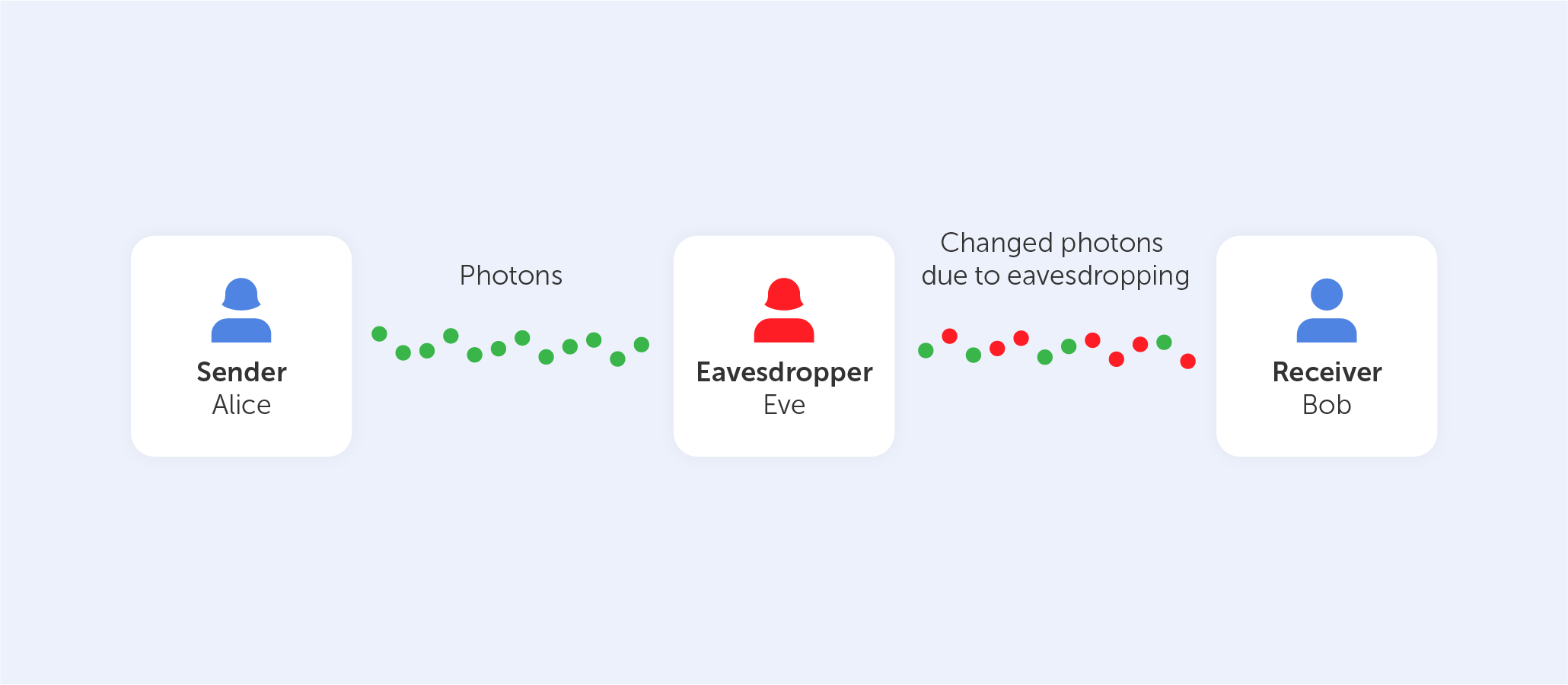
Alice and Bob would also be aware if Eve was listening in on their conversation. After Eve observes the flow of photons, the photon locations that Alice and Bob anticipate to see will be altered as a result of her observations.

Well, that’s all pretty mind-blowing, but for us, the general public, the biggest question is…

Is it really used?

Although the model described above has not yet been fully developed, there have been successful implementations of it, including the following:

  • The University of Cambridge and the Toshiba Corporation collaborated to develop a high-bit-rate quantum key distribution system based on the BB84 quantum cryptography protocol;
  • DARPA's Quantum Network, which operated from 2002 to 2007, was a 10-node QKD (Quantum Key Distribution) network constructed by Boston University, Harvard University, and IBM Research. It was operated by the Defense Advanced Research Projects Agency;
  • Quantum Xchange created the first quantum network in the United States, which is comprised of over 1,000 kilometers of optical fiber;
  • The development of commercial QKD systems was also carried out by commercial businesses such as ID Quantique, Toshiba, Quintessence Labs, and MagiQ Technologies Inc.

As you can see, these rare implementations are pretty far from what you’d expect to use every day. But hopefully, that will change in the near future.

The pros and cons of quantum cryptography

As with any developing technology, the state of it now (2022), may be very different to its state in the future. Thus, the following table may change dramatically. We do believe, however, that we’ll see fewer points in the ‘Limitations’ column as the years go on.
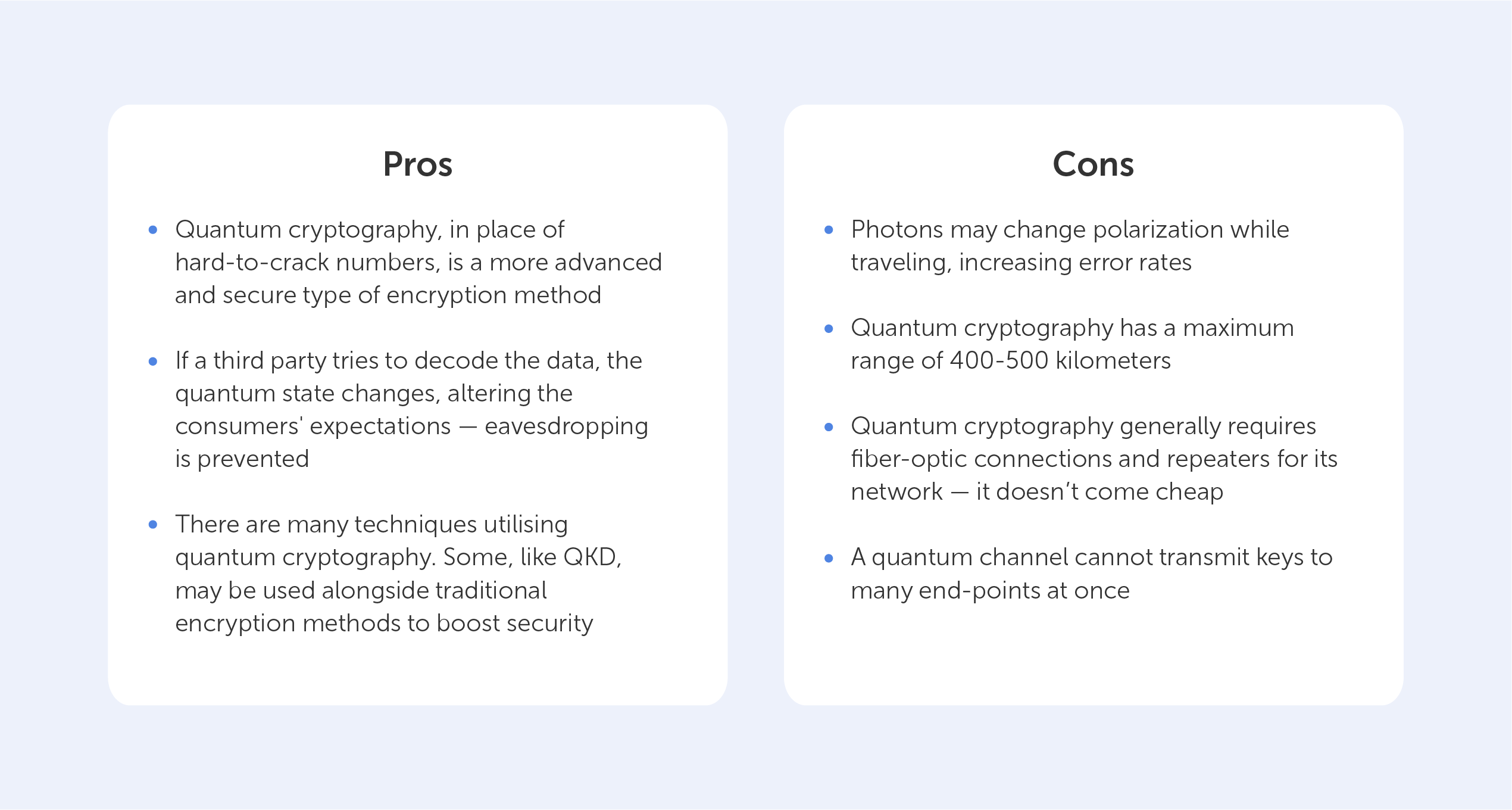
The need for unbreakable encryption is right there staring us down. The development of quantum computers is on the horizon, and the security of encrypted data is now in jeopardy due to the threat of quantum computing. We are fortunate in that quantum cryptography, in the form of QKD, provides us with the answer we need to protect our information long into the future — all while adhering to the difficult laws of quantum physics.


Python connector 0.1.5: Automated secrets management
The new Python connector version 0.1.5 expands CLI utility capabilities. We’ve added commands that solve critical tasks for DevOps engineers and developers — secure retrieval and updating of secrets in automated pipelines. What this solves Hardcoded secrets, API keys, tokens, and database credentials create security vulnerabilities and operational bottlenecks.
What is password hashing and salting?
Cryptography is both beautiful and terrifying. Perhaps a bit like your ex-wife. Despite this, it represents a vital component of day-to-day internet security; without it, our secrets kept in the digital world would be exposed to everyone, even your employer. I doubt you’d want information regarding your sexual preferences
Passwork: Secrets management and automation for DevOps
Introduction In corporate environment, the number of passwords, keys, and digital certificates is rapidly increasing, and secrets management is becoming one of the critical tasks for IT teams. Secrets management addresses the complete lifecycle of sensitive data: from secure generation and encrypted storage to automated rotation and audit trails. As

What is quantum cryptography?

Jan 12, 2022 — 6 min read

End-to-end encryption has been introduced by many communication providers in recent years, notably WhatsApp and Zoom. Although those companies have tried to explain the concept to their user base several times, we believe they failed. Whilst it's clear that these platforms have increased security, most don’t know how or why. Well, encryption is a rather simple concept to understand: It converts data into an unreadable format. But what exactly does "end-to-end" imply? What are the advantages and disadvantages of this added layer of security? We'll explain this as simply as possible without diving too much into the underlying math and technical terminology.

What is end-to-end encryption?

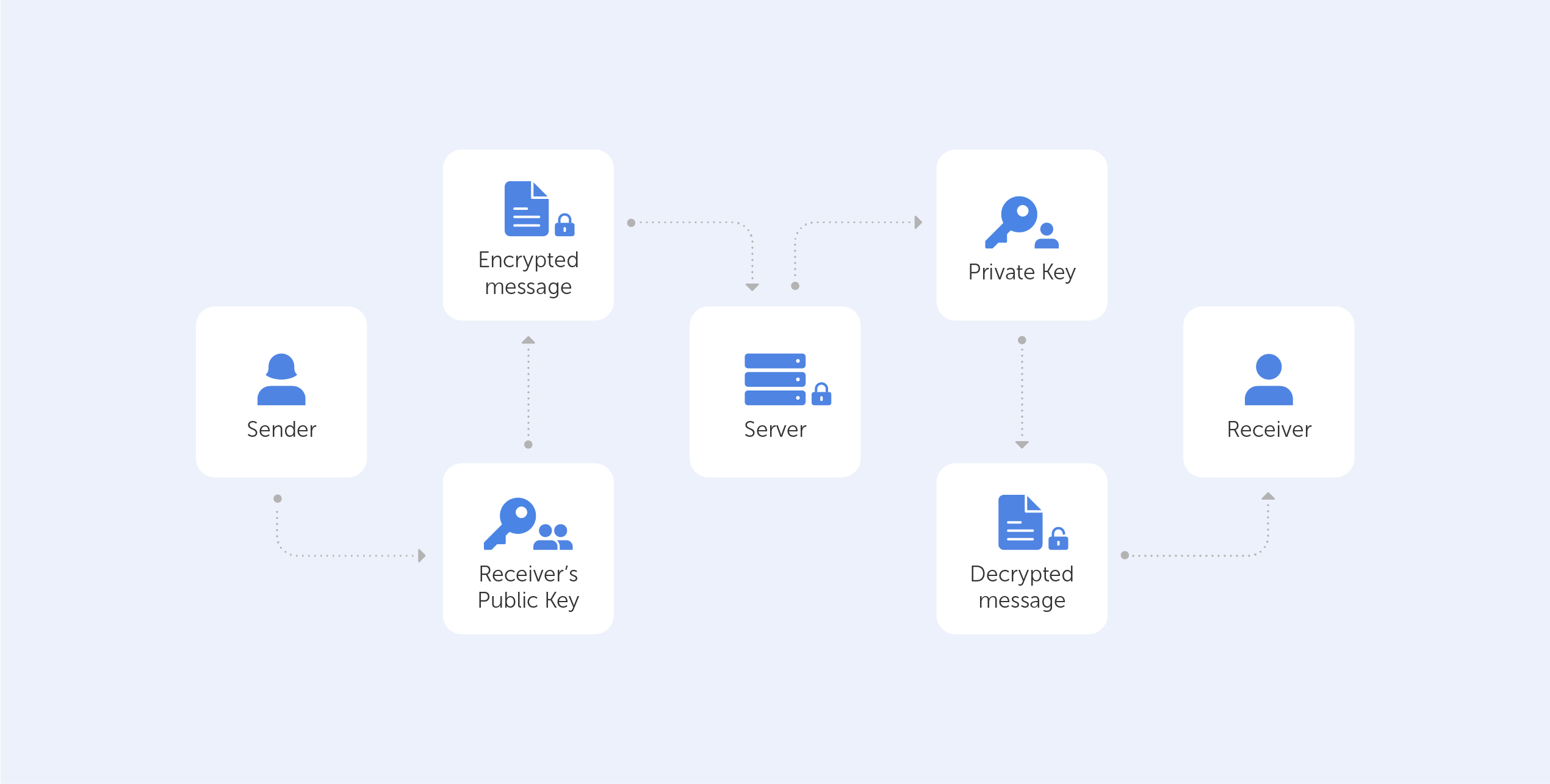
End-to-end encryption (E2EE) is a state-of-the-art protocol for communication security. Only the sender and the intended recipient(s) have access to the data in an end-to-end encrypted system. The encrypted data on the server is inaccessible to both hackers and undesirable third parties.

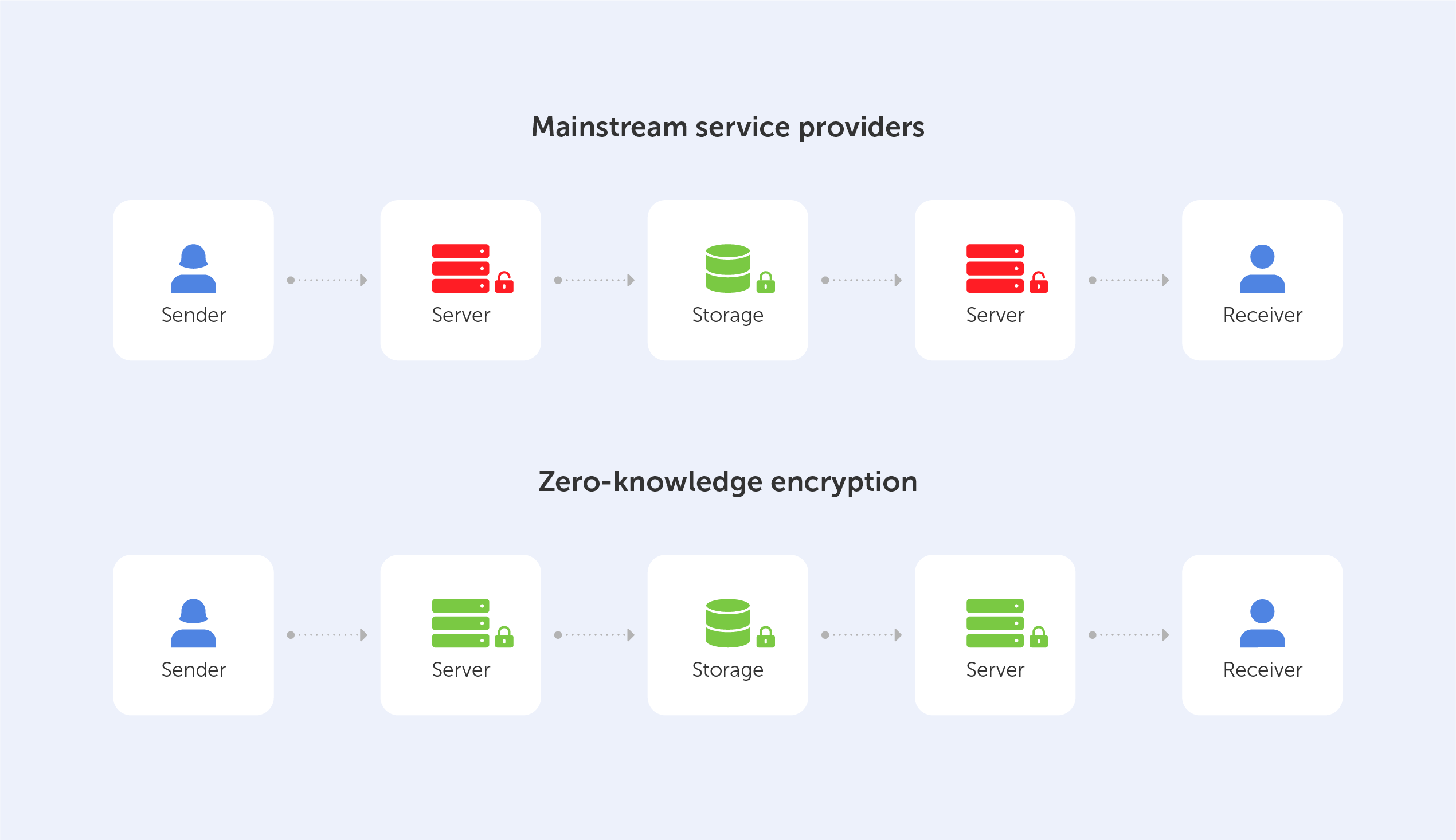
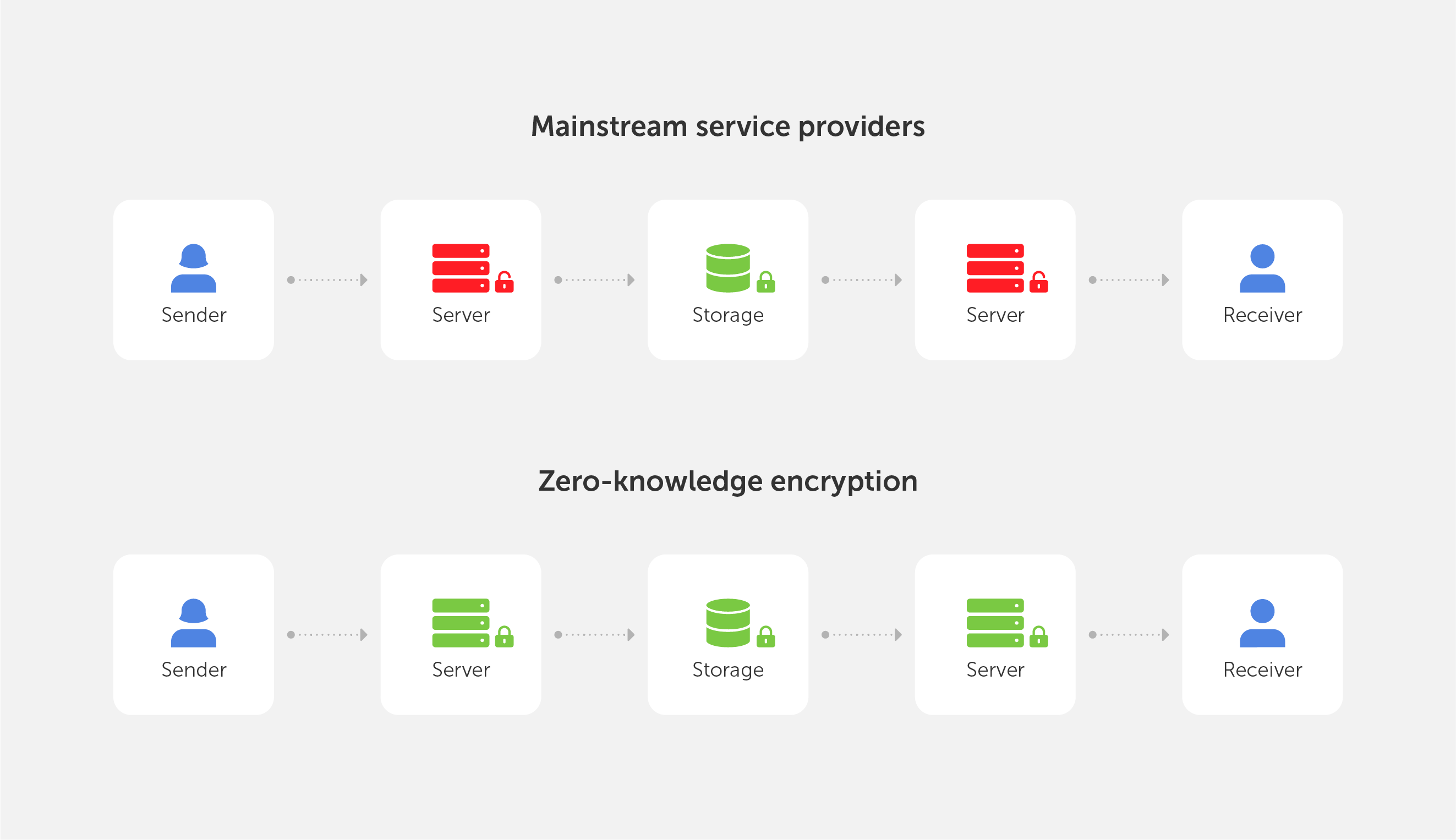
End-to-end encryption is best understood when compared to the encryption-in-transit approach, so let’s perform a quick recap. If a service employs encryption-in-transit, it is usually encrypted on your device before being delivered to the server. It’s then decrypted for processing on the server before it’s re-encrypted and routed to its final destination. When the data is in transit, it’s encrypted, but when it’s ‘at rest’, it’s decrypted. This safeguards the data during the most dangerous stage of the journey, transit — when it’s most exposed to hackers, interception, and theft.

End-to-end encryption, on the other hand, is the process of encrypting data on your device and not decrypting it until it reaches its destination. When your message travels through the server, not even the service that is delivering the data can view the content of your message.

In practice, this means that messengers using 'real' end-to-end encryption, like Signal, know only your phone number and the date of your last login – nothing more.

This is important for users that want to be sure their communication is kept secure from prying eyes. There are also some real-life examples that utilize end-to-end encryption for financial transactions and commercial communication.

How does it work?

The generation of a public-private key pair ensures the security of end-to-end encryption. This method, also known as asymmetric cryptography, encrypts and decrypts the message using distinct cryptographic keys. Public keys are widely distributed and are used to encrypt or ‘lock’ messages. Only the owner has access to the private keys, which are needed to unlock or decrypt the communication.

Whenever the user takes part in any end-to-end encrypted communication, the system automatically generates dedicated public and private keys.

If this sounds too complicated, here is a very simple metaphor:

You just bought a new Rolex for your buddy, who lives in Australia. Now, it’s already in a fancy green leather box, so you decide to put the stamp directly on it and send it. There is nothing wrong with that approach as long as you trust that the postal workers won’t steal it.

However, if you decide to put the Rolex box inside another box, hiding the nature of the gift from all interacting parties along the way, then you’ve effectively ensured (for all intents and purposes) that the Rolex is only visible to the intended recipient; when your mate from down under gets a hold of the box, he takes his pair of scissors and ‘decrypts’ the present. Indeed, you’ve ensured ‘end-to-end’ encryption.

You’re already using end-to-end encryption, daily

As we mentioned before, during an E2EE interaction, the server that delivers encrypted data between one "end" and the other "end" is unable to decode and read the data it sends. Even the servers' owners are unable to access the information since it is not saved on the servers themselves, only the "endpoints" (or the devices) of the discussion can decode the data.

If you’re daily using messengers like WhatsApp, iMessage, and Signal (where E2EE is enabled by default) or Telegram, Allo, and Facebook's ‘Secret Conversation’ function (where E2EE can be manually activated) – you’re already using end-to-end encryption.

What's more fascinating is that E2EE communication providers don't require you to trust them. And that’s great!

The fact that their systems can be hacked makes no difference to you because the transported data is encrypted and can only be read by the sender and receiver, which has enraged several organizations. There are known cases when such agencies asked for special ‘backdoors’ that would allow them to decrypt messages.

Why isn’t everything end-to-end encrypted?

End-to-end encryption is theoretically sound, but it lacks flexibility, thus it can't be utilized when the "two ends" that communicate data don't exist, such as with cloud storage.

This is why Zero-Knowledge Encryption was created, a solution that overcomes the problem by hiding the encryption key, even from the storage provider, resulting in an authentication request without the requirement for password exchange.

Moreover, end-to-end encryption does not hide information about the message, such as the date and time it was sent or the people who participated in the conversation. This metadata might provide indications on where the 'end-point' might be – not great if you are the target of a hacker.

The biggest problem, however, is that in reality, we never know whether the communication is end-to-end encrypted. Providers may claim to provide end-to-end encryption when what they truly deliver is encryption-in-transit. The information might be kept on a third-party server that can be accessed by anybody who has access to the server.

Conclusion

While it’s obvious that you shouldn’t be shipping Dave’s Rolex in its fancy green box, the reality is, if you’ve nothing to hide and you’re not transporting something incredibly valuable, encryption-in-transit is up to the job.

End-to-end encryption is a wonderful technology that enables a high level of security when properly implemented. But it doesn't really tackle the main issue – the end-user, still, to this day, needs to trust the system that they’re using to communicate. We hope that the next generation of encryption technologies such as ZKP will be able to change that.


Password-cracking techniques used by hackers
Which words pop into your head when creating a password for your new account on a website or on a social network? Safety? Privacy? Well, there’s some bad news for you here — in our digital world, hackers are clued-up on hacking any kind of password that you can think
Passwork 7: Security verified by HackerOne
Passwork has successfully completed the penetration testing, carried out by HackerOne — the world’s largest platform for coordinating bug bounty programs and security assessments. This independent evaluation confirmed Passwork’s highest level of data protection and strong resilience against modern cyber threats. What the pentest covered Security architecture and data
Passwork: Secrets management and automation for DevOps
Introduction In corporate environment, the number of passwords, keys, and digital certificates is rapidly increasing, and secrets management is becoming one of the critical tasks for IT teams. Secrets management addresses the complete lifecycle of sensitive data: from secure generation and encrypted storage to automated rotation and audit trails. As

What is End-to-end encryption?

Jan 10, 2022 — 6 min read

In this year of our lord, 2022, the term ‘Zero-Knowledge Encryption’ equates to best-in-class data insurance. We’ve already written an article named “What is Zero-Knowledge Proof?”, so we’re not going to look at definitions here, but rather, we’re going to explore the pros and cons of Zero-Knowledge proof encryption when compared to other technologies.

But for those who don’t want to dive deep into technical details, here’s an explanation of what Zero-Knowledge Encryption means:

It simply implies that no one else (not even the service provider) has access to your password-protected data.

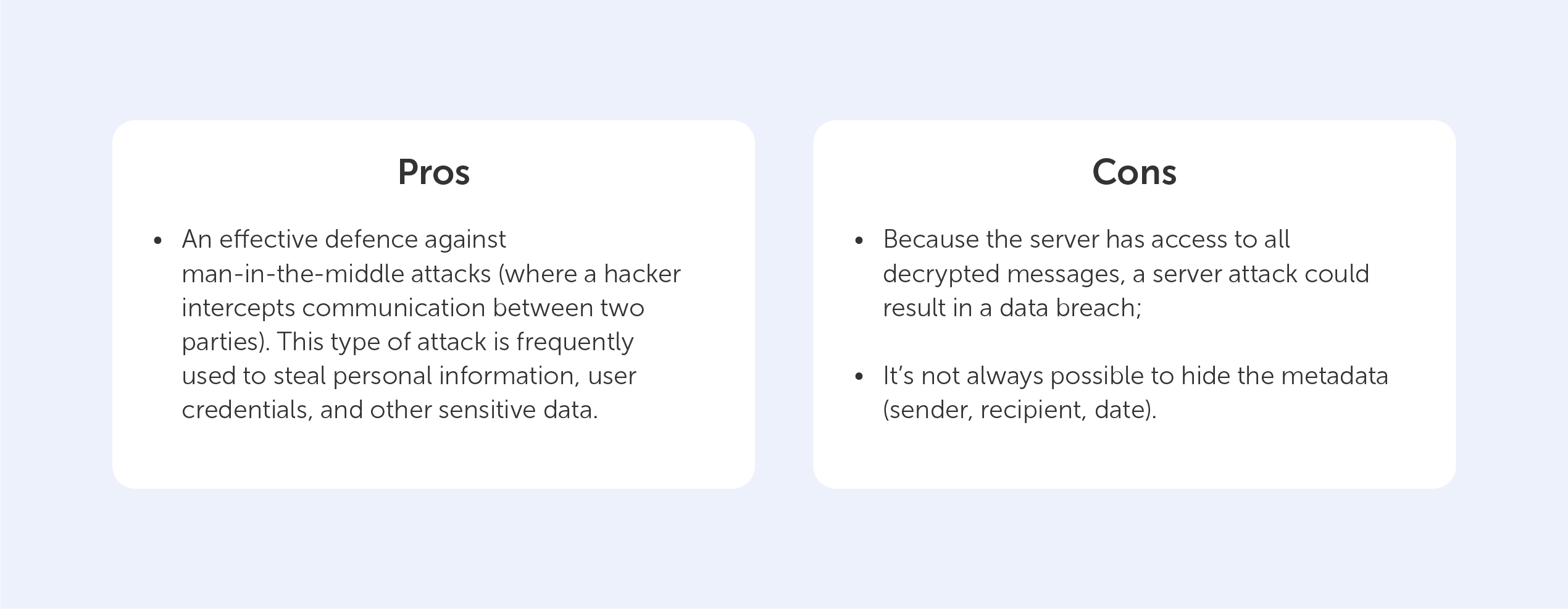
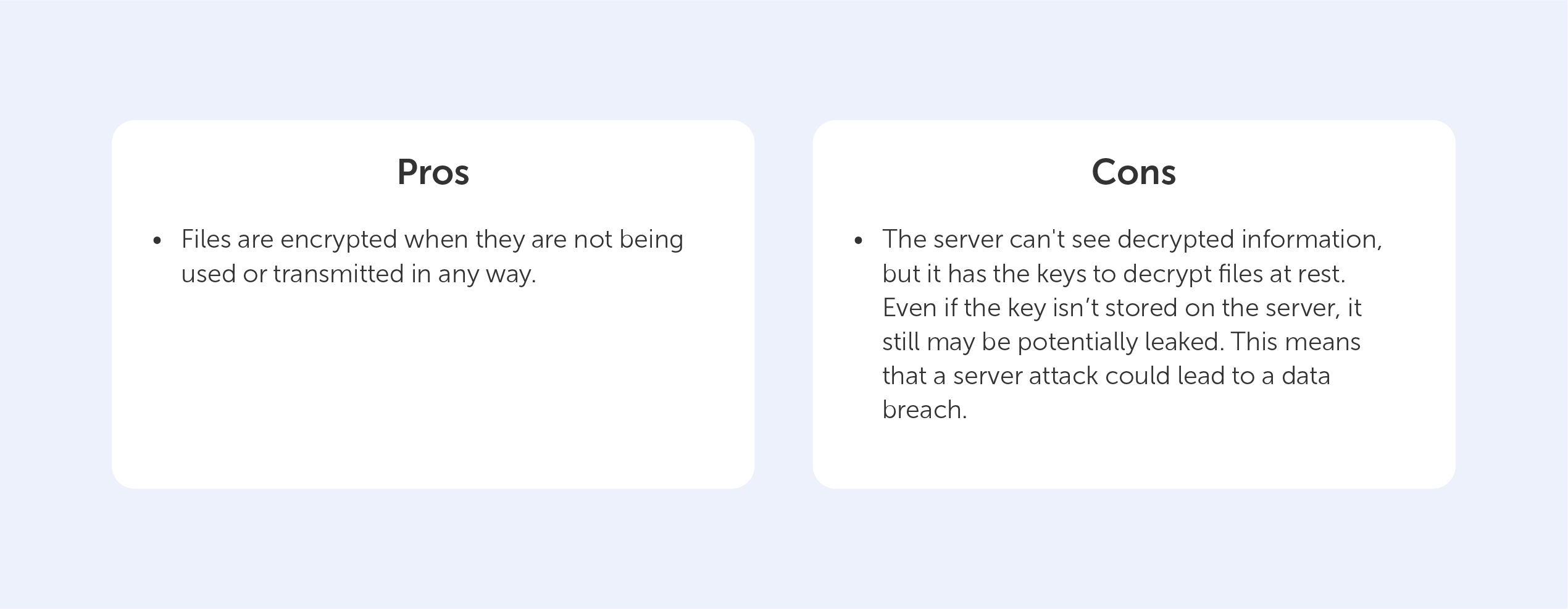
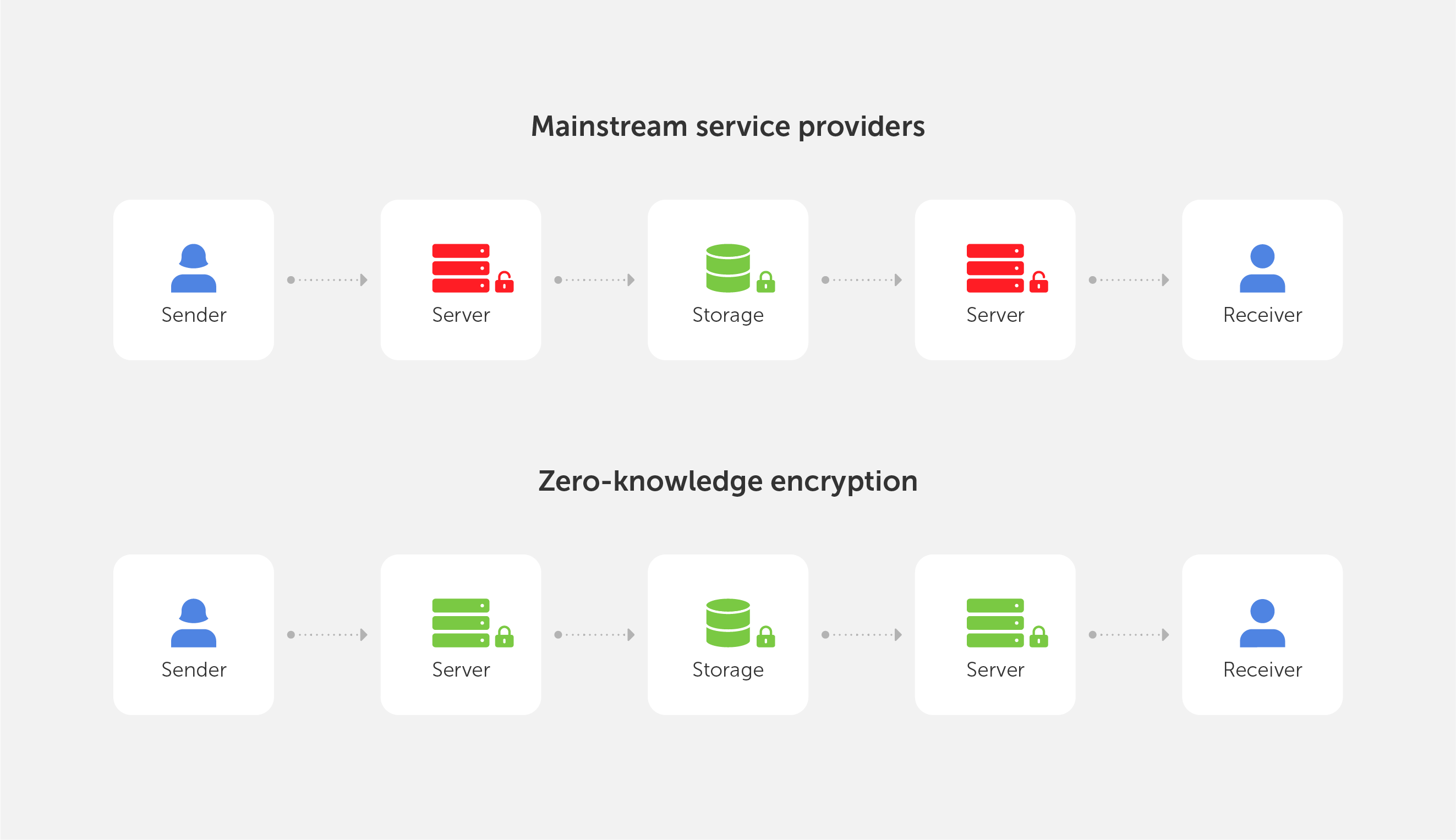
This is important because even if your files are completely encrypted, if the server has access to the keys, a centralized hacker attack can result in a data breach.

In order to gain a better understanding of the factors that led to the development of Zero-Knowledge Encryption, we've decided to present a succinct, yet comprehensive, assessment of the advantages and disadvantages of three existing options:

Encryption-in-transit

Data in-transit, also known as data in motion, is data that is actively flowing from one point to another, such as that over the internet or over a private network. Data protection in transit refers to the security of data while it is being transferred from one network to another or from a local storage device to a cloud storage device. Effective data protection measures for in-transit data are critical because data is often considered less secure while in transit. Think of it like hiring security guards to accompany your cash-in-transit vehicle’s trip to the bank.

This means that, while using this approach, stored docs are 100% decryptable, so vulnerable.

As for our everyday life, the following technologies use the ‘encryption-in-transit’ approach:

Encryption-at-rest

Any data encryption is the process of converting one type of data into another that cannot be decrypted by unauthorized users. For example, you may have saved a copy of your passport. You obviously don't want this data to be easily accessed. If you store encrypted data on your server, it’s effectively "resting" there (which is why it’s called encryption-at-rest). This is usually accomplished by the use of an algorithm that is incomprehensible to a user who does not have access to the encryption key needed to decode it. Only an authorized person will be able to access the file, ensuring that your data is kept safe.

The Advanced Encryption Standard (AES) is often used to encrypt data at rest.

But, in order to access the data, you need a key — and that’s where the potential vulnerability lies.


Encryption-at-rest is like storing your data in a secret vault, encryption-in-transit is like putting it in an armored vehicle with security guards for transport.

End-to-end encryption

End-to-end encryption is the act of applying encryption to messages on one device so that only the device to which it is sent can decrypt it. The message travels all the way from the sender to the recipient in encrypted form.

In practice, it means that only the communicating users (who have the key) can read the messages.

End-to-end encryption has created an impregnable fortress for communication services (for example, messengers), going beyond the security "façade" of encryption-in-transit and encryption-at-rest solutions.

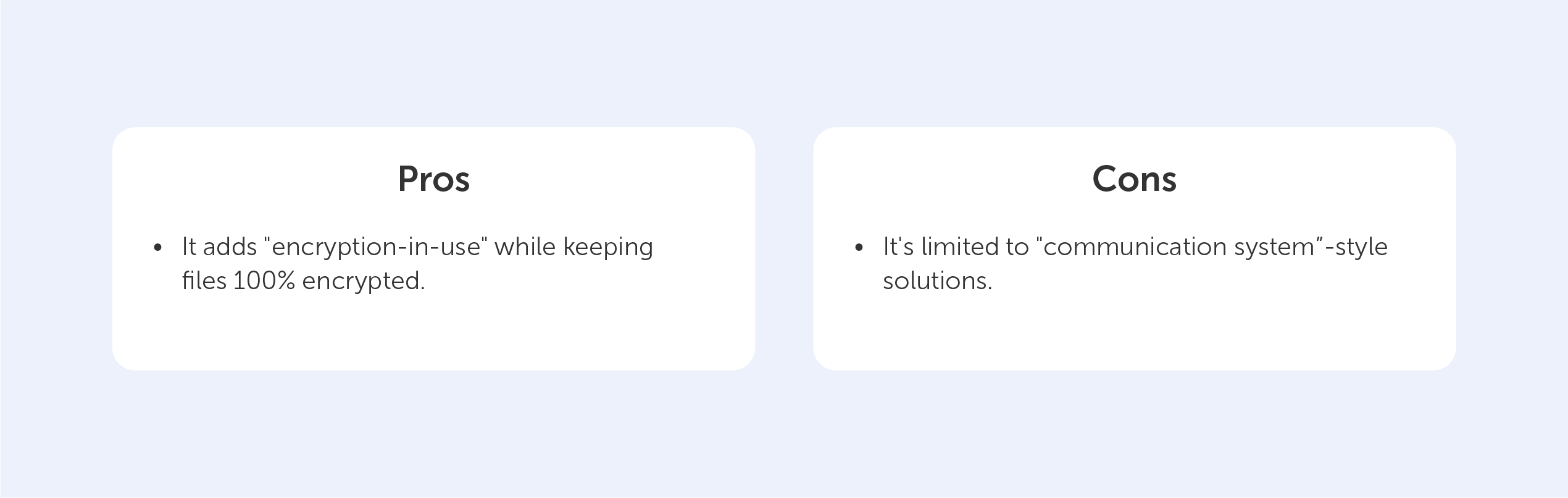
This is the most common approach when protecting oneself against data breaches nowadays, but it only works from "one end to the other," as the term implies. Even though this all sounds great, end-to-end encryption can only be used for a "communication system" like Whatsapp or Telegram.

While theoretically sound, end-to-end encryption lacks flexibility, so it can’t be used when the "two ends" that share data don't exist, such as for cloud storage.

This is the motivation behind the development of Zero-Knowledge Encryption, a method that solves the problem by hiding the encryption key, even from the storage provider, resulting in an authentication request without the need for password exchange.

Zero-Knowledge encryption

To log in to an account, you usually have to type in the exact password. In today's hyperconnected world, it's normal practice to tell the server your secret key ahead of time and test whether it matches.

Instead, there is another, more secure way, to manage this delicate process and that’s called Zero-Knowledge Encryption.

Without diving deep, The Zero-Knowledge relies on three main requirements:

  1. Completeness — an honest prover will be able to convince the verifier that he has the password by completing some process in the required way;
  2. Soundness — the verifier will almost certainly discover when the prover is lying;
  3. Zero-knowledge — if the prover has a password, the verifier receives no more information other than the fact that the statement is true.

Essentially, the system will check to see if you can demonstrate your knowledge several times by responding to various conditions. It’s like a brute force attack carried out backwards — you perform the same action many times in order to make sure that the prover isn’t lying.

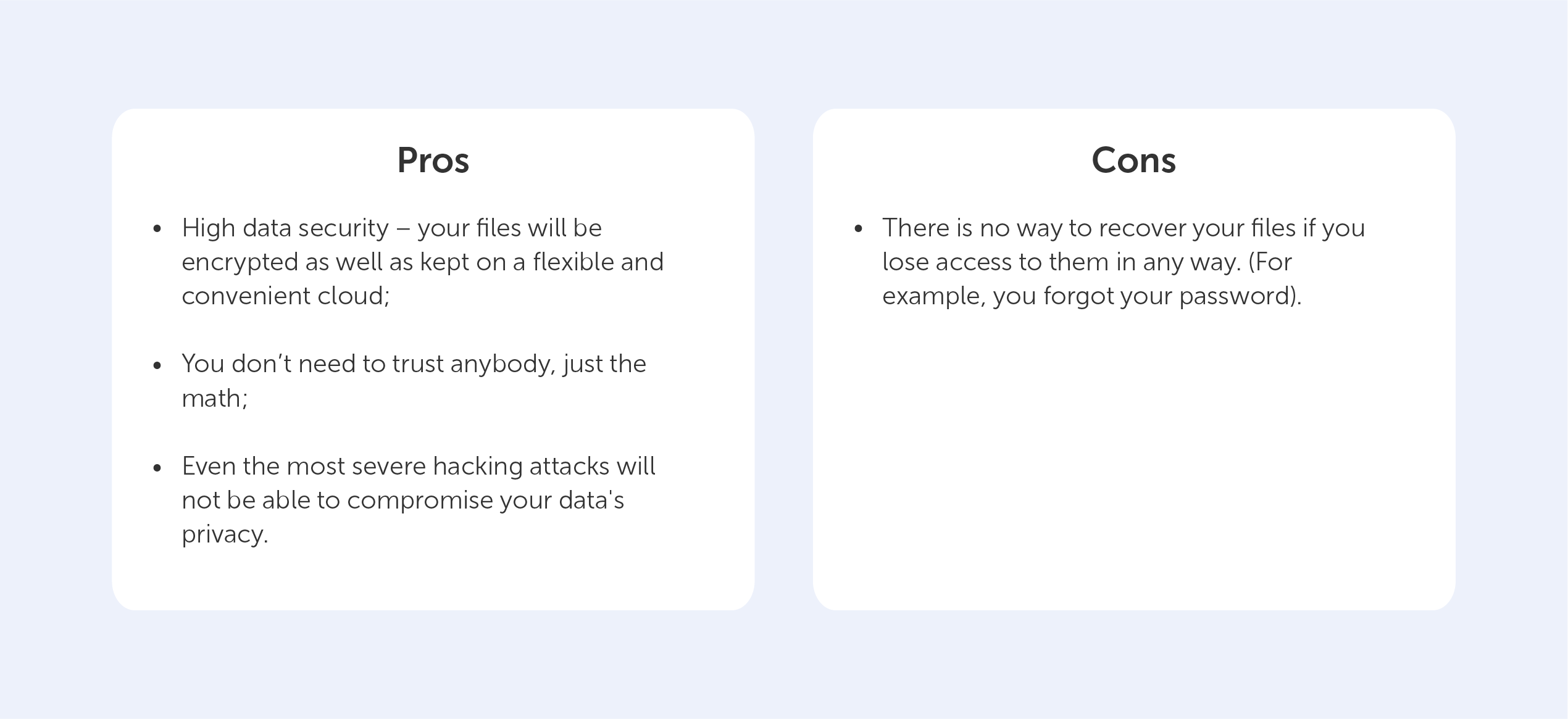
Instead of concluding, let’s round up the pros and cons of Zero-Knowledge proof encryption when compared to the alternatives:


The con here is a clear example of the exceptional security provided by the Zero-Knowledge Encryption solution, which prevents even system administrators from recovering your password. This is why we, at Passwork, rely on this technology in our products. Ultimately, that’s why you can rely on us too.


Comprehensive guide: Cybersecurity vocabulary – terms and phrases you need to know
Cybersecurity — as complex as it sounds — is an essential concept that we all need to be aware of in this day and age. Computers, phones, and smart devices have become an extension of our bodies at this point, which makes their security paramount. From your family photos to your bank
Why Zero-Knowledge Encryption is the best
In this year of our lord, 2022, the term ‘Zero-Knowledge Encryption’ equates to best-in-class data insurance. We’ve already written an article named “What is Zero-Knowledge Proof?”, so we’re not going to look at definitions here, but rather, we’re going to explore the pros and cons of Zero-Knowledge
Python connector 0.1.5: Automated secrets management
The new Python connector version 0.1.5 expands CLI utility capabilities. We’ve added commands that solve critical tasks for DevOps engineers and developers — secure retrieval and updating of secrets in automated pipelines. What this solves Hardcoded secrets, API keys, tokens, and database credentials create security vulnerabilities and operational bottlenecks.


Why Zero-Knowledge Encryption is the best

Dec 20, 2021 — 6 min read

It is rare for technologies to be born from ambitious philosophical concepts or mind games. But, when it comes to security and cryptography – everything is a riddle.

One of such riddles is ‘How can you prove that you know a secret without giving it away?’. Or in other words, ‘how can you tell someone you love them without saying that you love them?’.

The Zero-Knowledge Proof technique, as suggested by the name, uses cryptographic algorithms to allow several parties to verify the authenticity of a piece of information without having to share the material that makes it up. But how is it possible to prove something without supporting evidence? In this article, we’ll try our best to break it down for you as easily as possible.

Why?

We’re asking ourselves day after day – why on Earth would people decide to use such a complicated concept. Well, millions of people use the internet every day, accepting cookies and sharing personal information in exchange for access to services and digital products. Users are gradually becoming more vulnerable to security breaches and unauthorized access to their data. Furthermore, individuals frequently have to give up their privacy in return for digital platform services such as suggestions, consultations, tailored support, and so on, all of which wouldn’t be available when browsing privately. Due to all the above mentioned, there is a certain asymmetry regarding access to information – you give your information in exchange for a service.

In 1985, three great minds noticed ‘a great disturbance in the Force’ ahead of their time and released a paper called "The Knowledge Complexity of Interactive Proof-Systems" which introduced the concept of Zero-Knowledge Proof (ZKP) for the first time.

So what is it?

ZKP is a set of tools that allows an item of data to be evaluated without having to reveal the data that supports it. This is made feasible by a set of cryptographic methods that allow a "tester" to mathematically prove to a "verifier" that a computational statement is valid without disclosing any data.

It is possible to establish that particular facts are correct without having to share them with a third party in this way. For example, a user could demonstrate that he is of legal age to access a product or service without having to reveal his exact age. Or, it’s a bit like showing your friend your driving license instead of proving to him that you can drive by road-tripping to Mexico.

This technique is often used in the digital world to authenticate systems without the risk of information being stolen. Indeed, it’s no longer necessary to provide any personal data in order to establish a person's identity.

Sounds great, but how does it work?

The prover and the verifier are the two most important roles in zero-knowledge proofs. The prover must demonstrate that they are aware of the secret whereas the verifier must be able to determine whether or not the prover is lying.

It works because the verifier asks the prover to do actions that can only be done if the prover is certain that he or she is aware of the secret. If the prover is guessing, the verifier's tests will catch him or her out. If the secret is known, the prover will pass the verifier's exam with flying colors every time. It's similar to when a bank or other institution requests letters from a known secret word in order to authenticate your identity. You're not telling the bank how much money you have in your account; you're simply demonstrating that you know.

Wonderful, but how does it REALLY work?

To answer this, let’s take a look at a piece of research by Kamil Kulesza.

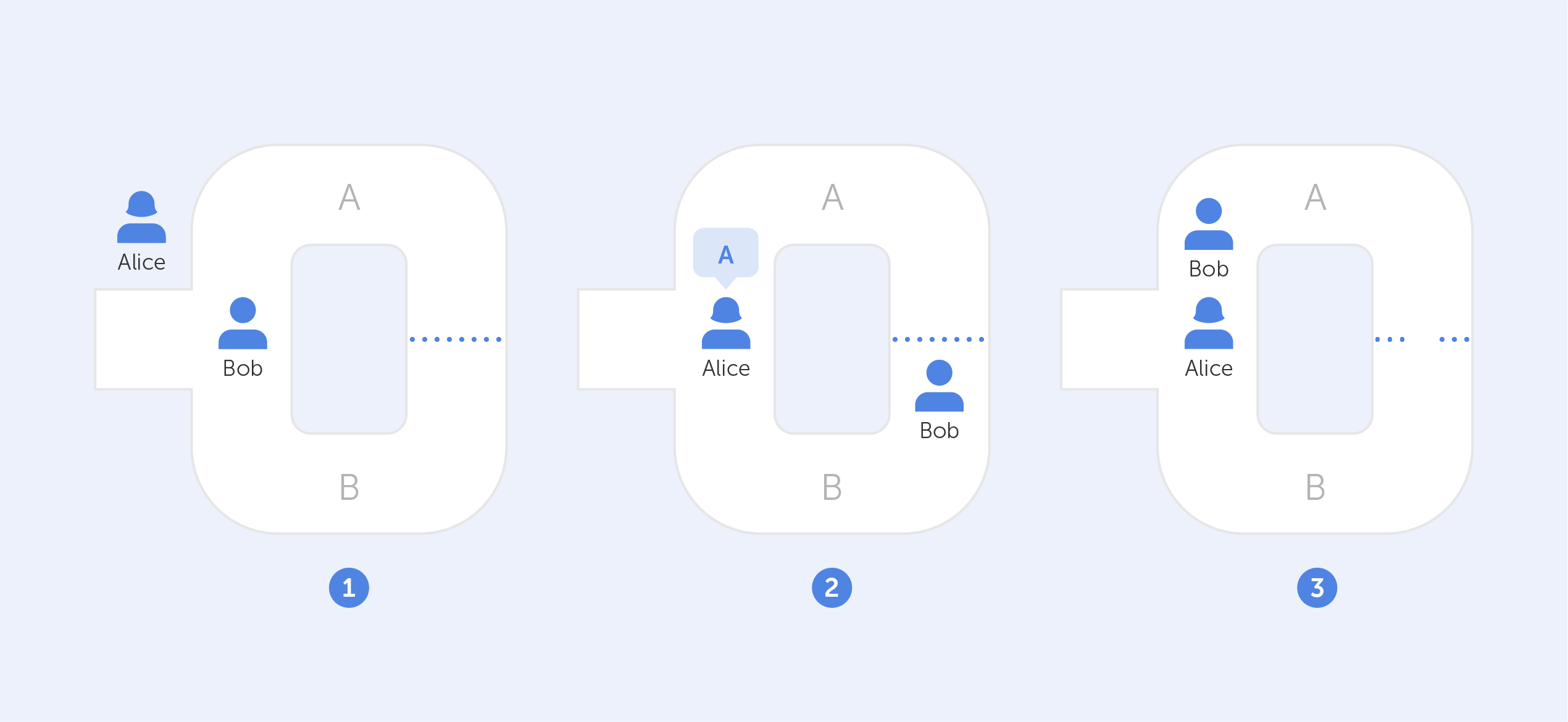
Assume that two characters, Alice and Bob, find themselves at the mouth of a cave with two independent entrances leading to two different paths (A and B). A door inside the cave connects both paths, but it can only be unlocked with a secret code. This code belongs to Bob (the 'tester,') and Alice (the 'verifier,') wants to buy it, but first, she wants to make sure Bob isn't lying.

How can Bob demonstrate to Alice that he has the code without divulging its contents? They perform the following to achieve this: Bob enters the cave via one of the entrances at random while Alice waits outside (A or B). Once inside, Alice approaches the front door, summons Bob, and instructs him to use one of the two exits. Bob will always be able to return by the path that Alice used since he knows the secret code.

Bob will always be able to return via the path that Alice directs him to, even if it does not coincide with the one he chose in the first place, because he can unlock the door and depart through the other side with the secret code.

But wait a minute, there is still a 50% chance that both Alice and Bob chose the same path, right? It is correct indeed, however, if this exercise is repeated several times, the likelihood that Bob will escape along the same path chosen by Alice without possessing the code decreases until it is almost impossible. Conclusion? If Bob leaves this path a sufficient number of times, he has unmistakably shown to Alice that his claim of holding the secret code is true. Moreover, there was no need to reveal the actual code in this case.

You can find out more about the Bob and Alice metaphor here.

Got it, so how is it used?

As for right now, ZKP is developing hand in hand with blockchain technology.

Zcash is a crypto platform that uses a unique iteration of zero-knowledge proofs (called zk-SNARKs). It allows native transactions to stay entirely encrypted while still being confirmed under the network's consensus rules. It’s a great example of this technology being used in practice.

Even though zero-knowledge proofs have a lot of potential to change the way today's data systems verify information, the technology is still considered to be in its infancy — primarily because researchers are still figuring out how to best use this concept while identifying any potential flaws. This, however, doesn’t stop us from using this protocol in our products! ;)

For a deeper understanding of the technical aspects and history behind this protocol, we recommend watching this video on YouTube.


Python connector 0.1.5: Automated secrets management
The new Python connector version 0.1.5 expands CLI utility capabilities. We’ve added commands that solve critical tasks for DevOps engineers and developers — secure retrieval and updating of secrets in automated pipelines. What this solves Hardcoded secrets, API keys, tokens, and database credentials create security vulnerabilities and operational bottlenecks.
Why Zero-Knowledge Encryption is the best
In this year of our lord, 2022, the term ‘Zero-Knowledge Encryption’ equates to best-in-class data insurance. We’ve already written an article named “What is Zero-Knowledge Proof?”, so we’re not going to look at definitions here, but rather, we’re going to explore the pros and cons of Zero-Knowledge
How to create a secure password
Of course you want to keep your data safe. So why are so many security precautions frequently overlooked? Many accounts, for example, are protected by weak passwords, making it easy for hackers to do their work. There is a fine line between selecting a password that no one can guess

What is Zero-knowledge proof?